How to Keep Pets Safe During a Power Outage
A power outage in an apartment is a climate emergency in miniature: no heat in January, no AC in August, no light in the stairwell, and a fridge full of medication slowly warming. Pets cannot tell you they are too hot or too cold until it is serious — and small animals hit dangerous temperatures far faster than you do. Most outages last under 4 hours, which most healthy pets ride out fine. The plan below covers the first hour, the long outage, and the mistakes that turn a nuisance into a vet visit.
- Heat kills faster than cold: above 85°F indoors with no airflow, start active cooling (wet towels, ice water) within the hour.
- Cold is a slow problem: below 50°F indoors, layer blankets and share body heat; small, young, old, and thin-coated pets need help first.
- Never run a generator or grill indoors or on a balcony — carbon monoxide kills pets before humans notice symptoms.
- Keep fridge meds cold with frozen water bottles; know which meds tolerate room temperature and for how long.
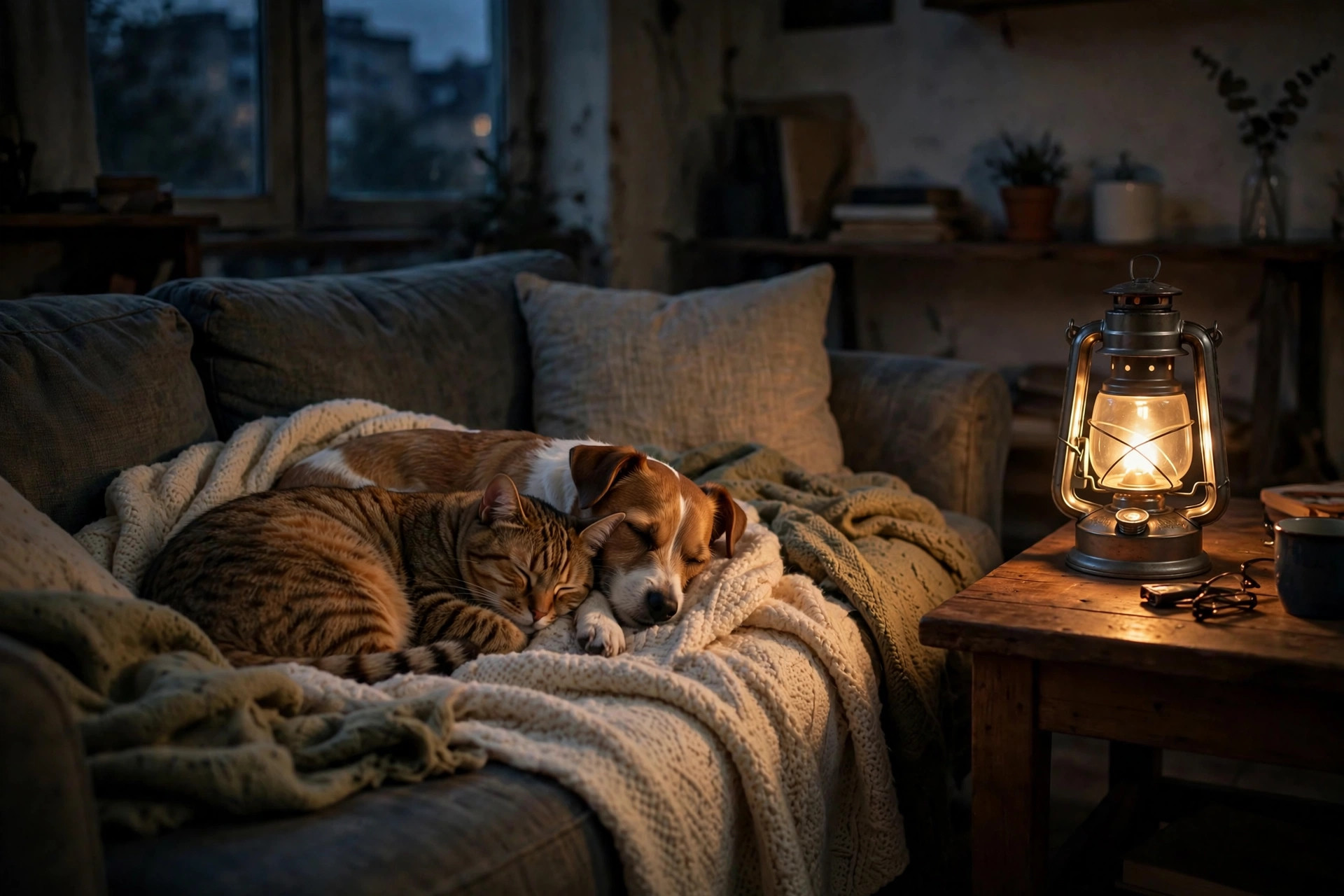
- A battery lantern beats candles every time — open flames plus stressed pets plus dark rooms equals fire risk.
The first hour: stabilize
- Check the scope. Look outside: streetlights on means it is your building — call maintenance. Dark block means the grid; check the utility’s outage map and estimated restoration time before deciding anything.
- Secure light. Battery lanterns and flashlights out; candles only as a last resort, in stable holders, on high surfaces, never unattended. A stressed cat knocking a candle off a table in the dark is a classic outage fire.
- Close the thermal envelope. In winter: close every interior door, hang blankets over the pet’s room doorway, keep everyone in one room. In summer: open windows on opposite sides for cross-breeze (secure screens first — cats push on loose screens), close blinds on the sun side.
- Locate everyone. Account for all pets now, while you can still see. Cats hide when the environment changes; find them before the apartment goes fully dark.
- Unplug sensitive electronics (surge risk when power returns) and leave one lamp on so you know the moment power is back.
Summer outages: beating the heat without AC
Heat is the urgent direction. Dogs cool only by panting and paw pads; cats by grooming and seeking cool surfaces — both fail in a sealed hot apartment. Danger signs: heavy panting that does not slow, drooling, glazed eyes, staggering, or a rectal temp over 104°F. Act on the first signs, not the worst ones.
- Water, everywhere: multiple bowls, add ice cubes. A water fountain with battery backup keeps water moving and appealing.
- Wet towels on the body: drape cool (not ice-cold) damp towels over the neck, armpits, and groin — re-wet every 15 minutes. For cats, a damp cloth on the paw pads and ears.
- Floor is your friend: tile and bathroom floors are the coolest surfaces; lure the pet there with a frozen water bottle to lie against.
- Frozen treats: frozen broth cubes or a wet towel frozen into a chew keep core temp down from the inside.
- Know the limit: if the indoor temp passes 90°F and is still climbing with no restoration estimate, leave — a friend’s place, the car with AC, a pet-friendly cooling center. Heatstroke kills in under an hour at those temperatures, and brachycephalic breeds (bulldogs, pugs, Persians) have half the margin.
Winter outages: staying warm without heat
Cold is slower but just as real. Below 50°F indoors, small dogs, puppies, seniors, and thin-coated breeds need active help; below 40°F, everyone does.
- One warm room: everyone — humans and pets — in the smallest interior room. Body heat is a legitimate furnace in a closed 10x12 room.
- Layer the pets: winter coats and sweaters go ON indoors during an outage (the one exception to the usual rule). Blanket nests and sleeping bags make excellent dog beds.
- Snuggle Safe discs ($30–$40): microwavable heat discs that stay warm 8–10 hours. Useless without a microwave during the outage — heat them before the storm if you have warning, or keep a couple charged as routine bed warmers.
- Warm water bottles wrapped in towels as bed warmers; refill from a gas stove if you have one (never use the oven for heat — CO risk).
- Space heaters only with extreme caution: fuel-burning heaters indoors risk CO poisoning; electric ones are dead without power anyway. Our heater safety guide covers the rules that still apply on generator power.
The generator rule is absolute: never run a fuel-burning generator indoors, in a garage, or on a balcony — CO is odorless, and pets succumb before humans feel dizzy. If you use one, it lives 20+ feet from the building with the exhaust pointed away, and a battery CO detector ($25–$35) stays on in the pet’s room regardless.
Special cases: meds, aquariums, and stairs
- Refrigerated meds (insulin, some allergy serums): a closed fridge holds safe temp about 4 hours. After that, move meds to a cooler with frozen water bottles — keep a few permanently in your freezer for this. Know each med’s room-temperature tolerance in advance (insulin vials typically tolerate ~28 days at room temp; opened pens less) and ask your vet for the specific numbers at your next visit.
- Aquariums: the filter and heater dying is a countdown — oxygen depletes in hours in a stocked tank. A battery-powered air pump ($15–$25, runs on D batteries) is the single most important aquarium emergency tool; keep one with spare batteries taped to the stand. Do not feed during the outage — uneaten food spikes ammonia when filtration is down.
- High-rise stairs: elevators die with the power. If you must take a dog out, use the stairs with a flashlight and a short leash — emergency lighting fades, stairwells get crowded, and a loose dog on dark stairs is a fall risk for everyone. Senior dogs may need carrying; plan who carries whom in advance.
- Automatic feeders and fountains: most die silently. Battery-backup models keep running; otherwise revert to manual feeding on schedule so the pet’s routine — and your memory of whether they ate — stays intact.
The outage kit (under $75)
Assemble once, store with the go-bag from our earthquake checklist: two battery lanterns + spare batteries, a battery CO detector, a battery-powered air pump (if you have fish), frozen water bottles in the freezer (rotate), a cooler, a 5-day printed med list with room-temp tolerances, and your vet’s and emergency clinic’s numbers on paper — phones die too. A pet camera with battery backup lets you check on pets if the outage hits while you are at work, and a night-light setup on battery keeps senior pets oriented in the dark. When the lights come back, check every pet for stress signs over the next 24 hours — appetite loss and hiding are normal, but persistent lethargy or vomiting earns a vet call.
FAQ
How long can my pet safely go without heat or AC?
Most healthy adult dogs and cats handle 4–6 hours of moderate temperature drift (down to ~50°F or up to ~80°F indoors) without issue. The risk groups — brachycephalic breeds, puppies, kittens, seniors, and pets with heart or respiratory conditions — have roughly half that margin. Beyond 6 hours in true heat (>85°F) or cold (<45°F), relocate.
Can I leave my pet alone during an outage if I’m at work?
If the outage is short and temperatures are moderate, usually yes — pets sleep through most of it. The danger is an outage that starts at 10 a.m. in August and runs 8 hours while indoor temps climb past 90°F. A temperature-alert sensor ($30–$50, cellular or WiFi with battery backup) that texts you when the apartment crosses a threshold is the working owner’s answer.
Is it safe to grill on the balcony during an outage?
For cooking, yes, with the usual fire precautions — but never bring a lit grill or generator indoors or into an enclosed balcony to "keep the heat in." CO poisoning from indoor grilling kills pets and people every storm season. Cook outside, eat inside.
Will my pet’s microchip still work without power?
Yes — microchips are passive RFID with no battery and no dependence on your home’s power. Scanners at shelters and vets have their own power. Keep the registration current; the chip only helps if the phone number on file is yours.