Best Dog Water Fountains for Apartments
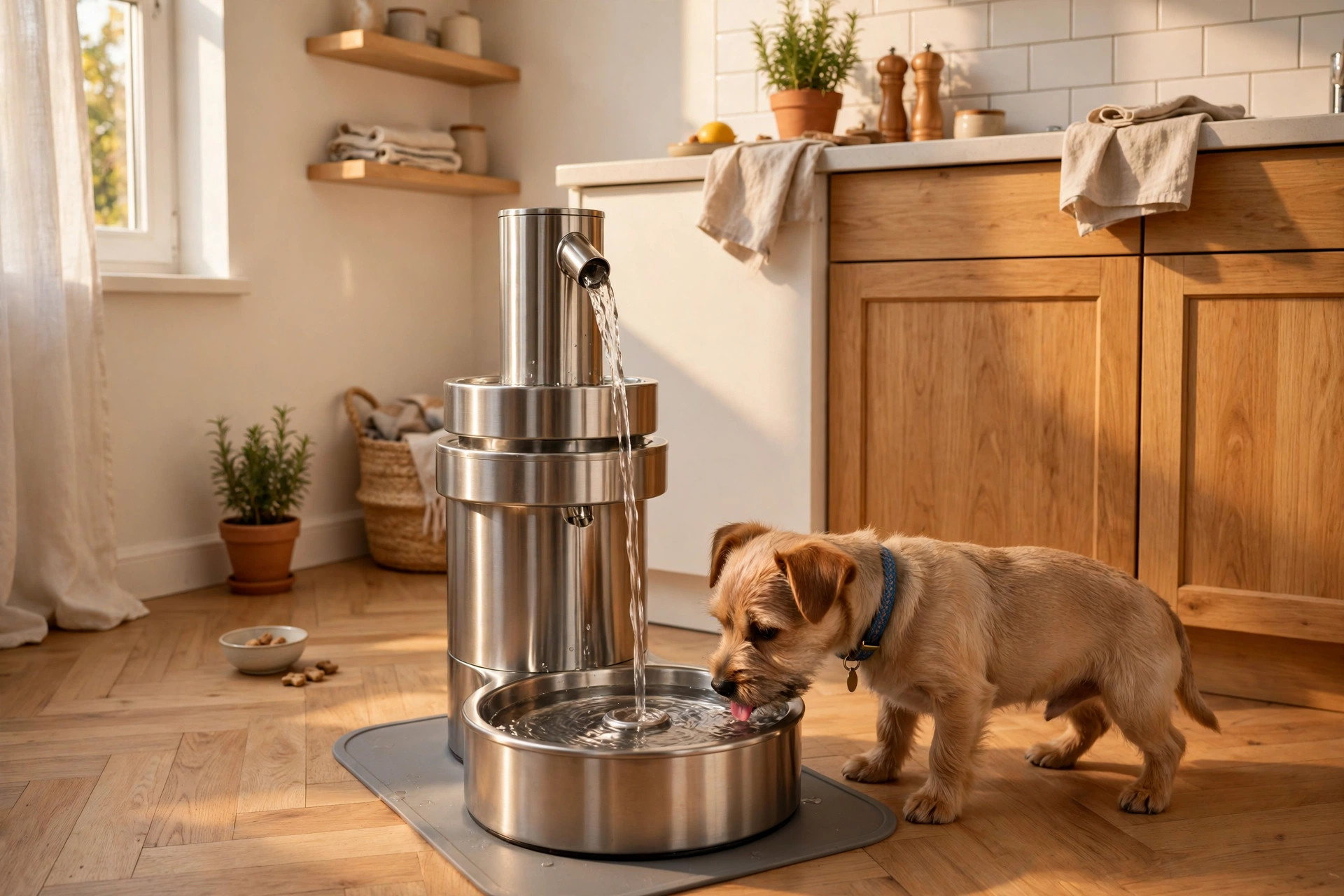
In a studio, the water bowl is never more than fifteen feet from where you sleep, eat, and work. A stagnant bowl grows a slick biofilm by day two, and a picky dog will choose the bathtub faucet over it every time. A recirculating fountain keeps water moving, filtered, and cooler — but in an apartment the wrong one hums through the wall at 2 a.m. and takes over half a counter to clean. The right one disappears into your kitchen routine.
Why a fountain beats a bowl in a small home
Three apartment-specific problems make fountains worth the outlet. First, air: in 500 square feet, dust, litter fines, and cooking film land in an open bowl within hours; a covered reservoir with a foam pre-filter keeps that grit out of the drinking surface. Second, encouragement: many dogs, especially seniors and brachycephalic breeds, drink more from a gentle stream or bubbling surface than from still water, which matters for kidney and urinary health when you cannot monitor intake on a workday. Third, spills: a weighted fountain with a defined drinking rim sloshes far less than a bowl when it gets bumped in a galley kitchen, protecting rental floors that show every water mark.
None of that matters if the pump is loud or the cleaning takes twenty minutes at the sink. In our comparison, noise and teardown time are weighted equally with capacity, because a fountain you dread cleaning becomes a bowl with a motor within a month. If spills are your main issue and you do not need circulation, our spill-proof bowl guide covers the simpler fix; if you have cats sharing the station, the cat fountain guide compares the shallower dishes cats prefer.
- Stainless steel cleans fastest and resists chin acne; plastic is lighter but holds odor in scratches.
- Look for pumps rated under 30 dB and a dry-run shutoff. A fountain that runs dry on a weekend away will burn out.
- True apartment size is 1.8–3.2 liters for one dog. Bigger reservoirs go stale before a small dog finishes them.
- Budget $30–$85 for the unit and $25–$45 per year in filters. Filter cost decides the real price.
Four fountains that earn counter space
Every model below has been sold for multiple years with filters you can reorder without hunting third-party cartridges. Prices are typical US street prices in fall 2026. We note the cleaning teardown honestly: how many pieces, whether they survive the top rack, and where slime hides.
| Model | Capacity | Typical price | Apartment note |
|---|---|---|---|
| Petlibro Dockstream | 2.5 L stainless | Usually $55–$75 | Dock separates for filling; quietest pump here. |
| PetSafe Drinkwell Platinum | 5 L plastic | Usually $45–$65 | Best for multi-dog; largest footprint. |
| Veken 95 oz Fountain | 2.8 L plastic | Usually $28–$40 | Budget pick; LED shows water level at a glance. |
| Pioneer Pet Raindrop | 1.8 L stainless/ceramic | Usually $50–$70 | Smallest steel option; elegant on a counter. |
Petlibro Dockstream — the apartment-first design
The Dockstream solves the most annoying fountain chore: carrying a plugged-in reservoir to the sink. The tank lifts off its powered dock, so you fill and scrub without dragging a cord or unplugging anything. The stainless tray goes in the dishwasher, the pump detaches for a vinegar soak, and the whole teardown is four pieces. At 2.5 liters it suits one small-to-medium dog for 3–4 days. The pump is the quietest in this group — a faint hum you notice only in a silent studio at night, and the app-free design means no Wi-Fi pairing fights. Filters are a two-pack subscription item; set a phone reminder, because the water stays clear-looking a week past the filter's effective life.
PetSafe Drinkwell Platinum — the multi-dog workhorse
If two dogs share one station, the Platinum's 5-liter reservoir and adjustable waterfall stream are the practical choice. The stream height dial matters in apartments: set it low at night to cut splashing sound, higher in the morning when dogs prefer the falling-water cue. The trade-off is size and plastic. It needs a 14 x 11 inch footprint, so measure your counter run or plan a floor mat corner, and the plastic housing needs a bottle brush in the corners where biofilm starts. Parts are everywhere and cheap, which is why shelters and fosters standardize on it. On hardwood, place it on a silicone mat from the start — our feeding mat guide lists sizes that catch the drip zone.
Veken 95 oz — the honest budget fountain
Veken's gray translucent tank, flower bubbler, and sub-$35 price made it the default first fountain, and it holds up better than its price suggests. The water-level window with LED makes the nightly check a glance instead of a lift-and-slash, and the three-stage filter (foam, carbon, ion-exchange) is adequate for city tap water. It is plastic, it has more seams to scrub, and the pump cord routes through the tank, so cleaning takes a few minutes longer than the Dockstream. For a first-time fountain owner in a rental, that is an acceptable trade: if your dog ignores it, you are out the cost of two bags of kibble, not a premium appliance.
Pioneer Pet Raindrop — the small steel option
The Raindrop's oval stainless (or ceramic) basin fits where square tanks do not — the end of a narrow counter, a wide windowsill, a bathroom corner. Water slides down a gentle ramp instead of falling, so there is almost no splash sound, and steel resists the chin breakouts some dogs get from plastic. Capacity is the limit: 1.8 liters means daily top-ups for a 40-pound dog in summer. It also has no water-level window, so apartment owners learn to top it with the morning kettle as a habit. If your kitchen is truly tiny and you want steel, this is the one that fits.
What to skip
Gravity bottle dispensers marketed as fountains (no pump, no filtration, all slime), any fountain whose filters are proprietary and sold by only one marketplace seller, and oversized 7-liter dog-park models that keep water sitting for ten days in a one-dog home. Water that sits gets warm, and warm recirculated water grows film faster than a daily-rinsed bowl.
Placement, noise, and the outlet problem
Measure the spot before ordering, including the cord path. Fountains need an outlet within about 4 feet unless you want a cord crossing a walkway, which in a small apartment becomes a trip line and a chew target. The quietest corners are on a mat over hard floor away from the bedroom wall; a fountain on a hollow counter or against a shared wall transmits pump vibration surprisingly far. Place a silicone mat underneath regardless of floor type: it damps hum, catches the head-shake spray radius (about 18 inches around the bowl), and protects security-deposit flooring.
Night noise deserves a test. Run the fountain for two nights before committing. If the pump's tone carries, check three fixes in order: clean the impeller (a single hair raises the pitch), seat the pump fully on its suction feet, and move the unit off a resonant surface onto the mat on the floor. If it is still audible in bed, return it — you will never acclimate, and neither will a light-sleeping neighbor through a thin wall. Dogs that eat nearby may also need distance: some dogs avoid a humming station, so keep food and water at least a few feet apart, a layout our elevated bowl guide diagrams for small kitchens.
The 10-minute weekly routine that keeps it drinkable
Fountains fail on maintenance, not mechanics. This is the whole routine, timed for a small sink:
- Daily (20 seconds): top up to the max line with fresh water. Topping up is not optional; low water is what makes pumps loud and short-lived.
- Every 3–4 days (2 minutes): lift the tray, dump the drinking surface water, wipe the rim where lips leave film, refill.
- Weekly (10 minutes): full teardown. Dishwasher or hot soapy soak for the basin, pump parts separated, impeller pulled and rinsed, foam filter rinsed (never soaped). In hard-water cities, a 20-minute vinegar soak for the pump monthly prevents the slow calcium death.
- Every 2–4 weeks: replace the carbon filter on the manufacturer's interval. Write the date on the filter with a marker; clear water is not evidence the carbon still works.
Store food away from the fountain corner if you can. Kibble dust plus water film is the fastest route to a sour station, and a sealed container from our food storage guide keeps the whole feeding zone cleaner. Finally, keep a plain backup bowl in a cabinet. On the day you travel or the pump quits, your dog still drinks while the replacement ships.
The slime rule: if the basin feels slick, it was due yesterday. Biofilm forms before water looks dirty, and dogs can smell it before you can see it. When in doubt, dump, wipe, and refill — two minutes beats a vet visit for a picky drinker who quietly dehydrates.
FAQ
Do dog water fountains use a lot of electricity in an apartment?
Very little. Most pumps draw 2–5 watts, roughly a phone charger, which works out to well under a dollar a month in most US cities. The cost that matters is filters, not power, so compare yearly filter cost before buying.
Stainless steel, ceramic, or plastic for a small kitchen?
Stainless steel for most apartment owners: lightest of the durable options, dishwasher-safe, and it does not hold odor. Ceramic looks best and stays cool but chips if dropped in a small sink. Plastic is cheapest and lightest to carry, but scratches harbor film and some dogs develop chin irritation from it.
How big a fountain does one apartment dog need?
About 2–3 liters for a small-to-medium dog. That is 3–4 days of drinking with evaporation, short enough that the water turns over before it stales. Bigger is only better for multi-dog homes or owners who travel overnight frequently.
My dog is scared of the fountain. How do I switch?
Run it unplugged beside the regular bowl for two days, then plug it in with the pump on the lowest flow and the old bowl still available. Most dogs investigate the moving water within a day. Remove the backup bowl only after you have seen the dog drink from the fountain voluntarily several times.