Best Elevated Dog Bowls for Small Spaces
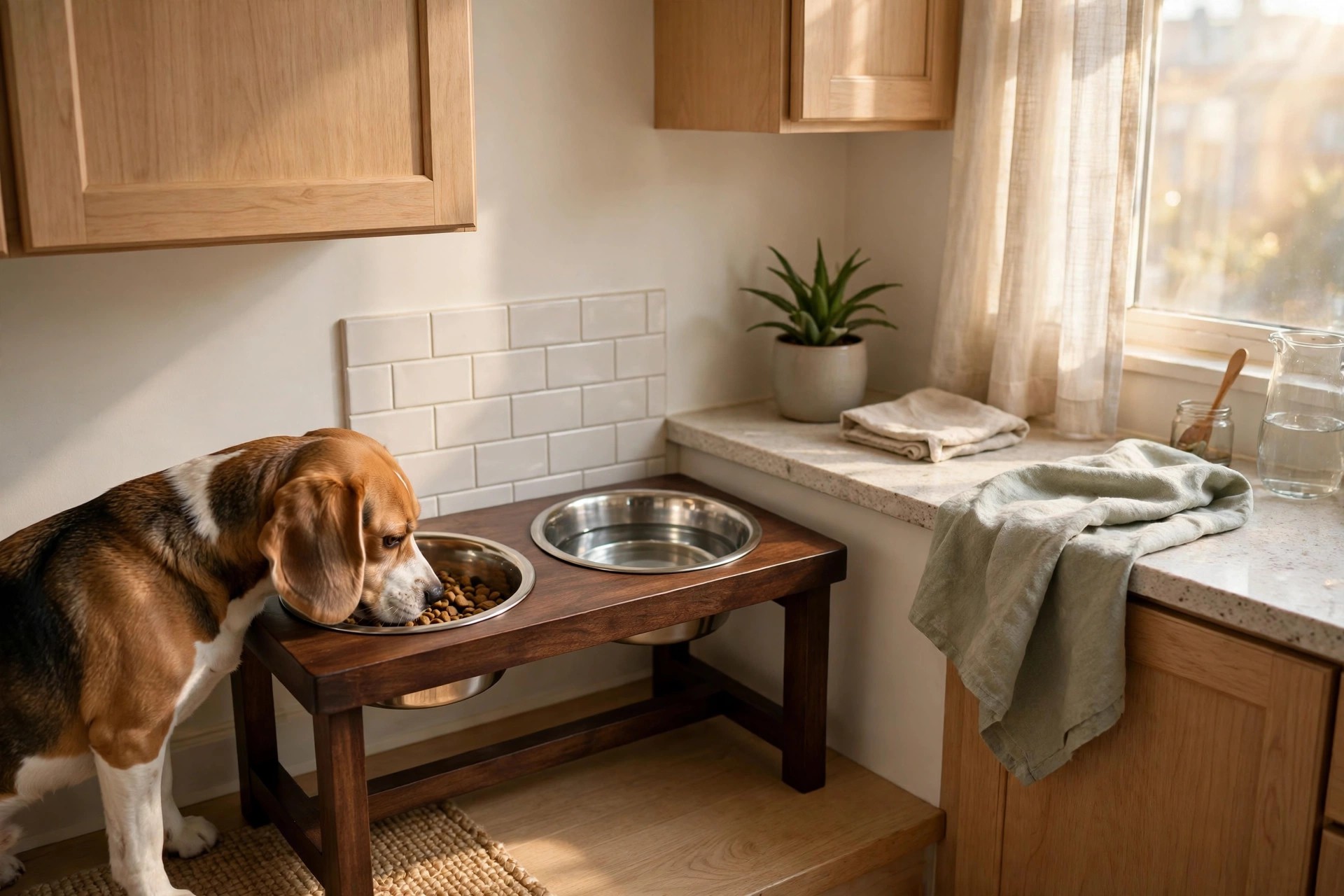
An elevated dog bowl lifts food and water a few inches so your dog eats at a more natural neck angle — and so the bowl stops skittering across the kitchen every meal. In a small apartment, though, a raised feeder is furniture: permanent floor space, splash risk on rental floors, twice-daily cleaning. The picks below balance all of that: real heights, real footprints, honest limits.
The whole decision in one line: measure your dog's shoulder height, subtract six inches, and buy a feeder whose bowls sit at that number — everything else (material, storage, looks) is a distant second.
Who actually benefits from eating raised
Elevated feeders solve specific problems. The clearest beneficiaries are tall dogs (roughly 20 inches at the shoulder and up), whose floor bowls force an uncomfortable downward reach, and senior or arthritic dogs, for whom bending down twice a day genuinely hurts. Dogs with megaesophagus are often prescribed elevated feeding by their vets for medical reasons.
Then there are the apartment lifestyle wins. A raised stand stops bowl-skittering: the classic scene of a dog pushing a metal bowl the full length of the kitchen disappears when the bowls lock into a weighted stand. Flat-faced breeds (pugs, French bulldogs, shih tzus) often drink more comfortably from a slightly raised water bowl, because it keeps their short muzzles out of a deep-bowl splash zone. Dogs that do not need one: healthy small dogs under about 15 inches at the shoulder generally eat fine from floor bowls, and puppies will outgrow a fixed-height feeder in months — for them, an adjustable model or a simple floor setup is the smarter spend.
The height math: measure before you buy
The most common elevated-feeder mistake is buying a cute stand at the wrong height. A feeder that is too tall makes the dog reach upward, which is worse than a floor bowl. Here is the measuring routine:
- Stand your dog square on a hard floor and measure from the floor to the top of the shoulders (the withers), in inches.
- Subtract 4–6 inches. That number is your target bowl-rim height. A 24-inch-shouldered dog lands around an 18–20 inch rim; a 16-inch dog lands around 10–12 inches.
- Check the product's bowl-rim height against your target — not the overall stand height, which marketing photos exaggerate. Rim height is the number that matters.
- For puppies, buy the height they will need in 6 months and raise it now with a mat or low platform, or choose an adjustable-leg model rather than replacing a fixed stand twice.
Water bowls follow the same rule. Some owners elevate food but keep water on the floor; there is no harm in that, but one stand holding both is simpler to keep clean — and in a small kitchen, one object always beats two.
Five elevated feeders compared
Every model below is a real, widely sold product with a track record — no obscure brands, no crowdfunding experiments. Prices shift with sales; treat the ranges as typical street prices. We weighted the small-apartment column most: floor footprint, height adjustment, and mess control.
| Model | Best for | Typical price | Small-space note |
|---|---|---|---|
| PetFusion Elevated Feeder | The slim, good-looking pick | Usually $50–$70 | Slim rectangle footprint; stands in 4", 8", or 12" heights; bowls lift out for the dishwasher. |
| IRIS USA Elevated Feeder | Kitchens with zero storage | Usually $25–$40 | Legs adjust to three heights; the base is an airtight kibble bin, so the feeder replaces a storage tub. |
| Neater Feeder Deluxe | Serious splash control | Usually $60–$90 | A catch basin under the bowls traps spilled food and water; larger footprint, but it genuinely protects rental floors. |
| Pawspired Raised Dog Bowl Stand | Tight budgets, tall dogs | Usually $25–$40 | Bamboo stand with stainless bowls; narrow and light — easy to tuck into a corner, easy for a big dog to nudge. |
| YETI Boomer 8 | Indestructible water bowl | Usually $50 | A single near-indestructible stainless bowl, not a stand; pair it with any elevated stand that fits an 8-cup bowl, or keep it as the floor water bowl. |
PetFusion Elevated Feeder — the slim pick
PetFusion sells three separate heights (roughly 4, 8, and 12 inches) rather than an adjustable stand, and that single-height honesty is the point: you buy the one that matches your measurement and it looks like it belongs in the kitchen. The footprint is a slim rectangle — the 12-inch large model is about 18 by 9 inches — that fits neatly against a wall. The stand reads as furniture rather than pet-aisle, the stainless bowls lift out for the dishwasher, and the anti-slip feet hold on hard floors. The tradeoff is zero adjustability: a growing puppy or a second dog of a different size needs a second stand.
IRIS USA Elevated Feeder — the storage pick
This is the cleverest pick for a tiny kitchen. The legs adjust across three heights, and the hollow base is an airtight bin holding several pounds of kibble — one object replaces both feeder and storage tub. The bowls are dishwasher-safe and the unit wipes down in seconds. Downsides: it is plastic, so determined chewers can mar the legs, and the medium/large sizes have the widest footprint here — though much of that floor space was going to a kibble tub anyway.
Neater Feeder Deluxe — the splash-containment pick
If your dog drinks like a sprinkler, this is the one. A deep catch basin under the bowls collects spilled water and kicked-out kibble, which you tip into the sink after meals — owners of drooly breeds report it cuts floor mopping dramatically, a real win on rental floors. The honest tradeoff: the biggest footprint on this list (the large is roughly 23 by 13 inches), and the basin needs a wash every few days or it develops a film. Pair it with a feeding mat and the splash problem is essentially solved.
Pawspired Raised Dog Bowl Stand — the budget pick
A simple bamboo stand with two stainless bowls, usually $25–$40 depending on size. It is narrow, light, and fine in a corner — sturdier than the wire or thin-metal cheap stands that bend when a large dog leans on them. Limitations: fixed height (measure first), and the lighter stands can slide when a strong dog eats enthusiastically, so a non-slip mat underneath is mandatory. The right call when you want the bowl-skittering solved for under forty dollars.
YETI Boomer 8 — the indestructible bowl
Strictly speaking this is not an elevated feeder — it is a single 8-cup stainless bowl built like camp cookware, dishwasher-safe, with a non-slip base. It earns a place because owners often drop a Boomer into an elevated stand as a permanent water bowl, or keep one on a stool-height stand as an elevated water station. At around $50 it is expensive, but it will not dent, warp, or pick up a metal taste; the smaller Boomer 4 (about $35) fits smaller stands. If your dog needs nothing raised, a Boomer on the floor is still one of the longest-lasting bowls you can buy.
What to skip
Skip wire-frame stands — the cheap chrome ones with bowls hanging in wire loops are light, rattle, and teach dogs to push the whole thing. Skip single-height ceramic sets too: beautiful in photos, but heavy bowls, fragile stands, and an expensive lesson if the height is wrong. When in doubt, measure twice and favor a stand with replaceable stainless bowls.
The apartment checklist: footprint, splash, cleaning, storage
Height is only half the purchase decision in a small home. Run through these four checks:
- Footprint. Measure your feeding corner before ordering. A medium feeder claims roughly 15–18 by 9–12 inches — about the size of a small doormat. Tape the outline on your floor with painter's tape for a day and see whether you step around it. If it crowds the walkway, the IRIS storage model may be the better trade since it removes a kibble tub from elsewhere.
- Splash containment. Elevated bowls do not reduce splashing on their own; the dog's drinking style does. Droolers and dunkers need either the Neater Feeder basin or a waterproof mat underneath — see our feeding mat guide for mat picks sized to feeder footprints.
- Cleaning effort. Prioritize stainless bowls that lift out and go in the dishwasher. Water bowls need washing at least every couple of days (biofilm builds fast); food bowls after every wet-food meal. If a feeder's bowls are fixed to the stand, walk away — you will stop cleaning them properly.
- Storage. Most stands do not fold, so think about where the feeder lives when guests are over. A slim rectangle like the PetFusion slides upright into a closet gap; a basin-style feeder is harder to stash. And consider whether the feeder replaces something — the IRIS model absorbing kibble storage is the only one here that earns floor space back.
The honest note on raised feeders and bloat
Raised feeders are sometimes marketed as preventing bloat (gastric dilatation-volvulus, or GDV) — and this deserves a straight answer, because it is the one health claim that follows this product category around. The evidence does not support the claim, and for some dogs it points the other way. A large study of large and giant breeds (Glickman et al., JAVMA, 2000) found that eating from a raised feeder was associated with a higher risk of GDV in large and giant deep-chested breeds — the breeds most prone to bloat in the first place (German Shepherds, Great Danes, Boxers, Weimaraners). The study was observational and later research has been mixed, but the key point stands: no study has shown that raised feeding prevents bloat, and veterinary guidance generally advises against raising bowls to prevent GDV.
What raised feeders do reliably provide is comfort: easier eating for tall, senior, or arthritic dogs, and less neck strain during meals. That is a perfectly good reason to buy one — just not a bloat-prevention reason. The evidence-backed steps for GDV risk are smaller, more frequent meals, no vigorous exercise right after eating, and a vet conversation for high-risk breeds. If your dog is a large deep-chested breed, ask your vet before going elevated.
Setting up the feeding corner
Getting the stand is step one; placement is step two. A few apartment-tested habits:
- Give it a permanent, tucked spot. Against a wall or beside a cabinet keeps the dog from circling the stand and you from tripping over it at night. Dogs eat more calmly when the bowl is always in the same place.
- Put a mat under everything. Even tidy drinkers drip. A waterproof mat slightly larger than the stand's footprint protects the floor and slides out for a weekly shake-down.
- Feed fast eaters separately. In multi-dog apartments, a dog that bolts food while another works through a maze can create tension that did not exist before — a slow feeder in a quiet corner is the calmer pairing.
- Wash bowls often. Water bowls need a wash every couple of days (biofilm builds fast); food bowls after every wet-food meal. Elevated stands sit at face height for toddlers, so keep rims clean and do not place the stand where a swinging door can knock it.
- Re-measure young dogs yearly. A stand at the right height for an 8-month-old retriever will be too short by age two. Mark your calendar, or start with an adjustable model.
FAQ
What is the correct height for an elevated dog bowl?
Measure your dog from the floor to the top of the shoulders, then subtract 4–6 inches — that is your target bowl-rim height. Buying at the rim height that matches this number matters more than any other feature.
Do elevated dog bowls help with digestion or prevent bloat?
They can make meals more comfortable for tall, senior, or arthritic dogs, but there is no solid evidence they improve digestion, and one large study linked raised feeding to higher bloat risk in large deep-chested breeds. Do not buy one to prevent bloat — ask your vet about your dog's actual risk factors instead.
Can I use regular bowls in an elevated stand?
Usually yes, as long as the diameter matches the stand's openings — most stands are sized for standard stainless bowls. This is also why stainless bowls are the best choice: they lift out for the dishwasher and can be replaced cheaply if dented.
My dog pushes the feeder across the floor. What works?
Put a non-slip mat under the stand first — that solves it for most dogs. If the stand still slides, switch to a heavier model (basin-style feeders like the Neater Feeder are the hardest to push) and place the feeder against a wall so it cannot travel.
Should the water bowl be elevated too?
There is no harm in keeping water at the same height as food — one stand holding both is simpler to clean and takes less floor space. The exception is dogs that play in their water; for dedicated splashers, a floor water bowl inside a deep catch tray can contain the mess better.