Best Apartment Dog Bed for Small Spaces
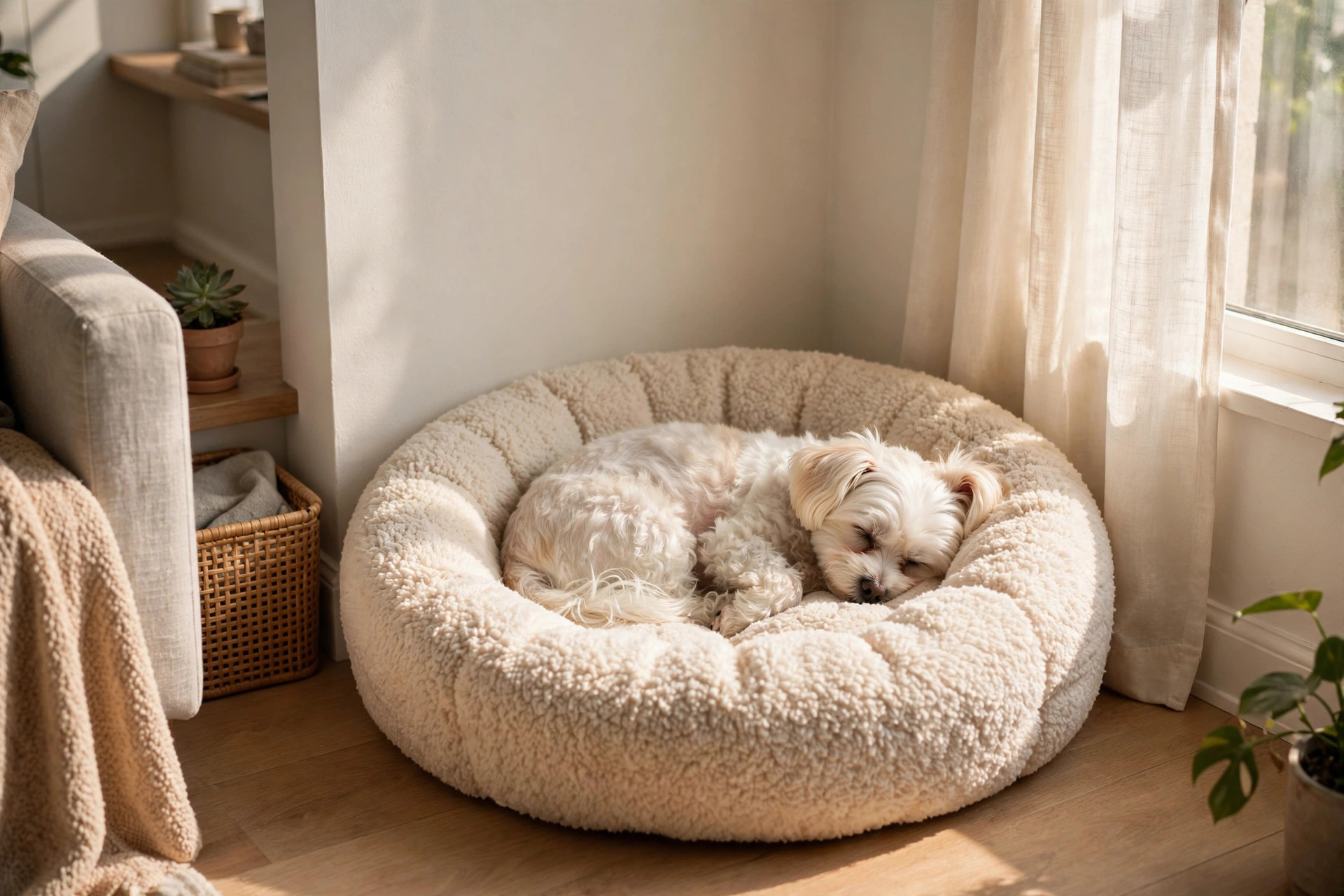
In a 550-square-foot one-bedroom, a single 36-inch rectangular dog bed eats almost seven square feet of floor — more than most coffee tables. The best apartment dog bed for small spaces is not the plushest one in the store; it is the one your dog actually sleeps on, in a footprint your layout can spare, with a cover that survives an apartment-sized washing machine.
- Measure the dog curled up (nose to tail) and add 6–8 inches — oversizing is the number-one small-space mistake.
- Round cuddler beds waste the least floor; elevated cots tuck under desks and keep air flowing in summer.
- Budget roughly $25–$165. A removable, machine-washable cover matters more than thread count.
- Whatever the shape, it must survive your washing machine — otherwise it becomes a smell problem by month two.
Start with the dog's sleeping footprint, not the product photo
Dog beds are sized by the dog, but apartment beds must be sized by the dog curled up. Most dogs sleep in a donut most of the night, which makes their sleeping footprint much smaller than their stretched-out length. Wait until yours is deep asleep, then measure nose to base of tail along the curve and add 6–8 inches. That number — not the breed chart on the listing — is the diameter or length you actually need.
Then do the floor math: a 36 x 27 inch rectangle is about 6.75 square feet — over 1% of a 550-square-foot apartment, and it has to sit somewhere you walk. A 30-inch round cuddler is about 4.9 square feet; a 24-inch round is only 3.1. That one-size difference is what turns a cozy corner into an obstacle course.
Before ordering, grab a roll of painter's tape and mark the footprint on the floor where the bed will live. Live with the outline for a day: open the doors nearby, walk the usual path to the kitchen, and see whether you step inside the tape. If you do, size down or switch shapes. This two-minute test has saved more returns than any review section ever could.
Five beds that earn their floor space
Every bed below is a widely sold, real model with a track record in small homes. Prices are typical US street prices and move with sales. The common thread: each one either shrinks the footprint, washes easily, or does double duty as something else.
| Model | Shape | Typical price | Small-space superpower |
|---|---|---|---|
| Best Friends by Sheri Calming Donut Cuddler | Round donut | Usually $25–$50 | Corner-tucks; entire bed goes in the washer. |
| Majestic Pet Bagel Bed | Round bolstered | Usually $50–$80 | Dense fill holds shape; no wasted corners. |
| Furhaven Plush & Suede Sofa | L-shaped sofa | Usually $30–$60 | Backrest leans against a wall; cheap to replace. |
| PetFusion Ultimate Dog Bed (Lounge) | Rectangle with bolsters | Usually $100–$180 | Removable cover; nests flush against bed or sofa. |
| K&H Original Pet Cot | Elevated mesh | Usually $45–$75 | Slides under a desk; storage space underneath. |
Best Friends by Sheri Calming Donut Cuddler — the corner king
This is the round faux-fur donut you have seen in a hundred apartment photos, and there is a reason: the round shape tucks into corners and against walls with zero wasted footprint, and the whole bed (not just the cover) is machine washable, which is rare at this price. Two caveats: big sprawlers will hang off it, and the faux-fur shell attracts lint between washes. For dogs under about 25 pounds, it is the most floor-efficient bed sold.
Majestic Pet Bagel Bed — the donut that keeps its shape
Same round logic as the cuddler, one step up in construction: the bagel-style bolster is stuffed denser, so it holds a defined bowl shape instead of flattening into a pancake. The cover is removable and washable, and owners of medium curlers (25–45 pounds) prefer it because the sleeping bowl stays put.
Furhaven Plush & Suede Sofa — the budget wall-hugger
The L-shaped sofa back lets the bed sit flush against a wall or your bed without the dead space a plain rectangle leaves behind, and the raised back doubles as a chin rest. It is also the cheapest bed on this list, which matters: at $30–$60, you can replace it yearly instead of fighting a permanently smelly bed.
PetFusion Ultimate Dog Bed — the tidy rectangle
When you genuinely need a rectangle — sprawlers, crate-trained dogs that sleep stretched out — this is the one that behaves in small rooms. The memory-foam base comes in a removable, machine-washable cover, the bolsters on three sides create a defined edge (so the dog stops sliding off onto your floor), and the low profile slides against a sofa or bed frame like it was built in. It is the priciest pick here, but it is also the only one people routinely keep for five-plus years.
K&H Original Pet Cot — the under-desk sleeper
An elevated mesh cot on removable legs: the dog sleeps 7 inches off the floor with air circulating underneath, which city dogs love in summer, and the space beneath stays usable for shoe or toy storage. It slides fully under a desk or console table when you need the floor back, and the mesh cover removes for washing. The trade-off is the hammock feel — some dogs take a week to trust it — and it is not the pick for seniors with stiff joints (see our orthopedic bed guide for those).
What to skip
Oversized memory-foam rectangles marketed for giant breeds are the main trap: a 44 x 34 inch bed in a one-bedroom becomes furniture you resent. Also skip any bed whose cover is not removable at the size you need — spot-cleaning a 36-inch bed in a bathtub gets old by the third time.
Four shapes, four apartment strategies
Once you know the footprint, pick the shape that matches your floor plan:
- Round cuddlers (donuts, bagels) for corners and dead zones — the curve wastes no space against two walls, and curlers feel safer in them.
- Nesting rectangles with bolsters for along-the-bed or along-the-sofa placement — the raised edge defines the bed visually so it reads as "the dog's spot" instead of clutter.
- Elevated cots for multi-use rooms — slide it under a desk by day, pull it out at night, and keep storage underneath year-round.
- Crate-fit mats for crate sleepers — if your dog already naps in a crate, a fitted mat inside it means one sleeping spot instead of two. Our crate setup guide covers sizing and placement in small rooms.
The unifying rule: every bed needs a "parked" position for guests. If you cannot fold it, slide it, or tuck it away in thirty seconds, it becomes a permanent obstacle — and obstacles end up in a closet, unused.
Where to actually park it in a small home
Placement decides whether the bed gets used. Work through the usual apartment spots in this order:
- Beside your bed. Dogs sleep best near their people, and a bed tucked against your nightstand usually survives the longest. Measure the gap first — you need the bed plus a few inches of walkway.
- Inside the crate. One sleeping spot instead of two. A crate in a bedroom corner with a fitted mat is the most floor-efficient setup that exists, and dogs that crate-train well often prefer it.
- The work-from-home nook. A cuddler under or beside your desk keeps the dog near you during the day, which quietly helps with the midday restlessness that becomes separation anxiety behaviors.
- The sunny spot. Most dogs will abandon a perfect bed for a sunbeam. If your bed placement fights the afternoon sun patch, the sun patch wins — so put the bed where the sun lands, or accept the migration.
One spot to avoid: right by the front door. Every hallway footstep becomes a bark trigger there, and in a small apartment you will hear all of it. Ten feet down the hall or around a corner is dramatically calmer.
The guest test: when friends come over, can you make the bed disappear in under a minute — folded against a wall, slid under furniture, or tucked in a closet? If yes, it belongs in your apartment. If it becomes a permanent floor fixture, it is too big.
Washing a dog bed without a backyard or big machines
In an apartment, washability is not a nice-to-have — it is the whole game. A bed you cannot wash becomes a smell source within two months, and in 600 square feet there is nowhere for the smell to go. Prioritize a removable cover first; whole-bed washability second.
Practical rules for apartment laundry: a cover from a bed up to about 36 inches fits a standard front-loader; whole small beds (the Sheri donut, small Furhavens) can go in on delicate. Wash warm, not hot, to protect waterproof liners, and skip fabric softener — it coats fibers and traps odor. Between washes, a sprinkle of baking soda left for an hour and vacuumed off buys you an extra week. If smells are the main battle, our guide on reducing dog smell in small apartments goes deeper, and a washable blanket cover over the bed extends every wash cycle.
FAQ
What size dog bed should I get for a small apartment?
Measure your dog curled up asleep (nose to tail), add 6–8 inches, and buy that — usually one size smaller than the breed chart suggests. Then tape the footprint on your floor for a day before ordering. Most dogs under 40 pounds are perfectly happy in a 24–30 inch bed.
Are elevated cots good for small apartments?
Yes, with one condition: your dog has to like the hammock feel, which takes some dogs a week to accept. The payoff is real — airflow in summer, usable storage underneath, and it slides under a desk when you need the floor. They are not ideal for seniors with stiff joints, though.
Round or rectangle: which wastes less space?
Round, for corner placement — a circle against two walls wastes nothing, while a rectangle leaves awkward dead corners. Rectangles win only when they nest flush against a sofa or bed, or when your dog is a dedicated sprawler that needs the length.
How often should I wash my dog's bed in an apartment?
Wash the cover every 2–4 weeks, more often in shedding season. In a small space, odor concentrates fast, so err toward frequent: a removable cover on a quick warm cycle is twenty minutes of effort and keeps the whole apartment smelling neutral.