Best Dog Crate Setup for Apartment Living
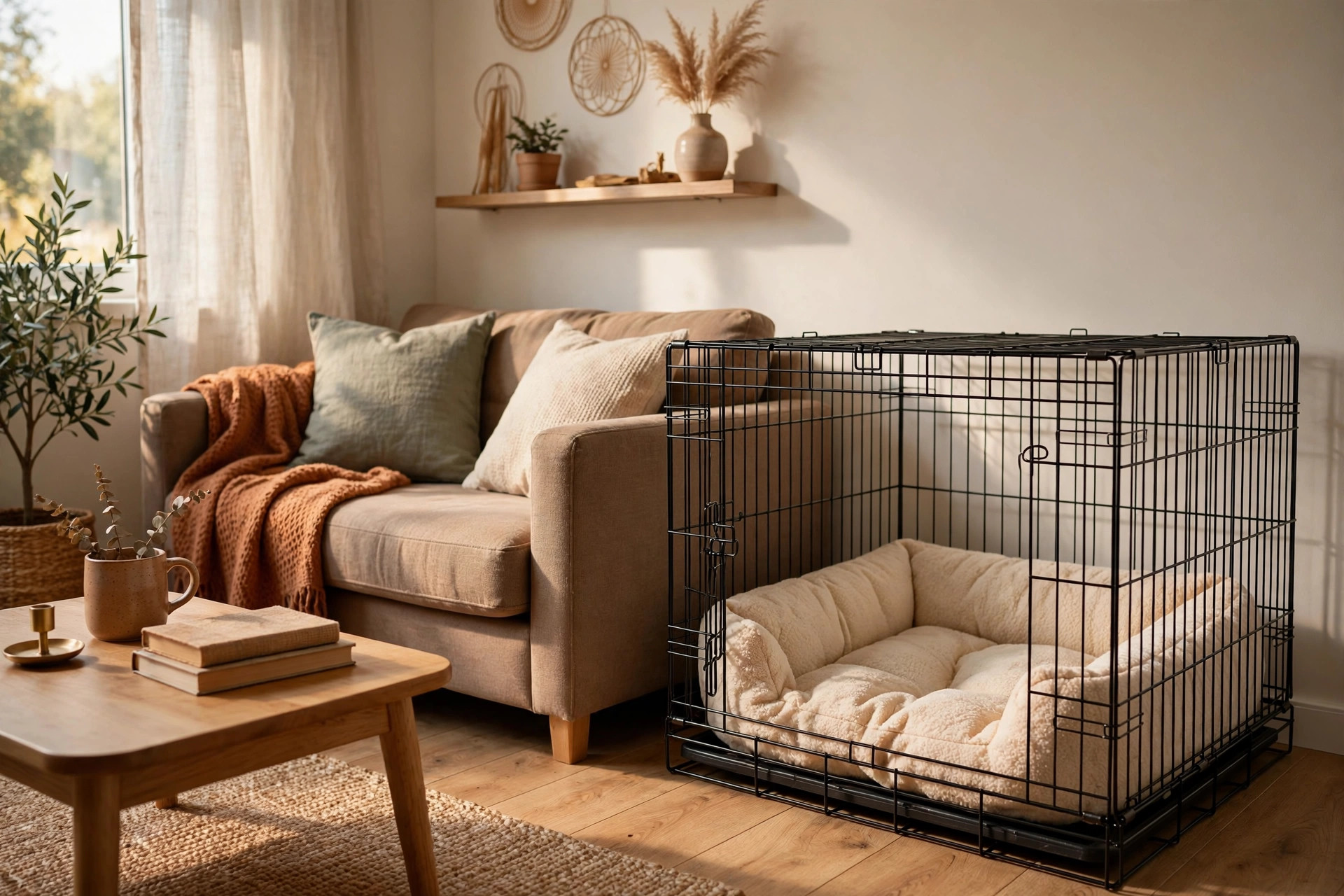
Most crate advice starts with the brand. In an apartment, start with the tape measure instead: the wrong footprint eats a room, the wrong placement annoys a neighbor, and the wrong base layer ruins a floor. Get those three right and almost any decent crate works.
Start with size, not the brand
The classic rule still holds: the dog should be able to stand up, turn around, and lie stretched out inside. Add roughly 2 to 4 inches to the dog's standing height and body length (nose to base of tail) and round up to the nearest standard crate size. The common wire-crate sizes are 24, 30, 36, 42, and 48 inches long.
For apartments, also measure the room, not just the dog. A 36-inch crate is typically about 36 x 23 x 25 inches — roughly 5.7 square feet of floor. In a 400-square-foot studio that is more than 1% of your entire home, so the crate's footprint deserves the same planning as a piece of furniture. Measure the exact corner or wall where it will live, including clearance for the door swing: most crates need the door to open a full 90 degrees, which adds another 20-plus inches of swing space in front.
Growing puppies are the exception to "buy once." A divider panel — included with most MidWest-style wire crates — lets you buy the adult size and shrink the interior, which matters because too much space invites one end to become a bathroom. Budget one crate, not two.
- Measure the dog, add 2–4 inches, round up to the nearest standard size.
- Measure the room too: a 36-inch crate claims about 5.7 sq ft plus door swing.
- For puppies, buy the adult size with a divider panel instead of buying twice.
- In rentals, fold-flat storage matters as much as the footprint — most wire crates collapse to 3–5 inches thick.
Four crates compared for apartment life
These are the crates that come up again and again in apartment-dog communities, compared on the things that actually matter in small spaces: footprint behavior, noise, storage, and looks. Prices are typical US street prices and move with sales.
| Crate | Best for | Typical price | Small-space notes |
|---|---|---|---|
| MidWest iCrate (double door) | The default choice; puppies and budget setups | Usually $50–$120 by size | Folds flat to a few inches; divider included on most sizes. Wire rattles — needs the noise-proofing below. |
| Diggs Revol | Living-room-visible crates; design-conscious renters | Usually $225–$375 | Collapses (rather than fold-flat) in about a minute; built-in puppy divider; far less rattle than wire. Premium price. |
| Frisco Double-Door Wire Crate | Chewy shoppers wanting iCrate-like value | Usually $40–$100 by size | Same fold-flat logic as the iCrate; frequently discounted. Finish quality varies by batch. |
| EliteField 3-Door Soft Crate | Travel and calm adult dogs; ultra-light storage | Usually $55–$110 by size | Packs into a carry bag; near-silent. Not for chewers or escape artists — fabric walls lose to determined teeth. |
Notice what is missing: there is no "best" here, only trade-offs. A wire crate wins on price and airflow but loses on noise and looks. The Revol wins on looks and quiet operation but costs three to four times more. The soft crate is silent and portable but useless for a teething puppy. Pick the trade-off that matches your dog and your lease, not the one with the most five-star reviews.
Where the crate actually goes
Crate placement in an apartment is a three-way negotiation between the dog's calm, your floor plan, and your neighbors. Work through it in this order:
- Away from shared walls first. If you share a bedroom wall with a neighbor, the crate goes on the opposite side of the room. Sound through a shared wall is the number-one crate complaint in apartments, and distance is free.
- Out of the hallway blast zone. Dogs stationed next to the front door hear every footstep, key jingle, and elevator ding as a personal event. A crate 10–15 feet down a hallway or around a corner dramatically reduces alert barking.
- Near, not in, the action. Total isolation (a closed spare room) can increase whining in velcro breeds; dead-center living room placement keeps some dogs too wired to settle. The sweet spot is usually a quiet corner of the room where you spend evenings — present but not center stage.
- Off the vent, off the draft. Avoid blasting HVAC vents (drying, noisy) and drafty window walls. Dogs settle faster in thermally boring spots.
Renters: check your lease for floor-protection expectations before you buy anything. A washable, waterproof mat under the crate — roughly 6 inches larger than the footprint on each side — protects hardwood and laminate from scratches and the occasional accident, and it doubles as rattle dampening.
Noise-proofing a wire crate (the 15-minute fix)
Wire crates rattle. In a house nobody cares; in an apartment the downstairs neighbor hears every shift at 6 a.m. Three cheap fixes handle most of it:
- A rubber or foam mat underneath decouples the crate from hard floors. Even a $15 interlocking foam tile set cuts transmitted thumps dramatically.
- Zip-tie the loose panels. The rattle usually comes from the side panels vibrating against the frame. A few small zip ties at the contact points cost pennies and work immediately.
- A fitted cover (or a heavy blanket, carefully) dampens high-frequency ping and reduces visual stimulation. Leave at least two sides uncovered for airflow unless the room is cool and the dog runs cold.
The neighbor test: after setup, have someone walk around inside the crate area while you stand in the hallway with the door closed. If you can clearly hear shifting and tags jingling, so can the neighbors — add the mat and ties before the first night, not after the first complaint.
The 20-minute settle routine
Equipment is maybe a third of crate success. The rest is the routine that teaches the dog the crate predicts calm, not confinement. This sequence works for most adult dogs and older puppies within a week or two of consistency:
- Minutes 0–10: burn the edge off. A sniffy walk or 10 minutes of gentle play. A dog entering the crate still buzzing will rehearse restlessness.
- Minutes 10–15: transition activity. A stuffed Kong, lick mat, or chew inside or next to the crate. This bridges "active" to "resting" instead of demanding an instant off-switch.
- Minutes 15–20: calm entry. Cue the dog in, close the door without ceremony, and leave the room. No long goodbyes — drama at the door teaches the dog that departures are events.
For the first week, keep daytime sessions short (30–60 minutes) and always end before the dog gets upset. A crate the dog chooses to nap in with the door open is the goal; a crate the dog only enters under protest will fail the moment apartment life gets stressful.
FAQ
What size crate for a 40-pound dog in a one-bedroom?
Usually a 36-inch crate (about 36 x 23 x 25 inches). It fits most 40-pound breeds like border collies and smaller lab mixes, and at roughly 5.7 square feet it tucks into a bedroom corner without dominating the room. Size up to 42 inches only if the dog is long-bodied or you want extra sprawl room — and re-measure your space first.
Is the Diggs Revol worth 3x the price of a MidWest iCrate?
Only in specific cases: the crate lives in your living room where you see it all day, your dog is past the destructive chewing phase, and the budget is comfortable. For puppies, fosters, or tight budgets, the iCrate plus $20 of noise-proofing (mat + zip ties) gets you 90% of the function at a third of the cost.
How do I stop the crate from sliding on hardwood?
A rubber-backed washable mat under the crate solves sliding, scratching, and rattle in one move — get one about 6 inches larger than the crate footprint on each side. Avoid adhesive pads marketed for furniture; they can damage floor finishes when removed.
My dog barks in the crate when I leave. Is the setup wrong?
Probably the routine, not the gear. Shorten sessions to 30 minutes, always exercise first, and practice departures where you leave for 2 minutes and return before barking starts — then stretch the time. If barking is intense, lasts more than 10–15 minutes, or is new behavior, talk to your vet or a certified trainer; true separation anxiety needs more than a better crate.