Apartment Puppy Routine for Full-Time Workers
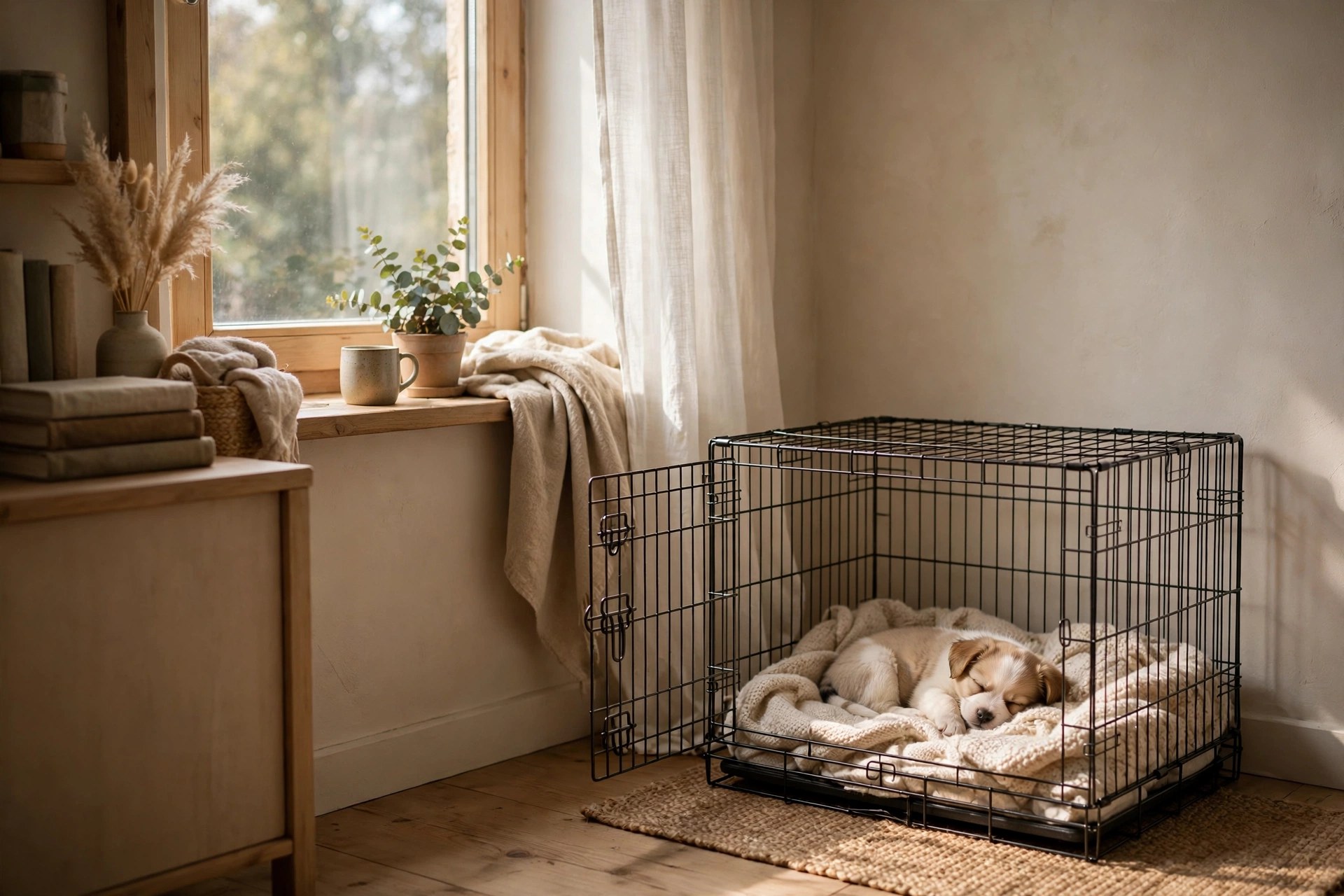
Raising a puppy in an apartment while working full-time is a scheduling problem, not a willpower problem. This is the actual clock — minute by minute — that makes it work: morning block, the workday gap solved by age, and an evening wind-down that protects your neighbors' sleep and yours.
The core math: bladder vs. workday
Everything in this routine flows from one constraint — how long a puppy can comfortably hold it:
| Puppy age | Max comfortable hold | What the workday needs |
|---|---|---|
| 8–10 weeks | ~1 hour (30–60 min typical) | Midday visits every 2–3 hours — a walker twice, or work-from-home flexibility |
| 3–4 months | ~2 hours | One midday walker visit + one early-afternoon check if possible |
| 4–6 months | 3–4 hours | One solid midday visit of 30+ minutes works for most puppies |
| 6+ months | 4–6 hours | Standard adult pattern: morning walk, midday break, evening walk |
The morning block: 6:00–8:30
Mornings are non-negotiable and cannot be rushed. A calm morning prevents 80% of daytime problems:
- 6:00 — Out immediately. Leash, elevator, potty spot. No phone scrolling while the puppy decides; reward the second they finish.
- 6:15 — Breakfast in a puzzle feeder or Kong, not a bowl. Fifteen minutes of working for food buys you a calmer crate entry later.
- 6:30 — Training micro-session, 5 minutes. One skill: sit, name recognition, or leash manners in the hallway. End while it is still fun.
- 6:45 — Second potty trip (puppies often go twice after eating), then a short sniff walk — 10–15 minutes, no distance goals.
- 7:15 — Crate or pen entry. Frozen Kong or chew goes in with the puppy. Calm departure: no long goodbyes, just leave.
- 7:30–8:30 — You get ready and leave. White noise machine on near the crate; it masks hallway sounds that trigger barking.
The workday block: 8:30–5:30
This is where age decides the plan. Pick your row:
8–12 weeks: the two-visit plan
Walker or sitter at ~11:00 and ~2:30, 20–30 minutes each: potty, play, fresh water, back in the pen. Between visits the puppy is in a pen (not a closed crate all day) with water, a chew, and puppy pads at the far end from the bed. Yes, this costs roughly double the single-visit price — for about two months.
3–6 months: the one-visit plan
One 30-minute visit around 12:30–1:00: potty, a real walk, training reinforcement (the walker practices "sit" at curbs — put it on the walker card). Crate or pen for the remaining stretches, with a frozen Kong at each re-entry.
6+ months: the standard pattern
Midday break around 1:00, 30 minutes. Many adolescent dogs this age can also handle a slightly longer morning crate stretch if the morning block was solid.
- Pen vs. crate during the day: under 4 months, a pen with pads is kinder than a crate the puppy cannot hold it in. A puppy forced to soil its crate learns that crates are toilets — the opposite of what you want.
- Camera check: one midday glance at a pet camera tells you whether the routine is working. Constant watching will only raise your blood pressure.
- Walker handoff: keep the entryway station stocked (leash, treats, bags) so visits never depend on your morning memory.
The evening block: 5:30–10:00
- 5:30 — Decompression walk, 20–30 minutes. Let the puppy sniff everything. Sniffing is mentally exhausting — a sniffy walk tires a puppy more than a forced march.
- 6:15 — Dinner (again in a puzzle feeder), then a potty trip 15–20 minutes after.
- 7:00 — Play + training, 15 minutes. Tug, fetch down the hallway, or a second 5-minute training session. This is the energy-burning window that determines your night.
- 8:00 — Wind-down begins. Chew or lick mat on the couch with you. No wild play after 8 — arousal takes 30+ minutes to fade in puppies.
- 9:30 — Last potty trip, then crate for the night. Puppies under 4 months may need one overnight trip (around 2–3 a.m.); set an alarm rather than waiting for crying.
The weekend shift
Do not sleep in past the puppy's bladder — but do shift the pattern. Weekends are for: one longer adventure walk (new neighborhood, pet-friendly store), a socialization outing (puppy class, friend's calm dog), and 1–2 hours of "boring" alone-time practice in the pen while you are home. That last one is the most important: puppies that only experience alone-time on workdays often struggle harder on Mondays.
Gear that earns its place
- Wire crate with divider (MidWest iCrate style, usually $40–70): the divider keeps the space small enough to discourage soiling as the puppy grows.
- Exercise pen (usually $40–60): the daytime headquarters for young puppies.
- Kong Puppy + lick mat (usually $10–15 each): frozen peanut butter or wet food turns crate entry into the best part of the day.
- Snuggle Puppy (usually ~$40): the heartbeat plush genuinely helps some puppies settle the first two weeks. Not magic, but widely reported as useful.
- White noise machine (usually $20–50): masks hallway noise that would otherwise teach your puppy that doors opening means barking time.
Before the routine: the first 72 hours
The schedule above starts on day 4. Days 1–3 have one job: let the puppy decompress. New home, new smells, no littermates — everything is overwhelming. Keep it boring on purpose:
- Limit the world to 2 rooms. The whole apartment is too much territory to learn at once. Baby gates are your friend.
- Same potty spot, every time. Carry or walk the puppy to one exact patch of grass. Repetition builds the habit faster than variety.
- Visitors wait. Everyone wants to meet the puppy; the puppy needs 72 hours of quiet first. Enforce it kindly and firmly.
- Start the crate on night one — next to your bed, with the Snuggle Puppy and a worn t-shirt. Proximity first, distance later.
- Log everything for 3 days: potty times, meals, naps. You will spot the puppy's natural rhythm, and the routine you build on day 4 will fit the puppy instead of fighting it.
The socialization checklist (weeks 8–16)
The routine keeps the puppy alive and sane; socialization makes the adult dog. The critical window closes around 16 weeks, so use weekends deliberately. Aim for 2–3 novel, positive exposures per week — quality over quantity:
- ☐ 5 different floor textures (grass, concrete, gravel, wet pavement, elevator floor)
- ☐ 10 different people (hats, beards, uniforms, kids — always paired with treats)
- ☐ City sounds at low intensity first: buses, sirens at a distance, skateboards
- ☐ 3 calm, vaccinated adult dogs (not the dog park — one stable dog at a time)
- ☐ Handling practice: paws, ears, mouth, collar grabs — 30 seconds daily, always with food rewards
- ☐ One novel outing per weekend: pet-friendly store, outdoor café, a friend's quiet apartment
FAQ
Is it cruel to crate a puppy while working full-time?
A crate used correctly — right-sized, introduced positively, with breaks matched to bladder capacity — is a safe den, not a cage. What is unfair is crating a young puppy longer than it can hold it. Match the plan to the age table above and the crate is fine.
Can I skip the walker and use puppy pads all day?
For 8–10 week puppies, pads in a pen during the longest gap are a reasonable bridge — not a permanent plan. Relying on pads past 4–5 months slows house training significantly, because the puppy learns indoors is acceptable. Use pads as a tool, then phase them out.
When can I stop the midday walker?
Most dogs are ready somewhere between 8–12 months, depending on size and bladder control. Test with a half-day first (a Saturday where you stay out 6 hours) before canceling the walker entirely.
My puppy cries in the crate every morning. What am I doing wrong?
Usually one of three things: the morning block was rushed (puppy went in wired, not tired), the Kong was not frozen (finished in 4 minutes instead of 25), or departures are dramatic (long goodbyes spike anxiety). Fix in that order.