Best Spill-Proof Dog Water Bowls for Apartments
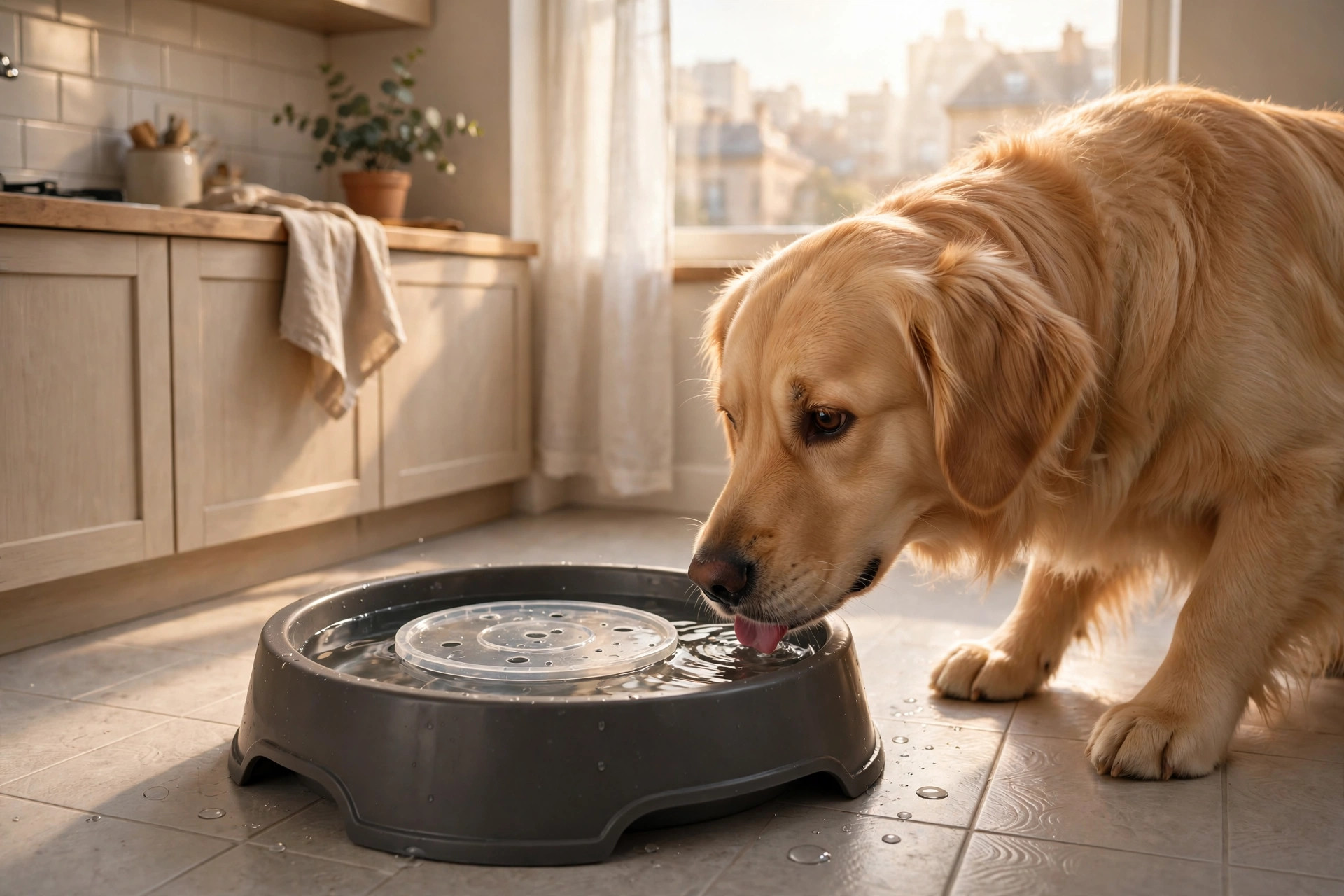
Every dog drinks the same way: scooping water with the back of its tongue, flinging half of it across the floor, and carrying the rest in its jowls. In a house with a mudroom, that is a shrug. In a rental with original hardwood, it is a slow-motion deposit deduction. Spill-proof bowls fix most of it — but the designs are not interchangeable, and a few trade one problem for another.
Why water is the sneakiest mess in a small home
Food mess is visible and finite. Water keeps happening all day, and the damage is cumulative in ways renters feel at move-out:
- Splash and dribble zones. Dogs splash while drinking and drip while walking away — the drinking spot develops a permanent damp halo about two feet across.
- Floor damage. Laminate and engineered wood bubble and peel at seams where water sits. A spoonful a day on the same seam for a year can cost you part of your deposit.
- Mildew smell. A perpetually damp mat under the bowl goes sour fast, and in 600 square feet one sour spot affects the whole home.
- Slip risk. Water on tile kitchens and entryways is a real hazard for dogs and humans alike.
A spill-proof bowl plus a good feeding mat solves the floor-damage problem almost entirely — and the bowl is the bigger half of the equation.
The three spill-proof designs, explained honestly
Nearly every "no-spill" bowl is one of three mechanisms, each with a catch:
- Floating disk. A buoyant disk floats on the surface so only a thin film of water is exposed — enthusiastic lapping cannot launch waves over the rim. Road Refresher pioneered it. Catch: the disk's crevices collect slime, some dogs take a day or two to trust the floating plate, and a few disks rattle on hard floors when the bowl runs low.
- Splash-guard lid. A fitted lid with drink holes covers the bowl, so water cannot slosh out when bumped. Slopper Stopper is the best-known example. Catch: the holes suit medium-to-large muzzles; small or flat-faced dogs may struggle, and determined chewers sometimes attack the lid itself.
- Elevated station with catch basin. The bowl sits in a raised housing; splashed water runs into a drainage tray instead of the floor. Neater Feeder is the standard-bearer. Catch: it contains the mess rather than preventing it, and at roughly 15×10 inches it has the largest footprint here.
A fourth option is not truly spill-proof but deserves mention: weighted, rubber-bottomed stainless bowls like the Frisco non-slip. They do nothing about splashing, but they stop the sliding and tipping that turn a small spill into a flood — sometimes all a gentle drinker needs.
Six bowls compared
These are all established, widely sold products with long track records — no crowdfunding experiments. Prices are typical street prices and move with sales.
| Model | Spill mechanism | Typical price | Small-apartment note |
|---|---|---|---|
| Road Refresher No Spill Bowl | Floating disk | Usually $25–$40 | The original no-spill design. Nearly silent, fully disassembles for cleaning, and the compact round shape fits tight kitchen corners. |
| Ray Allen No-Spill Water Bowl | Floating disk | Usually $20–$35 | Built for working and sporting dogs, so the construction is tougher than most. Fewer size options, but genuinely hard to splash out of. |
| Neater Feeder Express | Elevated + catch basin | Usually $40–$60 | Legs snap together tool-free; the front paw-wall funnels sloshed water into the tray. Raised height suits medium-large dogs. Needs a dedicated corner. |
| Slopper Stopper | Splash-guard lid | Usually $30–$55 | Best at surviving actual impacts — the lid keeps water in even when knocked hard. Drink holes fit medium-large muzzles best; watch for lid-chewers. |
| UPSKY / URPOWER Gravity Dispenser | Bottle auto-refill | Usually $15–$30 | Holds up to 3.8 L so you refill less on workdays. But the open tray still splashes and tips, so it only earns its place sitting on a mat. |
| Frisco Stainless Non-Slip Bowl | Weighted rubber base | Usually $8–$15 | The honest budget fix: heavy enough that most dogs cannot push or flip it. Not splash-proof — pair with a mat for calm drinkers. |
Pick the right one for your dog, not your kitchen
Match the mechanism to the drinker:
- The enthusiastic splasher (retrievers, spaniels, boxers): floating disk — it cuts splashing at the source. Road Refresher is the safe default; Ray Allen if your dog plays rough with bowls.
- The bowl body-checker (big dogs, homes with kids): Slopper Stopper or Neater Feeder Express. The lid or housing is what keeps water off the floor when the bowl takes a hit.
- Flat-faced breeds (pugs, bulldogs, shih tzus): skip small drink holes and tight disks. A wide, heavy non-slip bowl — or a Neater Feeder with its open bowl — is kinder than a mechanism they have to fight.
- Puppies under 4 months: skip the mechanisms. A moving disk or lid can spook a puppy off water; use a heavy low bowl and upgrade later.
- Long workdays: a gravity dispenser like the UPSKY/URPOWER keeps water available all day — parked on a mat, with the tray cleaned often, since standing water biofilms fast in warm apartments.
- Tiny kitchens: a floating-disk bowl takes up no more floor than a normal bowl. The Neater Feeder needs a dedicated corner — measure before you order.
Fighting mealtime mess too? A slow feeder bowl pairs well with any of these — slower eating usually means less post-meal water-gulping.
Water restriction is a feeding problem, not a cleaning problem. Never use a bowl that meaningfully slows drinking — small drink holes, stiff disks, tight valves — for a dog on medications that increase thirst (like prednisone), a dog with diabetes or kidney disease, or any dog that drinks heavily after exercise. If in doubt, a plain heavy bowl plus a mat is always the safe option.
The cleaning routine that keeps it from getting gross
No-spill bowls have more parts, and more parts mean more places for biofilm — the slimy layer of bacteria and algae that forms on wet plastic within 24–48 hours and makes bowls smell swampy. The routine:
- Daily: rinse and refill. Dump, rinse the bowl and disk or lid, refill. Thirty seconds — this alone prevents most slime.
- Weekly: full disassembly. Wash every piece with hot soapy water. Floating disks hide gunk in rim grooves; splash-guard lids collect residue in the drink holes.
- Monthly: descale. Soak hard-water-prone parts in a 1:1 white vinegar solution for 15 minutes, then rinse well — soap alone will not shift mineral film.
- Prefer stainless where possible. Stainless resists biofilm better than plastic and goes anywhere in the dishwasher. Plastic disks are usually top-rack-safe, but repeated heat warps them — hand-washing extends their life.
- Replace when scratched. Deep scratches harbor bacteria scrubbing cannot reach. At these prices, a yearly replacement is reasonable.
The elevated feeder's catch basin needs its own wipe-down every couple of days — kibble dust plus water dries into a cement-like paste.
Honest tradeoffs, before you buy
- They can slow drinking. Disks and small drink holes add resistance — fine for most healthy adults, but a real problem for dogs that need easy water access: puppies, seniors with weak tongues, dogs on thirst-increasing medication, and dogs with diabetes or kidney disease. For those dogs, a plain heavy bowl and a good mat is the safe option.
- They do not fix dribble trails. No bowl stops water from leaving your dog's jowls between the bowl and the rug. The bowl solves the splashing half; the other half is a mat or a towel by the door — see our rainy-entryway guide.
- Some dogs never accept the mechanism. A small fraction — especially anxious or senior dogs — refuse to drink through a disk or lid. Give it 3–4 days; if the dog still avoids water, drop the bowl. Hydration beats tidiness, always.
- Noise exists. A disk settling onto a nearly empty bowl can clatter on tile at 3 a.m. A silicone mat underneath absorbs most of it.
- Size for your dog's thirst. Most dogs drink about one ounce per pound of body weight daily — a 40-pound dog needs roughly 5 cups. Pick a bowl you refill once a day at most; one needing three refills will get neglected.
FAQ
Do no-spill water bowls reduce how much water my dog drinks?
For most healthy adult dogs, no — they adjust within a few days and drink normally. The exception is dogs that need very easy water access: puppies, seniors with weak tongues, and dogs on medications that increase thirst. For those, use a plain heavy bowl with a mat instead.
Are floating-disk bowls dishwasher-safe?
Most are top-rack dishwasher-safe, including the Road Refresher's disk. But repeated high heat can warp plastic disks, which breaks the seal that makes them spill-proof — hand-washing extends their life noticeably.
My dog flips every bowl over. Will any of these actually stop that?
The Slopper Stopper's lidded design handles hard knocks best — water stays in even if the bowl goes over. The Neater Feeder's housing is heavy and wide, so it resists tipping but is not tip-proof. No bowl survives a determined large dog that has decided to flip it; in those cases, a corner-anchored setup beats any freestanding bowl.
Are no-spill bowls safe for puppies?
Wait until the puppy is confidently drinking from a normal bowl first — usually around 4 months. A moving disk or lidded drink hole can startle a young puppy off water entirely, and consistent hydration matters far more than a dry floor at that age.
Do I still need a mat under a spill-proof bowl?
Yes. The bowl stops splashing; the mat catches the dribble trail from your dog's mouth and protects the floor from the daily damp ring. The two together are the complete solution — either one alone leaves half the problem.