How to Keep a Dog Entryway Cleaner in a Rainy Apartment
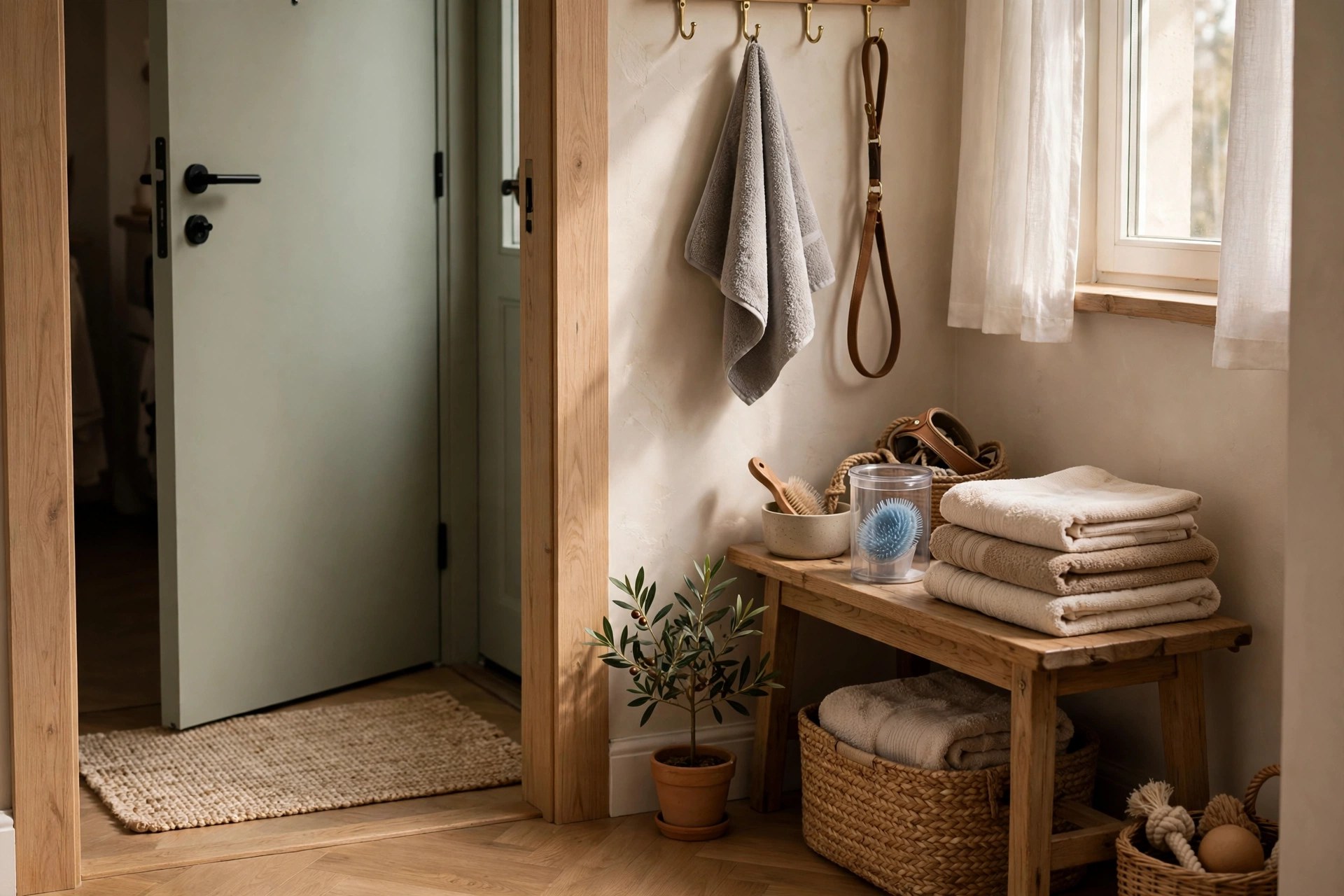
The reason your entryway stays muddy all rainy season isn't your dog — it's that your entryway has no system. A towel by the door is a hope, not a plan. This guide builds a five-zone entryway that catches water, mud, and shake-off spray before they reach your floors, plus the minute-by-minute routine and the training that makes your dog cooperate with it.
The five-zone entryway blueprint
Think of your entryway as an airlock: each zone catches a different kind of mess, in order. You don't need a big foyer — this works in a 3-foot-wide hallway nook. Measure your space first; the whole system fits in about 4 feet of wall and 3 feet of depth.
Zone 1 — The drip line (doormat outside the door)
A coarse outdoor mat, at least 24 by 36 inches, lives right outside your apartment door. Its only job is knocking off the worst: loose mud clumps and standing water from paws. Shake it out weekly; hose it monthly. This single mat prevents roughly half the dirt from ever entering.
Zone 2 — The landing pad (absorbent mat inside)
Inside the door, place a washable absorbent mat — microfiber chenille or a dedicated "waterhog"-style mat — at least 30 inches deep so all four paws land on it, not past it. This is where your dog learns to wait (see the training section). Keep a second one in the closet; swap them mid-week during heavy rain so one is always dry.
Zone 3 — The wash station (boot tray + paw cleaner)
A boot tray (about 30 by 15 inches) holds the paw washer cup, a folded microfiber towel stack, and a small pitcher of lukewarm water. Everything wet lives on the tray, so drips never touch your floor. Refill the pitcher each morning during rainy season — it takes 20 seconds and removes the main excuse for skipping the routine.
Zone 4 — The dry dock (towel hook + second towel)
A wall hook at your height holds the "finishing towel" — the dry one used after the paw washer. Separate from the wash-station towels, which get damp fast. A quick full-body rubdown here catches the shake-off spray that the paw washer misses, especially on long-coated dogs.
Zone 5 — The launch pad (leash hook + treat jar)
The last zone is behavioral, not physical: leash hook, treat jar, and waste bags at grab height by the door. When everything for the next walk is in one spot, you're never hunting for gear while a wet dog waits — which is when most messes happen.
The rainy-day protocol: minute by minute
Here's exactly what happens when you come home from a wet walk. Total time: about 5 minutes, most of it passive.
- T+0:00 — Door opens, dog to the landing pad. Cue "wait" on the inside mat. Leash stays on until all four paws are on the mat, not past it.
- T+0:30 — Shake containment. Let the dog shake now, while still on the absorbent mat. One shake on the mat saves ten minutes of wall-wiping later.
- T+1:00 — Paw wash. Dip-and-twist each paw in the washer cup (10 seconds per paw), then one pass with a wash-station towel.
- T+2:30 — Full-body dry. Finishing towel from Zone 4: ears, belly, legs, tail. Long-coated dogs get an extra minute here.
- T+4:00 — Release and reset. Treat, release cue, leash off and hung. Dump the paw-cup water, drape the damp towel over the tray edge to air out.
The first week this feels slow. By week three it's automatic — and it's still faster than mopping paw prints out of the living room, which is the actual alternative.
Training the "pause": teaching your dog to wait on the mat
No entryway system works if the dog sprints past it. The "pause" is a simple stationing behavior: dog steps onto the landing-pad mat and waits until released. Train it in dry conditions first, in five short sessions:
- Session 1–2 (indoors, no walk): toss a treat onto the mat. When the dog steps on it to eat, say "place" and treat again. Repeat 8–10 times. End while it's fun.
- Session 3: ask for "place" before tossing the treat. Reward only when all four paws are on the mat. Add a 2-second pause before the treat.
- Session 4: stretch the pause to 10 seconds, then 30. Treat for staying, not for sitting — standing is fine and more practical for paw washing.
- Session 5 (real walk, dry day): use it at the actual door after a normal walk. Then try it on a drizzly day before you need it in a downpour.
Most dogs get a reliable 30-second pause within a week of 3-minute sessions. The release cue matters: use a distinct word like "free" or "okay" so the dog learns waiting ends with permission, not with your attention drifting.
The weekly maintenance schedule
An entryway system fails slowly, through dampness and buildup. This 15-minute weekly routine keeps it working:
- Swap the inside mat mid-week and on weekends during rainy season. Wash both mats weekly on hot with a cup of white vinegar — it kills the mildew smell that detergent alone leaves behind.
- Scrub the boot tray with dish soap weekly. Standing water under the paw cup breeds exactly the smell you're trying to prevent.
- Rotate towels every 2–3 days. Keep a stack of 6–8 cheap microfiber towels so you never run out; they dry faster than cotton and don't go musty as quickly.
- Shake out the outdoor mat weekly and check the bristle insert of the paw washer monthly — splayed bristles mean it's time for a replacement (usually $15–$20).
- Sniff test monthly: if the entryway smells like wet dog even when dry, the mat's foam or rubber backing has absorbed odor and needs replacing, not washing.
FAQ
My entryway is barely 3 feet wide. Will this still work?
Yes — shrink the zones, don't skip them. Use a 24-inch outdoor mat, a 20-by-30-inch washable runner instead of a square pad, and mount the towel hook and leash hook on the wall instead of using floor space. The boot tray can slide under a narrow console table. The system is about sequence, not square footage.
What about winter road salt?
Salt needs a dedicated rinse, not just a paw washer pass. In winter, add a second pitcher of plain lukewarm water to Zone 3 and do a final rinse dip per paw after the wash. Watch for redness between the toes or excessive licking — both signal salt irritation that needs a vet's look, not more washing.
My dog shakes the moment we enter and sprays the walls. Help?
That's actually good timing — you want the shake to happen on the landing pad, not the couch. Train it: the instant the dog starts the pre-shake crouch, say nothing and let it happen on the mat, then treat. Within two weeks most dogs will offer the shake on the mat on their own. Keep a washable runner on the wall side if spray still reaches it.
Can I skip the paw washer and just use towels?
For light dampness, yes. For real mud, no — towels smear wet mud into the coat and push grit deeper between the toes. The washer cup is the cheapest part of the whole system (usually $15–$20) and does the one job towels physically can't: rinsing crevices with water.