Best Dog Paw Cleaner for Rainy City Walks
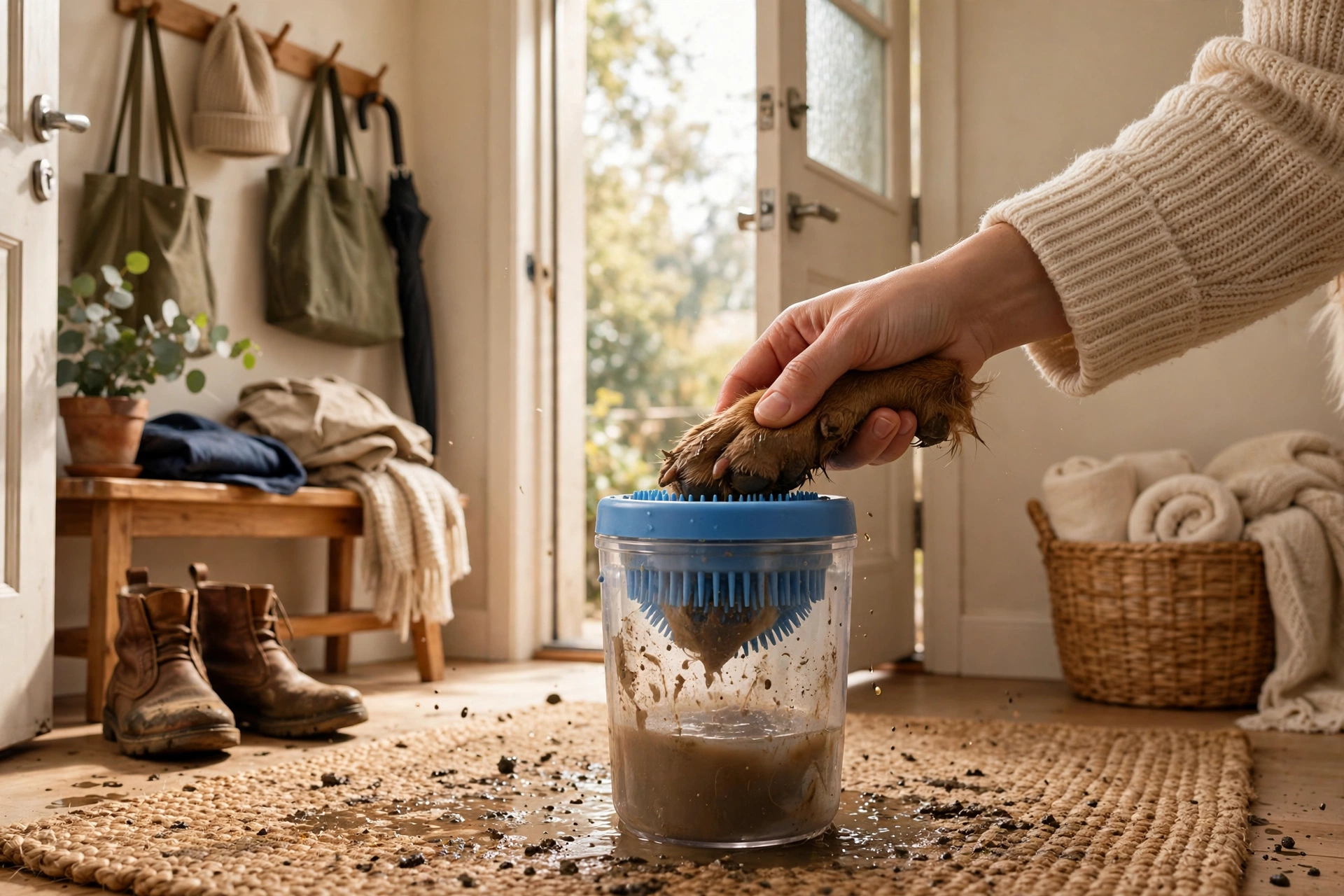
A rainy walk in the city ends the same way every time: four muddy paws, a wet hallway, and paw prints marching across your living room floor. A paw cleaner — a small cup with soft silicone bristles you fill with water and dip each paw into — won't replace a towel, but it removes the grit and mud a towel just smears around. For apartment life, the right one is the one you'll actually use at the door, one-handed, while your dog is still excited to be home.
The verdict up front
- Best for most apartment dogs: Dexas MudBuster (medium). The original paw washer, sized right for beagles to border collies, dead simple to rinse, and usually $15–$20.
- Best for large breeds: Dexas MudBuster (large). Same design with a wider mouth for labs, shepherds, and doodles. Usually $20–$25.
- Best gentle option: Paw Plunger. Softer bristle layout and a lid that doubles as a water cup — good for sensitive or senior dogs. Usually $20–$25.
- Best for full-leg mud: Mud Daddy. A brush-and-bottle combo that handles muddy legs and bellies, not just paws. Usually $30–$40.
If you only remember one thing: size matters more than brand. A cup that's too narrow makes the dog hate it; one that's too wide splashes water everywhere. Measure your dog's paw before you buy — the sizing section below takes 30 seconds.
Head-to-head comparison
| Product | Best for | Usually | Apartment notes |
|---|---|---|---|
| Dexas MudBuster (M) | Most medium dogs, daily rainy walks | $15–$20 | Fits in a tote by the door; bristle insert pops out for a 10-second rinse |
| Dexas MudBuster (L) | Labs, shepherds, large doodles | $20–$25 | Wider mouth avoids paw-squeezing; bulkier to store in a narrow entryway |
| Paw Plunger | Sensitive, senior, or nervous dogs | $20–$25 | Softer bristles; included lid works as a travel water cup; slightly slower per paw |
| Mud Daddy | Muddy legs, bellies, post-park disasters | $30–$40 | Brush head + water bottle in one; overkill for light rain, perfect for mud season |
What each one is actually like to use
Dexas MudBuster (medium)
This is the product that invented the category, and it still outsells everything else for a reason. You fill it about two-thirds with lukewarm water, insert the paw, and twist gently three or four times. The silicone bristles scrub between the toes where mud hides. The medium fits paws roughly 2 to 3.5 inches wide — think beagle, corgi, French bulldog, or a lean border collie. Cleanup is genuinely easy: pull out the bristle sleeve, rinse both parts, and leave it upside down on a towel. In a small entryway it lives happily on a boot tray without taking over.
Dexas MudBuster (large)
Identical design, scaled up. If your dog's paw is wider than about 3.5 inches — most labs, golden retrievers, German shepherds — the medium will feel cramped and your dog will start pulling away, which defeats the whole routine. The large uses more water per fill (about 3 cups versus 2), so keep a small pitcher by the door instead of refilling from the bathroom tap four times. The tradeoff is footprint: it's noticeably bulkier, so measure your entryway shelf before committing.
Paw Plunger
The Paw Plunger takes a gentler approach: the bristles are softer and arranged to be less "grabby," which matters for dogs that flinch at the MudBuster's firmer scrub. It comes with a lid that doubles as a cup, so it's the best pick if you also want something for the car or the dog park. It's a touch slower per paw — plan on an extra 10 seconds each — because the gentler bristles need a few more twists. For senior dogs with tender feet or rescues still building trust, that tradeoff is worth it.
Mud Daddy
Mud Daddy isn't really a paw cup — it's a 2.5-liter-style portable washer with a brush head that sprays as you scrub. When your dog comes home with mud halfway up the legs after a park session, no paw cup will save you; this will. For everyday light rain it's overkill (more water, more parts, more drying), but during mud season or for dogs that swim in every puddle, it's the only option here that handles the whole lower body. Store it in the bathtub or on the balcony between uses, not by the front door.
The 30-second sizing math
Guessing the size is the number-one reason paw washers end up unused in a cabinet. Do this instead:
- Trace the paw. Have your dog stand on a piece of paper and trace the front paw, or press it gently onto the paper. Measure the widest point.
- Add half an inch. The cup's inner diameter should be at least 0.5 inches wider than the paw so the bristles can move. A paw measuring 3 inches needs a cup around 3.5 inches across inside.
- Check depth. The cup should reach just above the wrist joint. Too shallow and dirty water sloshes out; much deeper and you're wasting water on every fill.
The 60-second door routine that makes it stick
A paw cleaner only works if using it is faster than the alternative (chasing a wet dog with a towel). Set up this sequence once and it becomes muscle memory:
- Before the walk: fill the cup two-thirds with lukewarm water and set it on the boot tray by the door. Cold water makes dogs pull away; hot water irritates paws.
- At the door: leash off, dog in a "wait" on the mat. Treat in your left hand, cup in your right.
- Dip and twist: front paws first — insert, three slow twists, lift straight out onto a dry towel. Then the back paws. About 10 seconds per paw once you're practiced.
- Towel finish: one quick pass per paw with a microfiber towel to remove the loosened water. The cup loosens the dirt; the towel removes it.
- Reward and release: treat, then "okay!" and let the dog into the apartment. Dogs that get paid for standing still learn to offer the paw within a week.
- Rinse the cup: dump the dirty water in the toilet or sink, quick rinse, upside down on the tray. Thirty seconds now saves a science experiment later.
Three mistakes that ruin paw washers
2. Never cleaning the cleaner. A cup left with dirty water grows a biofilm that smells like a pond and irritates paws. If it smells, you've waited too long.
3. Expecting it to handle winter salt alone. Paw washers remove grit and surface salt, but road salt in winter needs a dedicated rinse and sometimes a paw balm afterward — especially if your dog is already licking its feet.
FAQ
Is a paw cleaner actually better than just wiping with a towel?
For mud and grit, yes — measurably. A towel smears wet mud around and can't reach between the toes where grit hides. The cup's bristles scrub those crevices with water doing the carrying. Most owners end up using both: the cup for the deep clean, the towel for the final dry. For a merely damp walk with no mud, a towel alone is fine.
Can I use soap or shampoo in the paw washer?
A single drop of gentle dog shampoo is fine for very muddy paws, but plain lukewarm water handles 90% of rainy walks. Soap residue left between the toes can cause itching, so if you use soap, do one extra plain-water dip per paw afterward.
My dog hates having paws touched. Will this work?
Not on day one. Start with an empty, dry cup: treat for sniffing it, treat for one paw resting on the rim, treat for a one-second dip with no water. Build to water over 5–7 short sessions. Dogs that hate paw handling usually object to being restrained, not to the water itself — keep sessions under two minutes and always let the dog pull the paw out freely.
How often should I replace it?
The cup itself lasts years. Replace the silicone bristle insert (or the whole unit, at these prices) when bristles start to splay permanently or the cup retains odor after washing — typically every 12–18 months of daily rainy-season use.