Best Entryway Setup to Stop Dog Door Dashing in Apartments
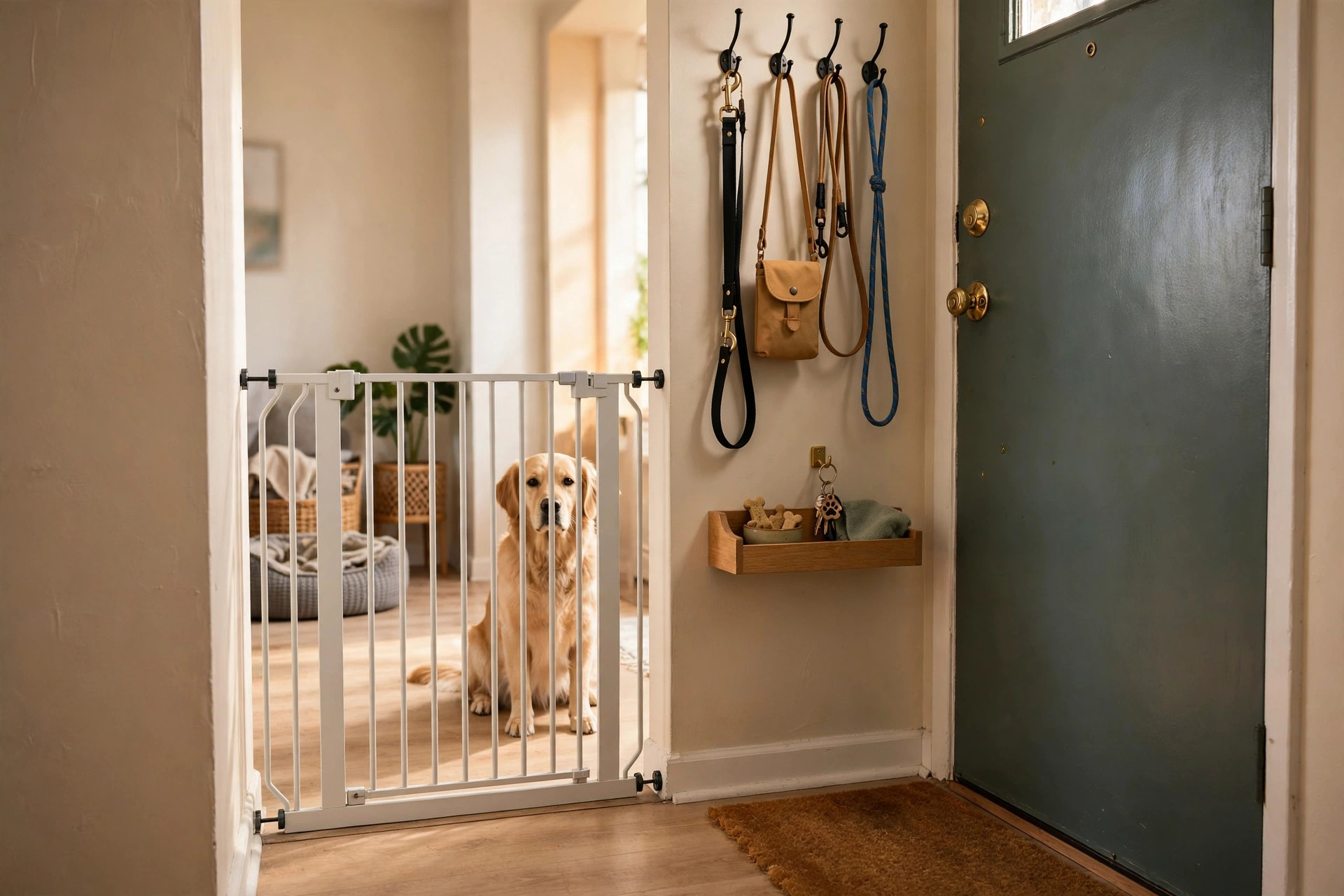
In an apartment, a door dasher doesn't run into a fenced yard — it runs into a hallway, a stairwell, or an elevator lobby shared with strangers and other dogs. Training matters, but training fails at the exact moment you need it most: when your hands are full of groceries and the delivery driver knocks. The reliable fix is physical: a 3-zone entryway that makes dashing structurally difficult while you train the behavior.
The 3-zone entryway
Map your entry as three concentric zones. The dog should never be in Zone 1 — the 3 feet directly inside the door — unless leashed and cued. Everything below serves that rule.
Zone 1 — The threshold buffer (0–3 ft inside the door)
This is the kill zone. Keep it empty: no dog bed, no toys, no food bowl. The emptiness is the point — it gives you a visual line ("paws don't cross the mat edge") and removes every reason for the dog to hang around the door. A cheap washable runner rug here doubles as the boundary marker and catches wet paws. If your entry is a straight shot with no natural barrier, this is where a pressure-mounted gate goes (see the comparison below).
Zone 2 — The holding area (3–8 ft inside the door)
This is where the dog waits during arrivals. It needs exactly two things: a defined "place" (a mat or bed) and a sightline barrier so the dog isn't staring at the door getting aroused. In narrow entries, a freestanding gate angled across the hallway creates this zone without any drilling. The holding area is also where you rehearse door manners — more on the protocol below.
Zone 3 — The gear station (wall, not floor)
Door dashing spikes when you're fumbling. Mount leash, bags, and treats on the wall beside the door — adhesive hooks hold a leash fine, and a small basket at hip height keeps poop bags and a treat pouch grab-ready. The rule: you should be able to leash the dog in under 5 seconds, one-handed, before the door opens. Every second of fumbling is a second the dog spends rehearsing the dash.
- Zone 1 empty: runner rug as the boundary line, nothing else.
- Zone 2 defined: mat/bed + a gate or barrier breaking the sightline.
- Zone 3 stocked: leash, bags, treats reachable in 5 seconds, one-handed.
4 barrier setups compared
Not every entry needs the same hardware. Match the barrier to your layout:
| Setup | Best for | Typical price | Small-space notes |
|---|---|---|---|
| Regalo Easy Step Walk Thru Gate | Standard doorways and hallway mouths 29–34 in wide | Usually $35–$50 | Pressure-mounted, no drilling; walk-through door so you don't climb over it with groceries. |
| Carlson Pet Products Extra Wide Gate | Open-plan entries wider than 36 in | Usually $60–$90 | Expands to about 76 in with extensions; pressure-mounted. The small pet door is useless for medium+ dogs — keep it locked. |
| Richell Freestanding Pet Gate | Renters who can't mount anything; angled hallway barriers | Usually $70–$110 | Stands on its own with feet; folds flat for storage. Tall enough (about 36 in) that most dogs won't jump it, but determined jumpers need a mounted gate instead. |
| Mighty Paw Smart Bell (training bells) | Dogs that dash from demand — scratching/whining at the door | Usually $15–$25 | Not a barrier: a communication tool. Hang on the door, teach "ring = out," and the frantic door-mugging drops because the dog has a polite option. |
Measure before buying: doorway width at the narrowest point, and check whether your door frame has flat trim for pressure pads to grip. Metal frames and uneven trim are the two reasons pressure gates fail — in those cases go freestanding.
The 2-week door protocol
Hardware buys you safety; this buys you a dog that doesn't test the hardware. Ten minutes a day, fourteen days:
Days 1–4: mat = treats. Put the Zone 2 mat down, reward the dog for any interaction, then for lying on it. Build to 30 seconds of settled lying with treats delivered between the paws every 5–10 seconds. No door involved yet.
Days 5–8: add the door. Dog on mat, you touch the doorknob — treat. Turn the knob — treat. Crack the door an inch — treat for staying. Close it. Repeat 8–10 reps per session. If the dog breaks, you went too fast: close the door, reset, make it easier.
Days 9–12: add a person. Have a friend knock. Dog holds the mat while you open the door fully and greet the person. This is the real-world rep — most dashing happens at guest arrivals, not random moments.
Days 13–14: proof it. Groceries in hand, leash on the dog as a safety backup, open the door like real life. Reward the hold, then release with a cue ("okay, let's go") so the dog learns waiting ends with permission, not with sneaking.
Keep the gate up for at least a month after the dog "gets it." Behavior that's only two weeks old isn't trained — it's rehearsed. The gate is what lets you rehearse safely.
Renter-safe installation notes
- Pressure-mounted gates leave only small rubber-pad marks; put felt pads behind the pressure points and you'll get your deposit back.
- Freestanding gates need a wall or furniture on at least one side to wedge against in narrow halls — test the wobble before trusting it.
- Adhesive hooks (large Command strips) hold a leash and treat pouch fine; they're for gear, not restraint.
- Door draft stoppers do double duty: they block the light-gap under the door that some dogs fixate on, and they cut hallway noise that triggers alert barking at the threshold.
FAQ
My dog jumps every baby gate. Now what?
Switch from freestanding to a pressure-mounted gate at least 36 inches tall, mounted in a doorway (not spanning an open room) so there's no run-up. And check the real cause: dogs usually jump gates from under-exercise or barrier frustration. A tired dog with a frozen Kong behind the gate rarely bothers jumping it.
Won't the dog just dash when the gate is open for me to pass?
That's what the training protocol is for — the gate is the backup, the mat behavior is the plan. In the meantime, pass through with the leash already clipped: gate opens, you step through, gate closes, then unclip. Awkward for two weeks, automatic after.
Is it okay to use the crate as the holding area instead?
Only if the dog already loves the crate. Stuffing an aroused dog into a crate at every doorbell will poison the crate fast. A mat in Zone 2 keeps the crate as a rest place, not a containment tool.
How long before I can take the gate down?
Plan on 6–8 weeks minimum, and only remove it when the dog holds the mat through 10 consecutive real-life door events (guests, deliveries, you leaving). Many owners keep a gate permanently — it's also useful for contractors, open windows, and visiting dogs.