Apartment Dog Emergency Kit Checklist for City Pet Owners
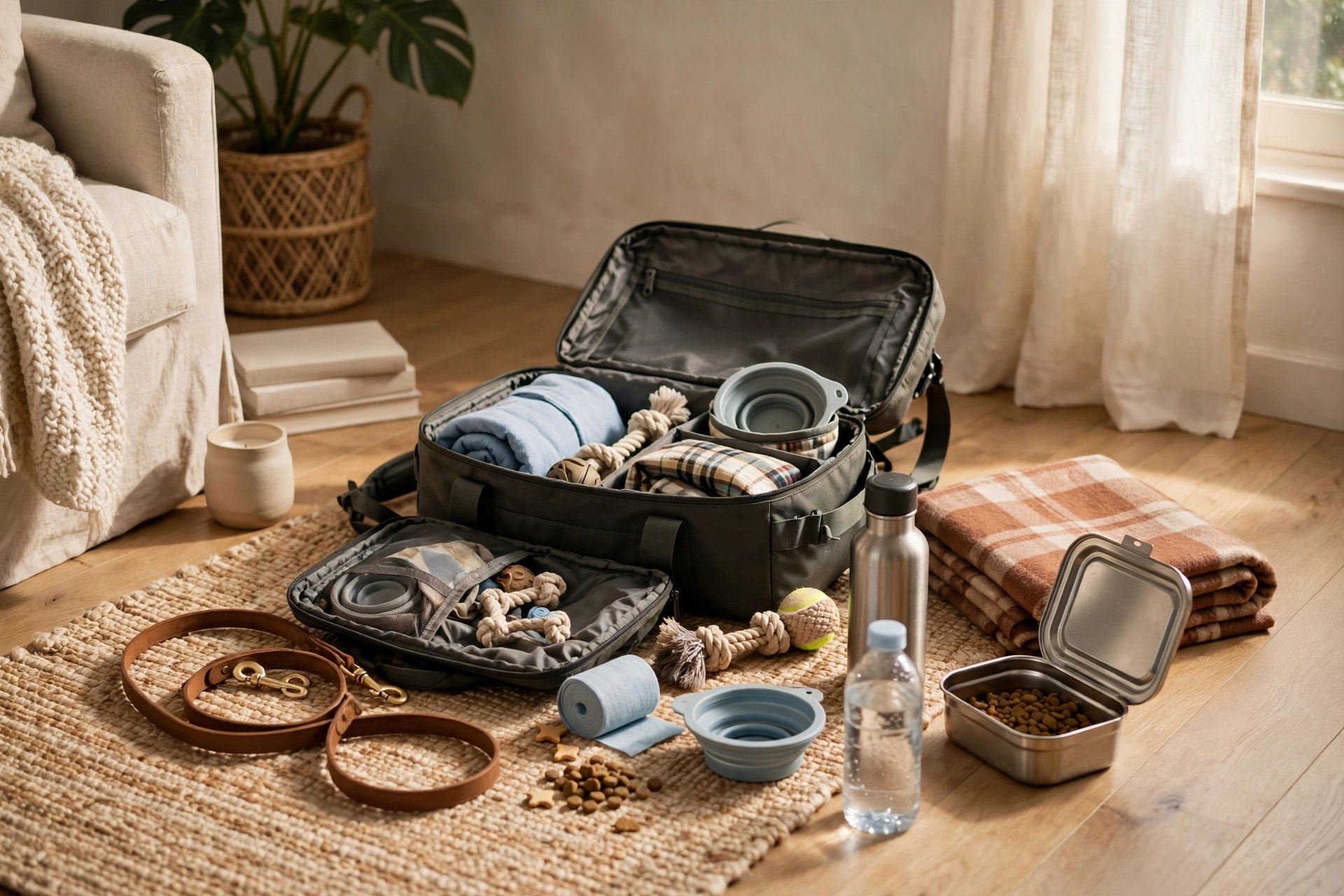
City emergencies look different from suburban ones: high-rise evacuations down 20 flights of stairs, elevators out of service, shelters that may not take pets. This guide builds your dog's kit in about 45 minutes, with exact quantities for 72 hours of self-reliance and storage spots that work in a small apartment.
Start with the 72-hour rule
Emergency agencies generally recommend 72 hours of self-reliance. For a dog, that translates into concrete numbers:
- Food: 3 days of rations + 1 extra day. If your dog eats 2 cups a day, pack 8 cups in a sealed bag, and rotate it every 2–3 months so it stays fresh.
- Water: roughly 1 ounce per pound of body weight per day. A 40-lb dog needs about 120 oz (just under a gallon) per day — pack at least 2 gallons plus a collapsible bowl.
- Meds: a 7-day supply of any daily medication, plus a written dosing card. Pharmacies may be closed; your memory under stress is unreliable.
Minutes 0–10: Documents and identification
Do this first — it is the part people skip, and the part shelters and vets ask for.
- ☐ Vaccination records (photo on your phone and a paper copy in a zip bag — phones die)
- ☐ A recent photo of you with your dog, printed or saved offline (proves ownership if you are separated)
- ☐ Vet's phone number and the nearest 24-hour emergency vet address, written on paper
- ☐ Microchip number and registry phone number
- ☐ Two emergency contacts who can take the dog, with keys or access arranged in advance
Minutes 10–25: Food, water, and containment
- ☐ 4 days of kibble in a sealed, labeled bag (rotate every 2–3 months)
- ☐ 2 gallons of water in sturdy jugs (rotate every 6 months)
- ☐ Collapsible food and water bowls (they pack flat — critical in small apartments)
- ☐ Slip lead + backup flat leash (a slip lead works even if the collar comes off)
- ☐ A carrier or crate the dog can actually ride in — for small dogs, a soft carrier; for large dogs, know your building's pet evacuation policy now, not during the alarm
- ☐ 3–4 poop bags per day × 4 days, plus a small trash bag roll
Minutes 25–35: Medical and comfort
- ☐ 7-day medication supply with written dosing instructions
- ☐ Basic first-aid: gauze, self-adhesive wrap, antiseptic wipes, tweezers (for ticks/debris), styptic powder
- ☐ A familiar-smelling blanket or worn t-shirt — scent is a powerful calm signal in chaotic environments
- ☐ A long-lasting chew (bully stick, frozen Kong) for stressful waiting periods
- ☐ Puppy pads (even for adult dogs — if you are stuck on a high floor with no outdoor access, these are gold)
Minutes 35–45: Pack the go-bag and place it
Everything above goes into one bag — a duffel or backpack — that lives in a single, fixed spot. In a small apartment you have three realistic options:
- Inside the coat closet by the front door. Best option: you grab it on the way out during an evacuation.
- Under the entryway bench or shoe rack. Works if closet space is tight; keep it visible, not buried.
- In the car trunk (if you have one). Acceptable backup, but useless for a building evacuation when you cannot reach the garage.
High-rise realities most checklists ignore
Apartment emergencies have specific failure modes. Plan for these now:
- Elevators out: practice carrying your dog down stairs (or walking a large dog down calmly) at least once. A 70-lb dog panicking on a stairwell landing is a situation you want to rehearse, not discover.
- Stairwell doors: many lock behind you. Know whether yours do, and where the re-entry floors are.
- Shelter pet policies: look up now whether your city's emergency shelters accept pets, and which ones do. Save the addresses offline.
- Power outage + high floor: no elevator, no water pressure above certain floors. Your stored water covers this.
- Window stickers: a "pets inside" decal on your front door or window tells firefighters an animal is in the unit. They cost a few dollars.
The 10-minute quarterly refresh
A kit rots silently. Four times a year, spend 10 minutes: swap the kibble bag, check water jugs, confirm meds are not expired, verify the photo and vet number are current, and re-fit the collar. Tie it to something you already do — the first day of each season works.
What not to pack (common mistakes)
- The entire pantry. A 20-lb bag of kibble is not a go-bag. Pack 4 days; shelters and stores restock.
- Anything needing refrigeration or cooking. Raw food, frozen toppers, and anything you have to prepare are dead weight in an outage.
- Your dog's favorite huge bed. Pack the small travel blanket instead. Space in a go-bag is for survival, not comfort maximalism.
- Unfamiliar gear. If the dog has never worn the emergency harness or eaten the emergency kibble brand, test both on a normal weekend first. Emergencies are not the time for surprises.
Run a 20-minute practice drill
A kit you have never used is a theory. Once, on a calm Saturday:
- Set a timer for 20 minutes. Pretend the fire alarm just went off.
- Grab the go-bag, leash the dog, and walk your actual evacuation route — stairs included.
- Time how long it takes and note every friction point: bag too heavy, leash tangled, dog balked at the stairwell door.
- Fix one thing after the drill. The drill is not about speed; it is about discovering the one stupid problem (a stuck zipper, a dead flashlight) while it is still cheap to fix.
FAQ
How much food should I actually store?
Four days at your dog's normal daily ration, sealed and labeled with the pack date. Rotate it into daily use every 2–3 months and pack a fresh bag — stale emergency kibble that your dog refuses to eat is not emergency food.
What if my building doesn't allow pets in stairwells during evacuation?
Check your lease and building emergency plan now. Most jurisdictions require allowing service animals; for pets, policies vary. Knowing the rule in advance lets you plan alternatives (a friend on a lower floor, a carrier that draws less attention) instead of arguing during an alarm.
Should the kit be different for a puppy vs. a senior dog?
The core is the same, but add puppy pads and extra cleaning supplies for puppies, and add joint medication, a sling or towel for stair carries, and a warmer blanket for seniors. Senior dogs chill faster in stressful situations.
Is a paper copy of documents really necessary?
Yes. Phones die, screens crack, and cell networks congest during real emergencies. A zip-lock bag with one page of records weighs nothing and works when nothing else does.