Best Pet Food Storage Containers for Small Kitchens
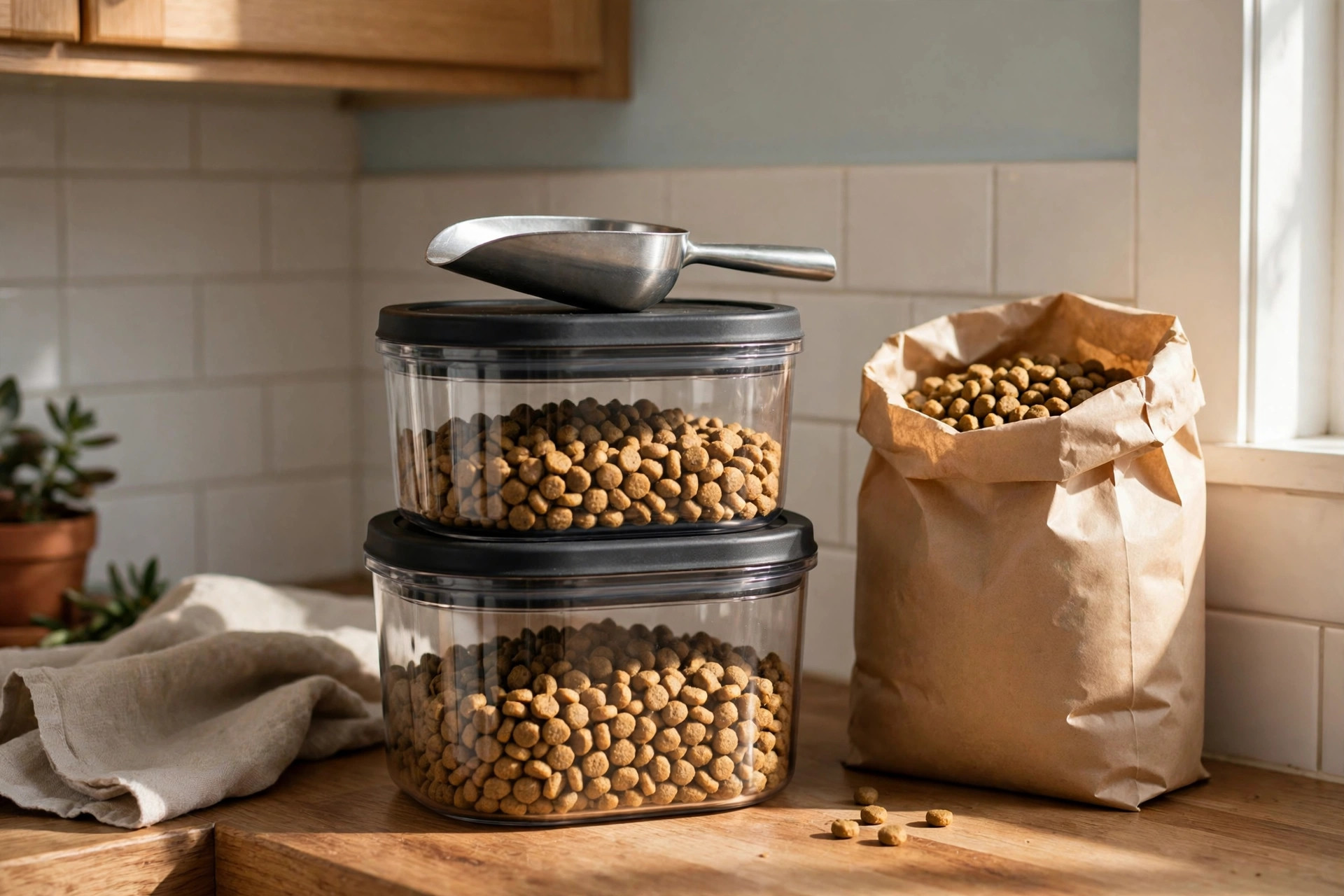
An open bag of kibble starts going stale the day you open it. The fats coating every kibble oxidize in air, the smell that made your dog enthusiastic fades within weeks, and in an apartment kitchen the open bag is also an invitation — to pantry moths, to humidity, to the cat that has learned to chew through the corner. An airtight container solves all of it at once, and in a small kitchen it doubles as the difference between a tidy corner and a permanent kibble bag slumped against the wall.
- Airtight is the whole product. A decorative canister with a loose lid is a kibble display case, not storage.
- Keep the kibble in its original bag inside the container — you keep the lot number for recalls and the bag’s fat barrier.
- Buy the container to match the bag size you actually buy, not the bag you aspire to. A 30-lb bag needs roughly 10 gallons of container.
- Stackable, square containers beat round ones in small kitchens — they use corner space instead of wasting it.
- Opened kibble stays fresh about 6 weeks. If the bag lasts longer than that, you are buying too big a bag.
Four containers worth the counter space
Every container below is a real, widely sold product with a genuine airtight seal — no decorative tins, no “farmhouse style” props. Prices are typical street prices.
| Container | Best for | Usually | Apartment note |
|---|---|---|---|
| IRIS USA Airtight Pet Food Container | Most kitchens | $20–$35 | 2-pack with snap latches and scoop; slim profile fits narrow gaps |
| Gamma2 Vittles Vault | Maximum freshness | $25–$45 | Gamma Seal lid spins airtight; stackable; keeps pests out completely |
| Buddeez Pet Food Dispenser | Daily pouring | $20–$30 | Bag-in design with pour spout; no scooping, no spills |
| simplehuman Pet Food Can | Design-conscious homes | $90–$130 | Lock-tight handle, fingerprint-proof steel; the buy-it-for-life option |
IRIS USA — the default pick
The container you see in half of America’s kitchens for a reason: a genuinely airtight snap-latch lid, BPA-free plastic, a slim rectangular footprint that slides into the six-inch gap between the fridge and the counter, and a two-pack (large plus small) that covers kibble and treats in one purchase. The included scoop lives on a lid clip instead of disappearing into the kibble. It is not the most airtight seal on this list — the Vittles Vault wins that — but it is airtight enough, stackable, and priced so reasonably that there is no excuse for the open bag anymore.
Gamma2 Vittles Vault — the freshness pick
The Gamma Seal lid is the real deal: a threaded ring that spins down onto a silicone gasket, creating a seal closer to a mason jar than a storage bin. If you buy premium kibble with high fat content (the stuff that goes rancid fastest), this is the container that protects the investment. It is also the most pest-proof — pantry moths and determined cats both fail against the threaded seal — and the stackable square shape uses kitchen corners efficiently. The lid takes two hands to open, which is mildly annoying at 6 a.m. and completely worth it.
Buddeez — the daily-use pick
The cleverest design for people who actually feed twice a day: the whole kibble bag drops inside, and a pour spout on top dispenses like a cereal dispenser — no scooping, no digging, no kibble on the counter. The two-way seal keeps things fresh while the spout makes portioning fast and consistent, which matters for multi-pet homes where everyone gets a measured amount. The footprint is taller than the IRIS, so measure under-cabinet clearance before buying; it needs about 18 inches of height.
simplehuman Pet Food Can — the lifetime pick
Yes, it costs as much as a month of premium kibble. What you get: a lock-tight handle that seals with a press, fingerprint-proof stainless steel that looks like it belongs in a designed kitchen rather than a garage, an inner bucket that lifts out for washing, and a magnetic scoop that docks under the lid. For the small apartment where the pet food container lives in visible space — no pantry, no utility closet — the simplehuman earns its price by not looking like pet food storage at all. Buy it once, use it for a decade.
The freshness science: why the bag-in-container method wins
Two facts drive the whole storage question. First, kibble is coated in fats that oxidize on contact with air — that is what “stale” means, and it starts immediately. An airtight container slows oxidation dramatically but cannot reverse it, which is why the 6-week rule exists: buy bag sizes your pet finishes within about six weeks of opening. A single cat eating a cup a day goes through roughly 10 pounds in six weeks — that 30-pound “value” bag is false economy.
Second, the original bag is itself a engineered barrier — most premium kibble bags have a fat-resistant inner lining that a bare container does not replicate. The best practice, recommended by veterinary nutritionists, is bag-inside-container: roll the opened bag closed, drop the whole thing in the airtight bin. You get the bag’s barrier plus the container’s seal, and you keep the lot number and best-by date for recall situations. Pouring kibble loose into the container looks tidier and performs worse on both counts.
- 10 lbs of kibble needs roughly a 12-quart / 3-gallon container — fits inside most lower cabinets.
- 20 lbs needs about 6–7 gallons — a slim tall bin beside the fridge.
- 30+ lbs needs 10+ gallons — honestly reconsider the bag size unless you have multiple large dogs.
- Treats deserve their own small airtight jar, not the kibble bin — every opening of the big bin costs freshness.
The pantry-moth problem (and the cat problem)
Apartment kitchens share walls, and pantry moths share apartments — once they find an open kibble bag, they colonize every grain product in the kitchen. An airtight container is the single most effective moth prevention there is, more reliable than traps or sprays. The same seal defeats the other kitchen pest: the cat that has learned to nose open cabinet doors and chew through bag corners at 4 a.m. A latched or threaded container ends that game permanently, which is worth the price on sleep quality alone.
One more hygiene note: wash the container — or at least the scoop and the inner bucket — between bags. Old kibble dust and fat residue at the bottom goes rancid and contaminates the fresh bag poured on top. A quick wash every bag change takes two minutes and resets the freshness clock properly.
The feeding station is the other half of this setup: container for storage, station for serving. Together they turn the most chaotic corner of a small kitchen — the slumped kibble bag, the spilled scoop, the cat performing bag surgery — into the tidiest one. Future you, refilling the bowl at 6 a.m. with dry hands and no sweeping, will be grateful.
FAQ
Can I store wet food in these containers?
No — these are for dry kibble and treats only. Opened wet food belongs in the refrigerator in a covered glass container or silicone can cover, and it keeps 2–3 days. Unopened cans are shelf-stable wherever you keep cans; they do not need a pet-specific container at all.
Is it safe to pour kibble directly into the plastic container?
It is common and not dangerous, but the bag-in method is better: you keep the fat-barrier lining, the lot number for recalls, and you avoid fat residue building up on the plastic over months. If you do pour directly, wash the container thoroughly between every bag — no exceptions.
My container smells stale even when empty. Is it ruined?
Probably not — that is oxidized fat residue in the plastic. Wash with hot water, dish soap, and a tablespoon of baking soda, let it air-dry completely in sunlight if possible, and the smell usually lifts. If the plastic itself has gone tacky or discolored after years, replace it; plastic does eventually absorb enough fat to retire.
Do I need a separate container for each pet’s food?
If the pets eat different formulas — very common in multi-pet homes — yes, or at minimum clearly separated and labeled. Mixing formulas defeats the point of buying the prescription or life-stage diet in the first place. Two slim IRIS bins side by side take up barely more space than one wide one.