Best Automatic Cat Feeders for Small Apartments
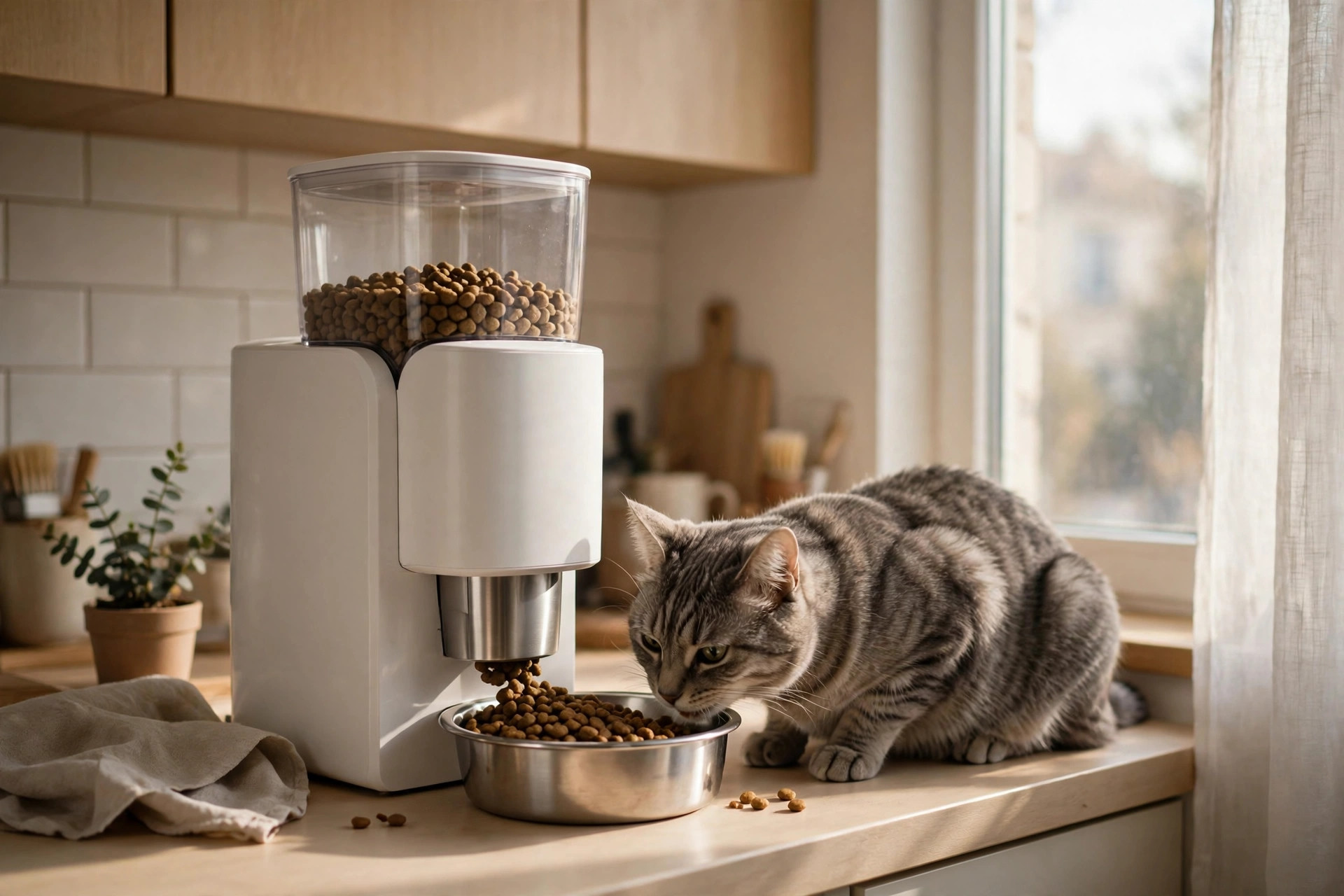
An automatic feeder ends the 5 a.m. wake-up paw to the face — but in a 500-square-foot studio, a feeder with a loud dispensing motor just trades one alarm clock for another. The right feeder for apartment life is judged on what happens at dawn: dispense noise through thin walls, permanent counter footprint, and whether breakfast still arrives when the building’s power flickers.
- Dispensing noise matters more than hopper capacity: a brief motor whir at 5 a.m. carries through thin walls.
- Budget roughly $70–$150 for a reliable app-controlled feeder; simple timer feeders start around $50, and microchip-selective models run $160–$210.
- Battery backup is non-negotiable. Feeders without it miss meals the moment the power blips — and apartment buildings blip.
- Almost all dispenser feeders handle dry kibble only. Wet-food feeding needs a timed compartment feeder with ice packs, and even those top out around 10–12 hours.
- A feeder schedules meals; it does not fix overeating by itself. Portion math is still your job.
The 5 a.m. test: why dispensing noise is the #1 spec
Feeder reviews obsess over hopper size and app features. Apartment owners who actually live with these machines talk about something else: the sound of kibble hitting a hard bowl at dawn, ten feet from where they sleep. Here is how to think about feeder noise before you buy:
- Two noise sources, not one. The motor’s whir during dispensing lasts only a few seconds, but kibble rattling into a stainless or hard-plastic bowl is surprisingly loud in a quiet room. A silicone mat under the bowl, or a feeder with a softer bowl insert, takes the edge off the part you actually hear.
- Distance is the cheapest soundproofing. In a studio you cannot put twelve feet between the feeder and the bed, but you can keep it out of the sleeping corner — a kitchen nook or entryway beats bedside. Closed bathroom doors also work as an overnight feeder closet in a pinch.
- The schedule matters as much as the machine. A feeder dispensing at 5:30 a.m. just automates your old alarm. Shift the first meal toward 7:00 over a week; most cats adjust.
- Slow-dispense modes spread the noise out. Feeders that trickle portions over 10–15 minutes are gentler minute-by-minute near a bedroom, but the motor runs longer overall. Pick which noise you prefer.
5 feeders ranked for small-apartment life
Every model below is a real, widely sold feeder with a long track record in cat homes. Prices move with sales, so treat the ranges as typical street prices. All five have battery backup — models without it did not make the list.
| Model | Best for | Typical price | Small-apartment note |
|---|---|---|---|
| PETLIBRO Granary Automatic Feeder | The all-rounder most owners buy | Usually $70–$100 | Wi-Fi app with flexible scheduling, voice-recorded meal call, and battery backup. The 5L hopper feeds one cat for roughly 3–4 weeks. Dispensing motor is audible but brief; the tall hopper needs about a square foot of counter. |
| Catit PIXI Smart Feeder | Tight counters and style-first kitchens | Usually $90–$120 | Noticeably smaller footprint than the big hoppers, with app scheduling and a clean design that does not scream “pet appliance.” Smaller capacity (~1.2 kg of kibble) means refilling every week or so with one cat — a fair trade for the space saved. |
| WOPET Automatic Cat Feeder | Tight budgets, no app needed | Usually $50–$70 | Old-school LCD panel and button scheduling — no Wi-Fi to configure or app to maintain. Large hopper and battery backup for the price. The interface feels dated, and portion steps are coarser than app models, but it reliably dispenses. |
| PetSafe Healthy Pet Simply Feed | Cats that inhale their meals | Usually $90–$130 | The standout feature is Slow Feed mode: it trickles a meal out over 15 minutes instead of dumping it, which genuinely helps gobblers. Holds up to 12 meals. Conveyor mechanism handles larger kibble shapes well. Bulkier base than the slim hoppers. |
| SureFeed Microchip Pet Feeder Connect | Multi-cat homes and prescription diets | Usually $160–$210 | Opens only for the registered cat’s microchip — the fix when one cat steals the other’s food or needs a prescription diet. Battery-powered and whisper-quiet (no dispensing motor at all). Caveat: it is portion access, not scheduled feeding — you still fill it yourself, and each unit serves one cat. |
Our take: the PETLIBRO Granary is the safest default — app scheduling, voice recording, and a hopper big enough to forget about for weeks. Pick the Catit PIXI if counter space is the constraint, the WOPET for the cheapest reliable timer, the PetSafe Simply Feed for gobblers, and the SureFeed when the problem is which cat eats.
Wet food vs. dry food: the cooling reality
This is where expectations most often collide with physics. Nearly every hopper-style automatic feeder — everything in the table above except the SureFeed — handles dry kibble only. Wet food clogs augers, smears sensors, and spoils in an unrefrigerated hopper within hours. If your cat eats wet food, you have two honest options:
- Timed compartment feeders with ice packs. Models like the Cat Mate C500 (usually $45–$60) open one covered compartment at a time on a timer, with ice packs underneath keeping wet food safe for roughly 10–12 hours. That covers a workday, not a weekend trip. The trade-off: only 5 compartments, and you are refreezing ice packs daily — make sure you have freezer space in a small apartment fridge.
- The hybrid routine. A dry-food dispenser handles scheduled daytime meals while you serve wet food by hand morning and evening. Many apartment owners land here: the feeder covers the long workday gap, wet food stays fresh and supervised, and the ice-pack logistics disappear entirely.
Footprint, power, and placement in a small kitchen
A feeder is a permanent countertop resident, so treat it like furniture, not a gadget. A 5L hopper occupies roughly a 10×10-inch square — about the footprint of a small microwave turned sideways. Before buying, tape that square on your counter and live with it for a day; in a galley kitchen it is a real commitment. A few placement rules that matter more in small homes:
- Outlet first, spot second. App feeders need constant power plus battery backup for outages. Do not stretch a cord across a walkway — it is a trip hazard and a chew temptation. Plan the outlet, then the square of counter next to it.
- Keep food and water apart. Cats instinctively prefer water sources away from food — ideally in a different area entirely. If you are setting up a feeding corner, put the water fountain across the room, not next to the hopper.
- Anchor against tipping. Determined cats rock lightweight feeders. Push the unit against a wall or backsplash, and consider the anti-slip mat most brands sell — kibble avalanches across a small kitchen floor get old fast.
- Two cats, one feeder? It works only if both cats eat the same food at the same pace. If one is a gobbler and the other grazes, the gobbler finishes both portions — that is exactly what the microchip SureFeed exists to solve. For a full feeding-zone layout, see our small-kitchen feeding station guide.
Portion math: the feeder schedules, you decide
A feeder dispenses exactly what you program — which only helps if the program is right. The most common feeder failure is not mechanical; it is months of eyeballed portions. The math takes five minutes:
- Start from calories, not scoops. An average indoor cat needs roughly 200–250 kcal per day (your vet can pin this down for your cat’s weight and age). Typical dry food runs 350–450 kcal per cup — so a 400 kcal/cup food means about half to two-thirds of a cup per day, total.
- Split into 3–4 small meals. This is the real win of automation: four small meals keep energy steadier and reduce the 5 a.m. desperation that caused the problem in the first place. Most app feeders support up to 6–10 meals a day.
- Weigh, don’t scoop, for the first month. A kitchen scale ($10–$15) removes all guesswork while you learn what your feeder’s “portion 3” actually weighs. After a month you will know it by heart.
- Re-check monthly. Weigh the cat monthly (step on a bathroom scale holding the cat, then without). If weight creeps up, trim 10% of daily calories and reassess in a month — small, patient adjustments beat crash diets.
FAQ
Will an automatic feeder make my cat overeat?
Only if you program it to. A feeder dispenses fixed portions on a fixed schedule, which usually means less food than free-feeding from a full bowl all day. The risk is setting portions by guesswork — do the calorie math once, weigh portions for the first month, and the feeder becomes a weight-management tool rather than a risk.
What happens to scheduled meals during a power outage?
On feeders with battery backup (all five in this guide), scheduled meals continue normally on batteries until power returns — swap the batteries every 6–12 months so they are fresh when needed. Feeders without backup simply miss meals during an outage, which is why backup was a requirement for this list.
Can any automatic feeder handle wet food?
Hopper-style dispensers cannot — wet food jams them and spoils. Timed compartment feeders with ice packs (like the Cat Mate C500) handle wet food for about 10–12 hours, enough for a workday. For longer absences, a pet sitter is still the answer; no feeder keeps wet food safe for a full weekend.
My cat wakes me at 5 a.m. for food. Will a feeder actually fix that?
Usually yes, within one to two weeks: the cat learns food comes from the machine, not from harassing you. Keep the bedroom door closed during the transition so early-morning lobbying earns nothing.