Best Air Purifier for Litter Box Smell in a Studio
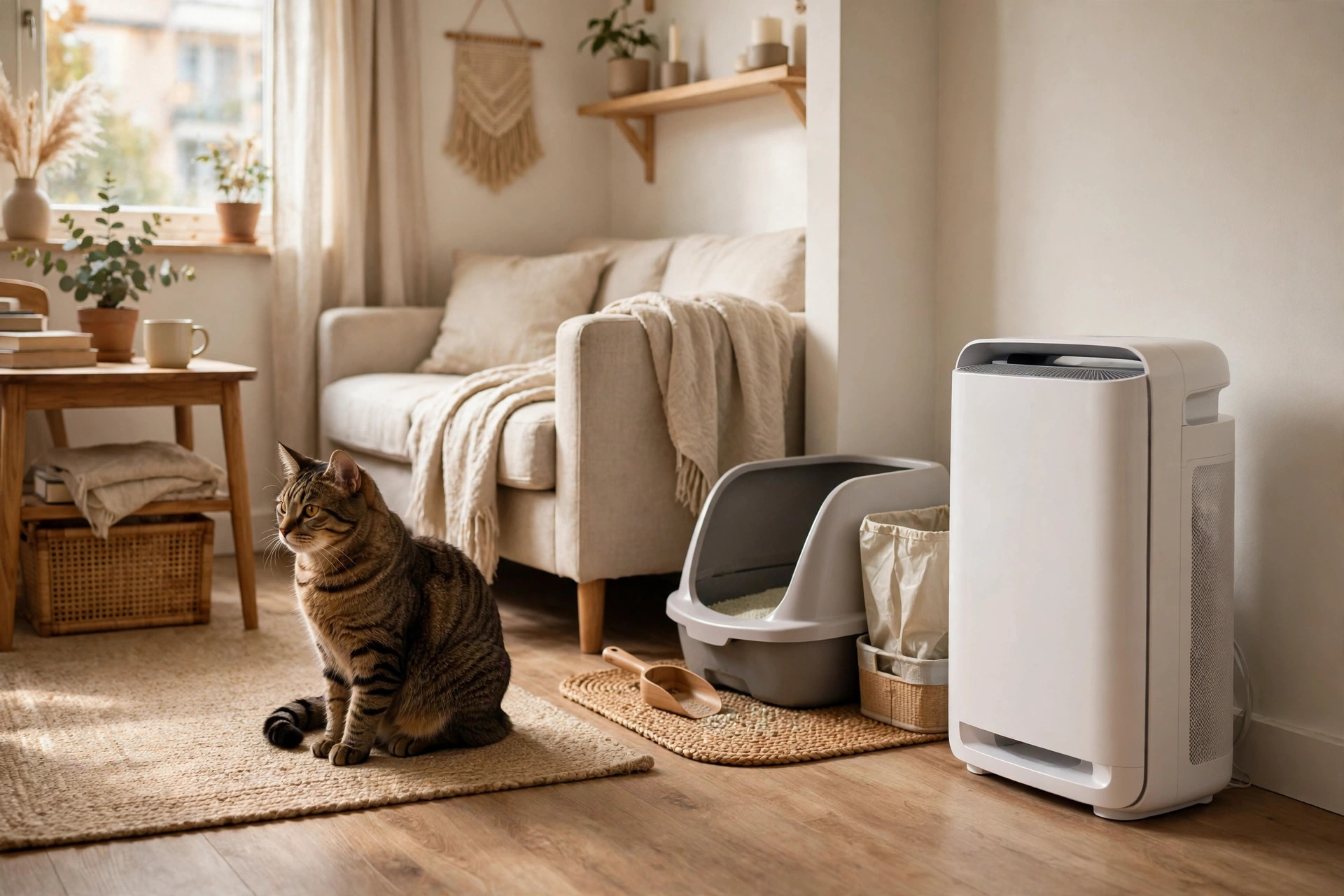
In a studio apartment, your litter box sits roughly six feet from your bed, your couch, and your dinner table — sometimes all at once. An air purifier cannot replace scooping, but the right one, placed correctly, is the difference between “I smell it the second I walk in” and “wait, you have a cat?”
Why studios are the hardest room to deodorize
It is not your imagination — studios are objectively the worst-case scenario for litter odor, and the physics explains why:
- One shared air volume. A 450 sq ft studio with 8-foot ceilings holds roughly 3,600 cubic feet of air, and all of it is shared. In a two-bedroom, a closed door cuts odor migration dramatically. In a studio, there is no door.
- Two kinds of stink. Litter odor is gases (mainly ammonia) plus fine dust. A HEPA filter catches the dust; gases pass straight through it. Only an activated-carbon filter adsorbs gases — a purifier without real carbon is a dust filter with good marketing.
- Air changes matter more than room ratings. Manufacturers’ “covers up to X sq ft” claims usually assume one or two air changes per hour. For odor control you want four to five air changes per hour in the space — which means sizing up, not buying exactly to spec.
- True HEPA filtration plus a substantial activated-carbon filter — carbon weight matters more than brand name.
- A CADR (clean air delivery rate) rated for at least your studio’s square footage; bigger is better for odor.
- A genuinely quiet sleep mode, ideally around 24–26 dB, since the machine sits near your bed.
- Replacement filters you can afford: check the filter price before you fall in love with the machine.
Four purifiers that work next to a litter box
These are established models with real carbon filters and honest coverage specs — the two things that actually move the needle on litter smell.
| Model | Best for | Typical price | Studio note |
|---|---|---|---|
| Levoit Core 300S | Small studios on a budget | Usually $90–$150 | Strong for ~200 sq ft; size up or run two in larger studios. |
| Levoit Core 600S | Large studios and open layouts | Usually $200–$300 | High CADR for ~600 sq ft; app plus air-quality display. |
| Winix 5500-2 | Odor plus dander combo | Usually $160–$250 | Washable pre-filter; PlasmaWave can be switched off. |
| Coway Airmega 150 | Set-and-forget simplicity | Usually $150–$230 | Compact cube for ~300 sq ft; clear filter indicator. |
Levoit Core 300S — the budget starter
The 300S is the best-selling purifier in its class for a reason: it is quiet (Levoit rates sleep mode at 24 dB), compact enough for a nightstand, and the replacement filters are among the cheapest from a major brand. The honest limitation is coverage — it is happiest in spaces around 200 sq ft. In a 400+ sq ft studio, either size up to the 600S or accept that one 300S handles the sleeping zone while odor lingers near the kitchen. For a small studio with the box near the bed, it is the price-to-quietness winner.
Levoit Core 600S — the big-studio workhorse
If your studio pushes past 400 sq ft or has an open kitchen-living layout, the 600S’s much higher CADR earns its price. The onboard air-quality display is genuinely useful in a studio: you will watch the particle reading spike after scooping and fall as the carbon does its work, which teaches you more about your air than any review. The app lets you schedule higher fan speeds while you are at work and quiet mode overnight. Replacement filters cost more than the 300S’s — budget for it.
Winix 5500-2 — the odor-and-dander combo
The 5500-2 pairs a true HEPA filter with a real activated-carbon sheet, and its washable pre-filter catches cat hair before it reaches the expensive filters — a small thing that stretches filter life noticeably in pet homes. It covers around 360 sq ft, the sweet spot for most studios. About the PlasmaWave feature: Winix states it produces no harmful ozone, and it can be switched off entirely. If you are cautious, turn it off — the HEPA plus carbon do the real odor work anyway.
Coway Airmega 150 — the simple cube
Coway’s smaller Airmega is the “I don’t want to think about it” pick: compact square footprint that tucks beside a litter cabinet, a clear filter-replacement indicator, and straightforward controls with no app to configure. Coverage around 300 sq ft suits the average studio. It lacks the air-quality display of the Levoit 600S, so you run it on a schedule rather than by the numbers — medium during the day, low at night, and it simply works.
Placement beats power: the 3-foot rule
A $300 purifier across the room loses to a $120 purifier next to the box. Odor is strongest at the source, so capture it there:
- Within about 3 feet of the litter box — not across the room, not in the hallway. Close enough that box air reaches the intake before it mixes into the whole studio.
- Give it breathing room. Most purifiers need roughly 1–2 feet of clearance on their intake sides. Shoved inside a cabinet, even a great machine barely circulates.
- Keep it low. Litter dust settles downward and the box sits on the floor; a purifier at box height or on a low stand captures more than one on a tall shelf.
- Run it constantly. Purifiers only clean air passing through them. In a studio, turning it off lets odor rebuild noticeably within the hour — medium 24/7, low overnight.
Change the carbon filter on schedule, not when you remember. In a studio with a litter box six feet from your pillow, a saturated carbon filter can start releasing trapped odors back into the room — usually every 6 months, sooner if you notice it “working less” than it used to.
FAQ
Will an air purifier eliminate litter box smell completely?
No — and distrust anyone who says otherwise. A good purifier with real carbon cuts airborne odor roughly in half or more between scoops, but the box itself still needs daily scooping. Think of the purifier as the cleanup crew, not the janitor.
HEPA or carbon — which matters more for odor?
Carbon, by a mile. HEPA traps dust and dander particles; gases like ammonia pass straight through it. For smell, the weight and quality of the activated-carbon filter is the specification that counts.
Should it run all day, or just after scooping?
All day on low or medium. Odor rebuilds continuously — from the box, from the trash, from the cat itself — and a purifier only works on air moving through it right now. Constant low beats occasional turbo.
Is the Winix PlasmaWave feature safe around cats?
Winix states the feature produces no harmful ozone levels, and it can be turned off with a button press. If you prefer zero doubt, run with it off — in odor testing the HEPA and carbon filters do the heavy lifting regardless.