How to Stop Litter Box Smell in a Small Apartment
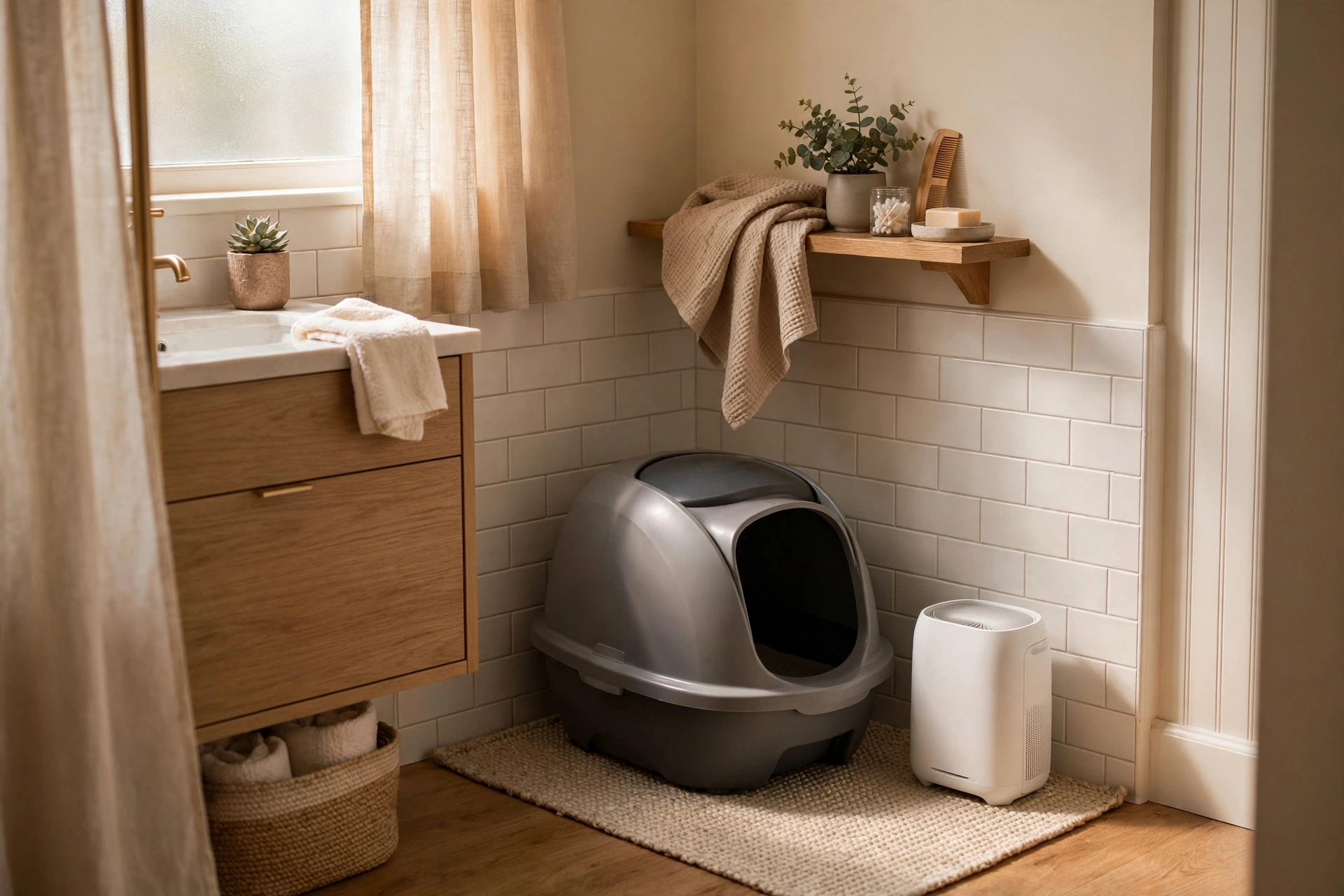
Most odor advice tells you to buy something. But in a small apartment, the smell usually comes from one of six specific sources — and buying an air purifier won't help if your actual problem is a box that's been "topped off" for two months. Run this 2-minute odor audit first, fix the sources in ranked order, and you'll know exactly which purchases (if any) are worth it.
Step zero: the 2-minute sniff test
Leave your apartment for 10 minutes — nose blindness is real, and you can't audit what you can't smell. Come back in and walk this route, sniffing deliberately at each stop:
- The front door. What hits a guest first? If you smell litter here, the problem is airborne and apartment-wide.
- One foot from the box. Sharp ammonia sting means urine isn't being neutralized — a litter or depth problem.
- The box itself, lid off. Sour, musty, or "old" smell right after scooping means the litter is saturated and needs a full change, not more scooping.
- The floor around the box. Get low. If the mat or floor smells, tracked litter and misses are feeding the odor.
- The waste container. Open it and close it quickly. If this is the worst stop, your disposal routine is the leak.
Note which stop smelled worst. That's your source #1 — start there, not at the store.
The 6 smell sources, ranked by impact
Fix them in this order. Each row is roughly ordered by how much odor it contributes in a typical small apartment:
| Rank | Source | Why it stinks | Fix |
|---|---|---|---|
| 1 | Saturated litter | Litter that's been topped off for weeks holds dissolved urine throughout — scooping removes solids but the base stays loaded | Full dump and wash; then replace on a schedule (below) |
| 2 | Scooping gaps | Every missed session lets bacteria multiply; in warm apartments the smell curve steepens after ~12 hours | Twice daily, same times — tie it to meals or coffee |
| 3 | Too-shallow litter | Under 3 inches, urine hits the box bottom and clumps can't form properly; the pan itself becomes the smell | Maintain 3–4 inches; measure it, don't eyeball it |
| 4 | Dead-air placement | Closets and windowless bathrooms trap ammonia; the box "works" but the room marinates | Move to a spot with passive airflow, or add a small fan |
| 5 | Tracked litter + misses | Granules ground into mats and grout hold odor invisibly | Washable mat, laundered weekly; enzyme-mop the surrounding floor monthly |
| 6 | Waste storage | Tied bags in an open bin off-gas for days | Sealed container + trash-day schedule (see our disposal routine) |
Litter depth math: the cheapest fix nobody does
Three to four inches of litter sounds like a lot — it is, and that's the point. At proper depth, urine is absorbed mid-column and forms a tight clump you can remove completely. At two inches, urine pools at the plastic bottom, where no scoop can reach it, and the box itself starts smelling within days.
- Measure once: mark 3 inches on the inside of the box with a permanent marker. Top up to the line, not "until it looks right."
- The weekly top-off trap: adding fresh litter on top of saturated litter just buries the problem. Every 3–4 weeks (one cat), dump everything, scrub the box with unscented soap, dry fully, and refill.
- Two cats, one box: full changes move to every 2–3 weeks. The math is linear — twice the cats, twice the saturation rate.
- Clumping test: if clumps crumble when you lift them, the litter is too old or too shallow. Either way, it's telling you something.
Ventilation fixes for windowless spots
Sometimes the box has to live in a bathroom with no window or a closet nook. You can't add a window, but you can move air:
- Cracked-door policy: a 2-inch door gap changes the air exchange dramatically versus a closed door. A door-mounted cat flap or a simple door strap holds the gap while keeping dogs out.
- Small USB fan: a $12–15 quiet fan on a shelf near the box, pointed at the door gap, pushes stale air out. Run it on low — you want gentle exchange, not a wind tunnel the cat hates.
- Bathroom exhaust: if the box is in the bathroom, run the exhaust fan 20–30 minutes after scooping sessions. It's the highest-CFM ventilation most apartments already have.
- Air purifier placement: if you own one, put it 3–6 feet from the box, not across the room. Carbon filters help with odor; HEPA helps with dust. Neither replaces sources 1–3.
The 7-day odor reset challenge
If the apartment already smells and you want a clean slate, follow this day-by-day plan. Each day takes 15–30 minutes:
- Day 1 — Full litter change. Dump everything, scrub the box with unscented dish soap, dry completely, refill to the 3-inch mark. This alone fixes most chronic odor.
- Day 2 — The mat and floor. Launder the litter mat on hot. Enzyme-mop a 3-foot radius around the box. Smell the floor on your hands and knees — that's the guest's-eye (nose) view.
- Day 3 — The waste system. Set up the sealed container if you don't have one. Take all existing waste bags out of the apartment today, even if it's not trash day — use the chute or dumpster.
- Day 4 — Airflow. Implement one ventilation fix: door gap, USB fan, or a scheduled exhaust-fan routine. Test it by closing the bathroom door for an hour and sniffing on re-entry.
- Day 5 — Soft surfaces. Wash the throw blanket nearest the box, vacuum upholstery within 6 feet of the zone. Fabric holds odor longer than hard surfaces.
- Day 6 — Scoop discipline. Set two daily phone alarms for scooping, a week out. The system only works if the habit sticks past the challenge.
- Day 7 — The guest test. Leave for 20 minutes, come back, and sniff at the front door like a visitor. If it's clean, you've reset. If one spot still smells, that's your remaining source — treat it directly.
FAQ
Will a covered box fix the smell?
It contains the smell between visits, which helps the apartment — but it concentrates ammonia inside the box, which many cats hate. If your cat starts avoiding a newly covered box, the cover is the problem. Open box + good routine beats covered box + neglected routine.
Do litter deodorizer powders actually work?
Baking-soda-based powders help mildly with surface odor for a day or two. They're a supplement, not a solution — and some cats dislike the texture change. Fix sources 1–3 first; most people find they don't need the powder afterward.
My cat's urine suddenly smells much stronger. Is that normal?
A sudden change in urine odor can signal dehydration, diet change, or a urinary issue — especially in male cats. If it persists more than a couple of days, or comes with straining or frequent trips, see a vet. Don't just buy stronger litter.
How long until the apartment stops smelling after I fix everything?
Airborne odor clears within hours once sources are fixed. But smell absorbed into mats, rugs, and the box itself lingers — launder the mat, enzyme-treat surrounding soft surfaces, and give it 3–5 days for the full reset.