Cat Enrichment Ideas for Tiny Apartments
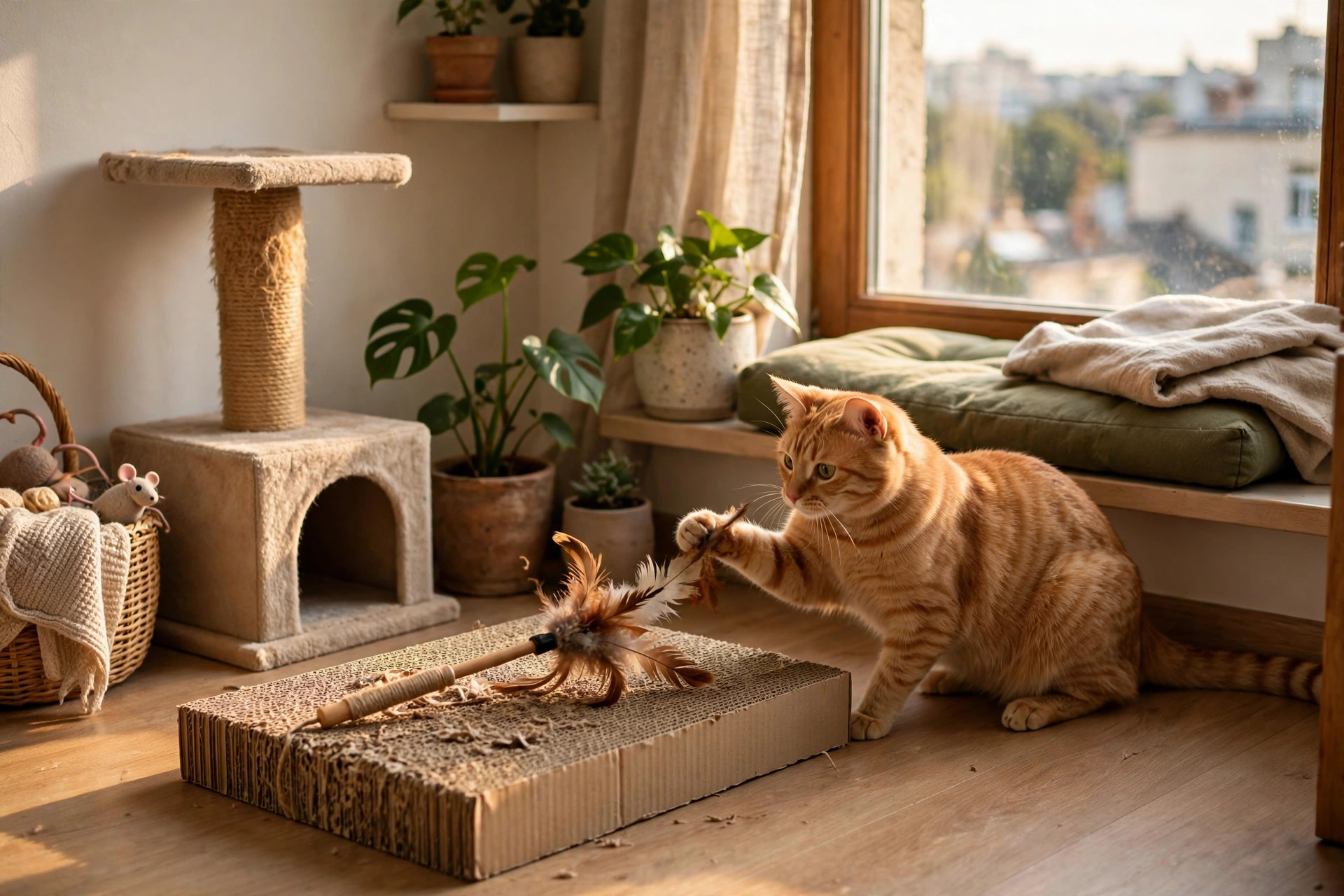
A cat in 400 square feet doesn't need more stuff — she needs more decisions. Enrichment is anything that lets a cat choose, investigate, climb, or hunt. The good news about tiny apartments: small spaces are actually easier to enrich than big houses, because every square foot you improve gets used constantly. This guide starts with a five-minute audit of what your cat already has, then walks room by room with ideas measured for real small spaces.
Start with the 5-channel enrichment audit
Walk through your apartment with this checklist. Score each channel 0 (missing), 1 (present but weak), or 2 (solid). Anything scoring 0 is your priority — a cat missing an entire channel will invent her own entertainment, usually involving your curtains.
- 1. Climb — vertical territory. Can the cat get at least 4 feet off the ground somewhere? Cats measure territory in cubic feet, not square feet. One good vertical route beats a room full of floor toys.
- 2. Hunt — predatory play. Does the cat get 10+ minutes of interactive play daily that ends in a "catch"? Solo toys don't count here — this channel needs you and a wand toy.
- 3. Scratch — appropriate surfaces. Is there a scratcher within 3 feet of where the cat sleeps (the post-nap stretch zone) and one near the most-scratched furniture? Location beats quantity.
- 4. Watch — visual stimulation. Is there a comfortable window spot with a view of something — birds, street life, even swaying trees? A window with nothing to see is just glass.
- 5. Forage — food challenge. Does at least one meal a day require effort? Puzzle feeders, scattered kibble, or hidden treats turn eating from a 90-second event into a 15-minute activity.
Most tiny apartments score 4–6 out of 10 on the first pass, usually missing climb and forage. Those two are also the highest-impact fixes — which is convenient, because they're the cheapest.
One more thing the audit reveals: dead zones. Every small apartment has a corner or hallway stretch the cat never uses — often because it's dark, slippery, or a dead end. A $10 motion-activated night light or a textured runner rug can convert a dead zone into a patrol route overnight. Cats that "own" more of the apartment's footprint show fewer stress behaviors, even when the total square footage hasn't changed.
Room-by-room: micro ideas with measurements
The living room — build up, not out
Clear the top of one bookshelf (about 12 inches of depth is enough for most cats) and put a folded blanket there — instant high perch, zero footprint. If you can mount two staggered wall shelves (each 10 by 18 inches, about $20–$30 each from Catastrophic Creations or similar), you create a vertical loop: floor → shelf → shelf → bookcase top. Keep 12–14 inches of vertical gap between shelves so the cat can jump comfortably. In rentals, use the heavy-duty adhesive-mounted options rated for 25+ lbs rather than drilling.
The bedroom — the 3 a.m. circuit
Cats are crepuscular; your bedroom is their midnight highway. Put a scratcher within arm's reach of the bed's foot — post-sleep stretching happens here, and a scratcher in this spot gets used 3x more than one across the room. Slide a crinkle tunnel (about 10 inches diameter, collapsible) under the bed's edge so it forms a peek-a-boo tube. Total floor cost: roughly 2 square feet.
The kitchen — forage central
Move one meal a day out of the bowl. Scatter a quarter-cup of kibble across a snuffle mat or a clean bath mat (the texture slows them down), or hide five treats around the kitchen before work — on a chair rung, behind the trash can, on a low shelf. A Doc & Phoebe's indoor hunting feeder (about $20) turns mealtime into a mouse-hunt with three little feeders you hide around the apartment. Start with easy hides; a cat that can't find anything quits.
The bathroom — the overlooked playground
Small, tiled, easy to clean: bathrooms are perfect for messy enrichment. A ping-pong ball in the empty bathtub is a classic — it can't escape, it rattles, and the cat can chase it in circles. On bath day, float a bottle cap in an inch of water for supervised paw-fishing. Keep the toilet lid down and medications locked away, obviously.
The windows — make them count
One good window beats three empty ones. Clear a sill at least 8 inches deep, add a $25–$40 suction-cup or sill-mounted perch rated for your cat's weight, and hang a bird feeder outside if your building allows it (suction-cup feeders work on glass and cost about $15). No outdoor access? A "cat TV" video of birds on a tablet, propped at cat height for 20 minutes, genuinely holds many cats' attention.
Three budget tiers: $0, under $30, splurge
Under $30 — fix your weakest audit channel. One wall shelf ($20–$30), one puzzle feeder ($12–$20), one suction-cup bird feeder ($15), or a crinkle tunnel ($10–$15). Pick the single purchase that addresses your audit's lowest score.
Splurge ($50–$150) — the vertical highway. A floor-to-ceiling tension-mounted cat tree (no drilling, fits in 2 square feet of floor) or a set of three wall shelves forming a full loop. This is the one purchase that permanently changes how big your apartment feels to a cat.
A realistic weekly enrichment schedule
Enrichment fails when it depends on motivation. Anchor it to things you already do:
- Morning (2 min): scatter breakfast kibble or hide the hunting feeders before you leave. The cat "hunts" while you're gone.
- Evening (10 min): one wand-toy session before dinner — hunt, catch, eat, groom, sleep. This single habit fixes more behavior problems than any product.
- Weekly (5 min): rotate two toys, move the cardboard box to a new spot, refresh the window perch blanket.
- Monthly (15 min): re-run the 5-channel audit. Scores drift as seasons change (windows get boring in winter, climbing routes get blocked by holiday clutter).
FAQ
My apartment is under 400 sq ft. Is it even fair to keep a cat?
Yes — with the audit above scoring 7+. Cats don't need square footage; they need vertical space, hunting outlets, and routine. Many behaviorists consider a well-enriched studio better for a cat than a large empty house. What matters is usable territory and daily interaction, not floor area.
My landlord forbids drilling. How do I add vertical space?
Tension-mounted floor-to-ceiling cat trees need no drilling and fit in about 2 square feet. Heavy-duty adhesive shelves rated for 25+ lbs work on smooth walls (test first). And don't overlook furniture tops: clearing a bookshelf or wardrobe top is free vertical territory.
How do I enrich for two cats in a tiny space?
Duplicate the contested resources, not everything. Two cats need two feeding stations (separated), two litter boxes minimum, and ideally two high perches — resource competition in small spaces is the top trigger for inter-cat tension. Vertical escape routes (a shelf path) let a bullied cat leave without confrontation.
My cat only likes the box the toy came in. Normal?
Completely normal, and useful — boxes are enrichment (hiding, ambushing, scratching). Lean into it: rotate boxes like toys, cut entry holes in different spots, put a box on its side as a cave. The $30 toy isn't failing; the free box is just better at being a box.