Best Cat Feeding Station for Small Apartment Kitchens
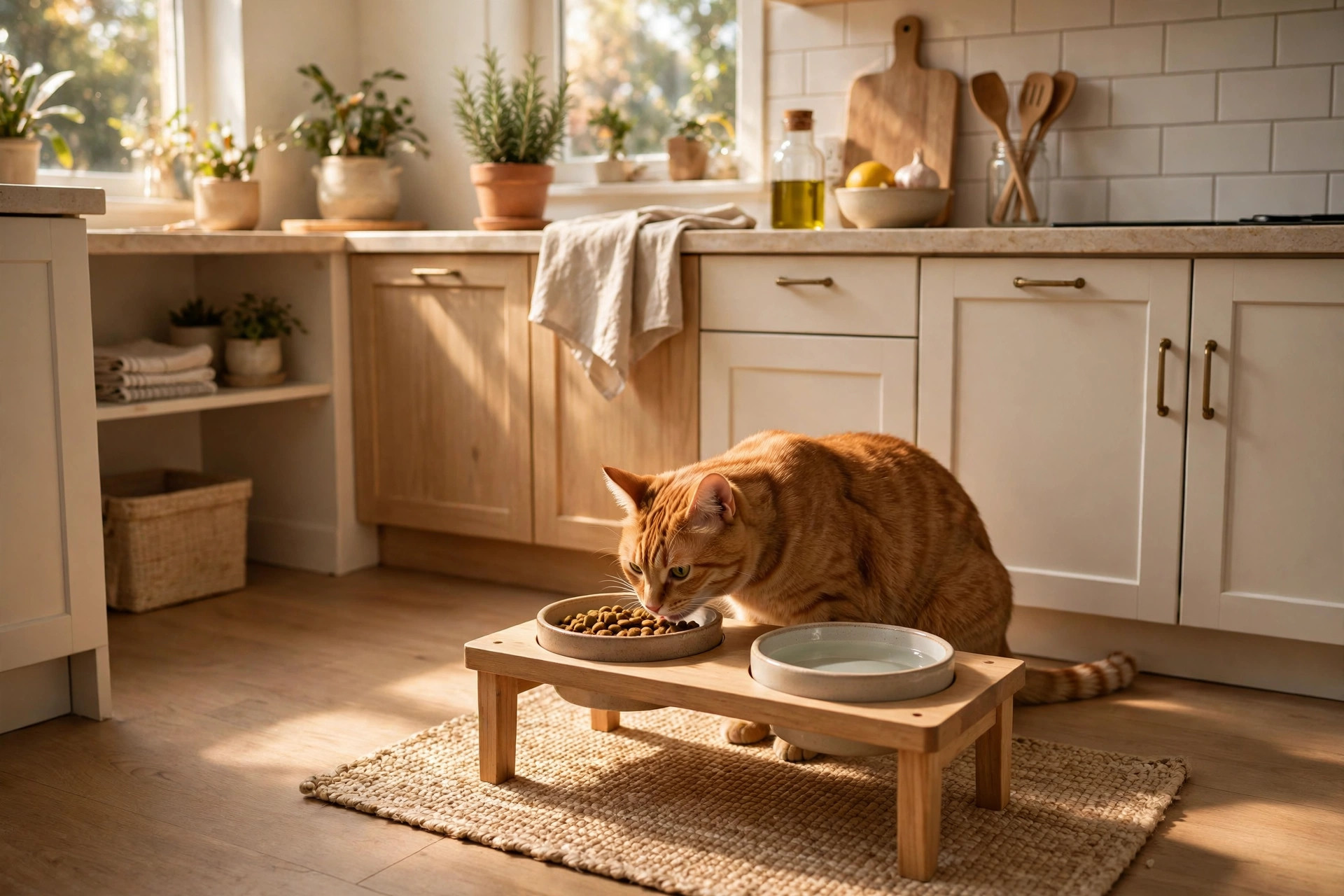
A cat feeding station is not just two bowls on the floor. In a small kitchen, it is a defined two-square-foot zone that keeps kibble off your socks, water off the baseboards, and the whole setup from migrating across the room every time your cat eats.
The two-square-foot problem
Here is what happens in most small kitchens: you put a food bowl and a water bowl on the floor, and within a week the food bowl has traveled eighteen inches from where you left it, there is a constellation of kibble under the fridge, and the water bowl has left a damp ring on the hardwood you will lose your deposit over. Cats push bowls. They drag them. They fish kibble out and eat it three inches to the left.
A feeding station solves this by giving meals a boundary. The station — a tray, a stand, or a walled corral — defines where food stays, catches what escapes, and keeps the bowls in one place. In a galley kitchen or a kitchenette corner, that boundary is the difference between a tidy corner and a permanent crumb zone.
The three station archetypes, ranked
Every feeding station on the market is a variation of one of three ideas. Here is how they compare for a genuinely small kitchen.
1. Tray corral (best for most apartments)
A shallow tray — usually silicone or plastic, roughly 18 by 12 inches — with a raised lip around the edge. Bowls sit inside it. Kibble that gets batted out lands on the tray instead of the floor, and the whole thing can be picked up and shaken into the trash. The footprint is honest: what you see is the space it takes, and it does not grow.
2. Elevated stand (best for senior or messy cats)
A low stand, typically 3 to 5 inches tall, holding two bowls. Raising the bowls slightly reduces neck strain for older cats and, more practically for apartments, makes it harder for the cat to push the bowls around — the stand has weight and the bowls lock into cutouts. The tradeoff is a slightly larger footprint and a stand that needs wiping underneath.
3. Wall-mounted or fold-down shelf (niche pick)
A small shelf bracketed to the wall or the side of a cabinet, holding one or two bowls. This frees floor space entirely, which sounds perfect for a tiny kitchen — but it only works if your cat will reliably jump to and eat from a fixed shelf, and renters need to check whether they can drill. For most people, the floor tray is simpler and more forgiving.
Four stations compared
These are widely available, well-reviewed options that suit small kitchens. Prices are typical US ranges and move with sales.
| Product | Best for | Usually | Small-kitchen note |
|---|---|---|---|
| IRIS USA Elevated Cat Feeder | Everyday reliability | Usually $18–$25 | Compact two-bowl stand with removable bowls; legs detach for flat storage. A safe default. |
| Frisco Elevated Double Bowl Stand | Budget pick | Usually $12–$18 | Stainless bowls included. Light enough to move for mopping, heavy enough to stay put. |
| Loving Pets Bella Bowl Stand Set | Non-slip priority | Usually $20–$30 | Wire stand with rubber feet plus spill-resistant bowls. Good if your cat is a bowl-pusher on tile. |
| Necoichi Raised Cat Food Bowl (pair on a tray) | Whisker-stress-prone cats | Usually $16–$24 for two | Wide, shallow porcelain bowls on short legs. Set them on any lipped tray for a premium corral. |
My practical recommendation: buy the IRIS USA stand and set it on a $10–$15 silicone tray with a lip. You get elevation plus containment for under $35 total, and each piece can be replaced separately when it wears out.
Five placement rules for tiny kitchens
Where you put the station matters as much as which one you buy.
- Keep it 3+ feet from the litter box. Cats dislike eating near their toilet, and in a studio this is the rule people break most. Even a few feet of separation — opposite sides of the kitchen — helps.
- Stay out of the cook triangle. Do not put the station between the stove, sink, and fridge. You will step in water bowls at 7 a.m. Tuck it against a wall or in a dead corner.
- Back it against something. A station pushed against a wall or cabinet side cannot be shoved backward. Open-floor placement invites migration.
- Separate water if you can. Many cats drink more from a water bowl placed a few feet away from food — a quirk worth exploiting in a small space. A second small water spot near a different wall costs nothing.
- Think about your feet, not just the cat. The station should not sit in the path between your bed and the bathroom. Nighttime water-bowl encounters are a rite of passage, but they are avoidable.
The cleaning cadence that actually works
A feeding station only stays hygienic if cleaning it is nearly effortless. Here is the routine that works in real apartments:
- Daily (30 seconds): dump the tray's collected kibble and give the water bowl rim a quick wipe. Do it while your coffee brews.
- Every 2–3 days: wash the food bowl with hot soapy water. Wet food residue goes biofilm-fast, especially in warm kitchens.
- Weekly: wash the water bowl fully and wipe down the tray or stand, including underneath. This is where the slimy layer hides.
Choose dishwasher-safe bowls and you will actually follow this. Hand-wash-only porcelain is lovely until week three, when it becomes a science project.
Adjusting for two cats in one kitchen
Two cats sharing one station creates resource tension — the confident cat eats first and the shy one waits, or worse, stops eating reliably. In a small kitchen the fix is separation, not a bigger station. Place a second simple setup (even just a tray with one bowl) at least 3 feet away, ideally on the opposite side of the kitchen or around a corner where the cats cannot stare each other down while eating.
If your cats are on different diets — one on urinary food, one on regular — a microchip-activated feeder (such as the SureFeed Microchip Pet Feeder, usually $70–$90) is worth the money. It opens only for the registered cat's microchip, which solves diet policing in a space too small for closed doors. For water, one shared station is fine; cats are far less territorial about water than food.
FAQ
Do cats really need an elevated feeding station?
Not medically, in most cases — but elevation helps in apartments for a practical reason: stands keep bowls from sliding across hard floors, which is half the mess battle. Senior cats with arthritis may genuinely eat more comfortably from a raised bowl.
My cat keeps dragging kibble out of the bowl. Will a station fix that?
A lipped tray catches most of it, which is the realistic goal. Some cats "paw" food out because the bowl is too deep or narrow — try a wider, shallower bowl before blaming the cat.
Can I put the feeding station inside a cabinet with a cat door?
You can, and some small-kitchen owners love it, but it concentrates smell and makes cleaning awkward. Only do this if you will actually pull the tray out to clean it every few days.
Plastic, stainless steel, or ceramic bowls?
Stainless steel is the best all-rounder: light, unbreakable, dishwasher-safe, and it does not harbor odors. Ceramic is great but chips; avoid cheap plastic, which scratches and can contribute to chin acne in some cats.