Best Cat Water Fountain for Small Apartments
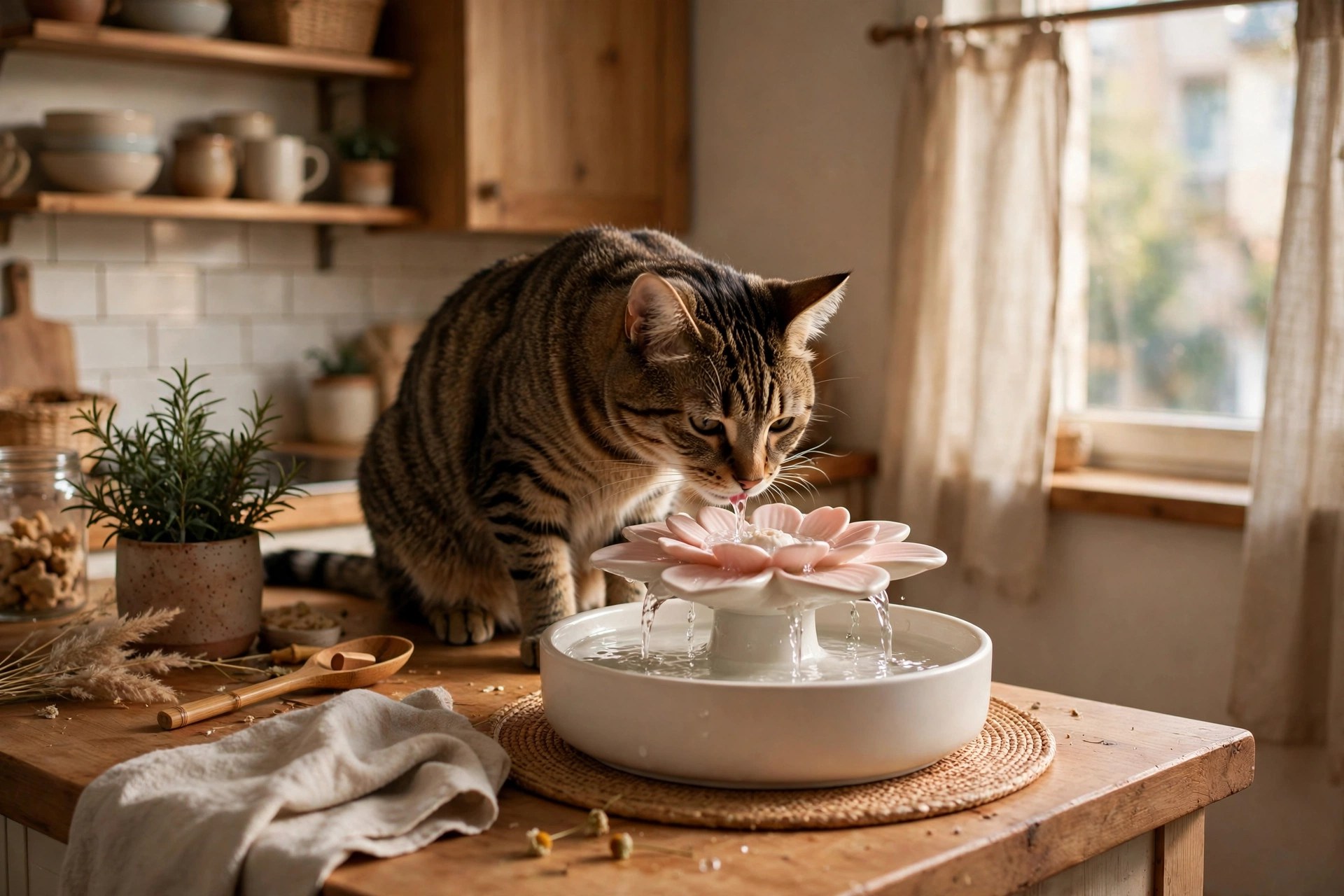
A water fountain gets cats drinking more — which matters for urinary health — but in a 600-square-foot apartment, the wrong fountain is a 24/7 buzzing roommate. This guide ranks fountains noise-first, because in small homes the quietest good fountain beats the fanciest loud one.
Why noise is the #1 spec in an apartment
Fountain noise comes from two sources: the pump's hum and water falling onto a hard surface. In a house you never notice either. In a studio at 2 a.m., a rattling pump is a sleep problem and a neighbor problem. Here's how to read the specs:
- Under 30 dB — effectively silent; you hear water, not machinery. This is the apartment target.
- 30–40 dB — a soft hum, like a whisper. Fine in a living room, noticeable in a silent bedroom.
- Over 40 dB — audible across a small apartment. Skip it unless the fountain lives far from sleeping areas.
- The low-water trap: every fountain gets loud when the water drops — the pump sucks air and rattles. A larger reservoir isn't just convenience; it's noise insurance between refills.
- Surface matters: a fountain on a hollow countertop amplifies vibration. A silicone mat or folded towel underneath cuts transmitted hum noticeably.
4 fountains ranked for apartment life
| Product | Best for | Typical price | Apartment notes |
|---|---|---|---|
| Catit Flower Fountain | The proven default | Usually $25–35 | The best-selling fountain for a reason: ~3L capacity, genuinely quiet pump (typically under 30 dB when full), and three flow settings including a gentle bubble mode cats like. Filters are cheap and everywhere. Slightly bulky footprint. |
| Catit PIXI | Small spaces, style-first | Usually $35–45 | Compact stainless-steel top, small footprint ideal for tight counters. Smaller reservoir (~2L) means more frequent refills — fine for one cat, watch the low-water rattle with two. |
| PETLIBRO Dockstream | Tech features, easy cleaning | Usually $40–55 | Wireless pump (no cord in the water — easier and safer to clean), quiet operation, ~2.5L. App-connected version exists if you want low-water alerts on your phone. Replacement filters cost more than Catit's. |
| Veken 84oz (2.5L) | Budget quiet | Usually $20–28 | Often the cheapest way to get a genuinely quiet fountain with a large reservoir. Two flow modes, simple design, widely available filters. Plastic body shows wear faster than pricier options. |
Our take: the Catit Flower is the safest first fountain — quiet, big enough to stay quiet between refills, and cheap to maintain. Choose the PIXI if counter space is the constraint, the PETLIBRO if you hate cleaning cords, and the Veken if the budget is tight.
The 2-minute weekly clean (fountains are not self-cleaning)
The #1 reason fountains get loud, slimy, or abandoned is skipped cleaning. Biofilm builds up in about a week regardless of brand. This routine takes two minutes:
- Dump and rinse (30 sec). Pour out all water — never just top up for weeks. Rinse the basin.
- Wipe the pump (30 sec). Pull the pump, wipe the impeller area with a cloth or old toothbrush. This is where slime lives and where noise starts.
- Check the filter (30 sec). Rinse it; replace every 2–4 weeks depending on your water hardness and cat count. A brown filter isn't filtering.
- Refill to the line (30 sec). Fill to max — a full fountain is a quiet fountain.
Placement rules for thin walls and small counters
- Away from food, away from the litter box. Cats prefer water sources separated from both — ideally 6+ feet from food and in a different area from the box.
- Not on a wobbly surface. Washer tops, thin shelves, and hollow-core counters amplify pump vibration. Solid counter or floor with a mat underneath.
- Near an outlet, not across the room. Cord-stretching across walkways is a trip hazard and a chew temptation. Plan the outlet first, then the spot.
- Bedroom-adjacent? Test first. If the only practical spot is near where you sleep, run the fountain there for 2–3 nights before deciding. Some people find the water sound soothing; some find the pump maddening. Know which you are.
- Two cats, one fountain: size up the reservoir or add a second water station. Competition at the fountain means someone drinks less.
Bowl vs. fountain: when a bowl is actually fine
Fountains are great, but they're not mandatory. Be honest about which camp you're in:
- A bowl is fine if: your cat already drinks well, you refresh the water daily, and you use a wide, shallow bowl (whisker-friendly — narrow deep bowls put some cats off). Total cost: $8–15 for a good stainless bowl.
- A fountain earns its place if: your cat barely touches still water, has a history of urinary issues, or you're away long hours and want water to stay fresh and aerated all day.
- The hybrid approach: fountain as the main station, one bowl in a second room. Cats drink more when water is available in multiple locations — and the bowl is your backup during the weekly fountain clean.
Filter subscription math: the real running cost
The fountain's sticker price is only half the story. Replacement filters run $8–15 per pack of 4–6, and at a change every 2–4 weeks you'll use 12–20 filters a year — roughly $25–60/year in filters alone, often more than the fountain cost over two years. Before buying, check two things: filter availability (can you buy them without the manufacturer's app or store?) and whether third-party compatible filters exist, which usually cost half as much. A $25 fountain with $40/year proprietary filters is more expensive than a $45 fountain with cheap universal ones. Factor two years of filters into the purchase decision, not just the box price.
FAQ
Do cats actually drink more from fountains?
Most do — moving water triggers a freshness instinct, and studies on feline water intake generally favor fountains over bowls. But a minority of cats ignore fountains entirely. Buy from a retailer with easy returns and give it a full week before judging.
Plastic vs. stainless steel vs. ceramic — does it matter?
For chin acne, yes: some cats develop feline acne from plastic dishes, and stainless or ceramic is the fix. For noise, heavier materials (ceramic, steel) dampen vibration better than thin plastic. For budget, plastic wins. Stainless is the best all-rounder.
How often do I really need to change the filter?
Every 2–4 weeks. Hard water and multi-cat homes push toward 2. The filter is not optional maintenance — a saturated filter just recirculates dirty water through a clean-looking fountain.
My cat is scared of the fountain. What now?
Run it on the gentlest flow (or unplug the pump for a few days so it's just a fancy bowl), place treats near it, and let curiosity work. Don't force it — a stressed cat drinks less, which defeats the purpose. About a week of patience converts most skeptics.