Smoke and Carbon Monoxide Safety for Apartment Pets
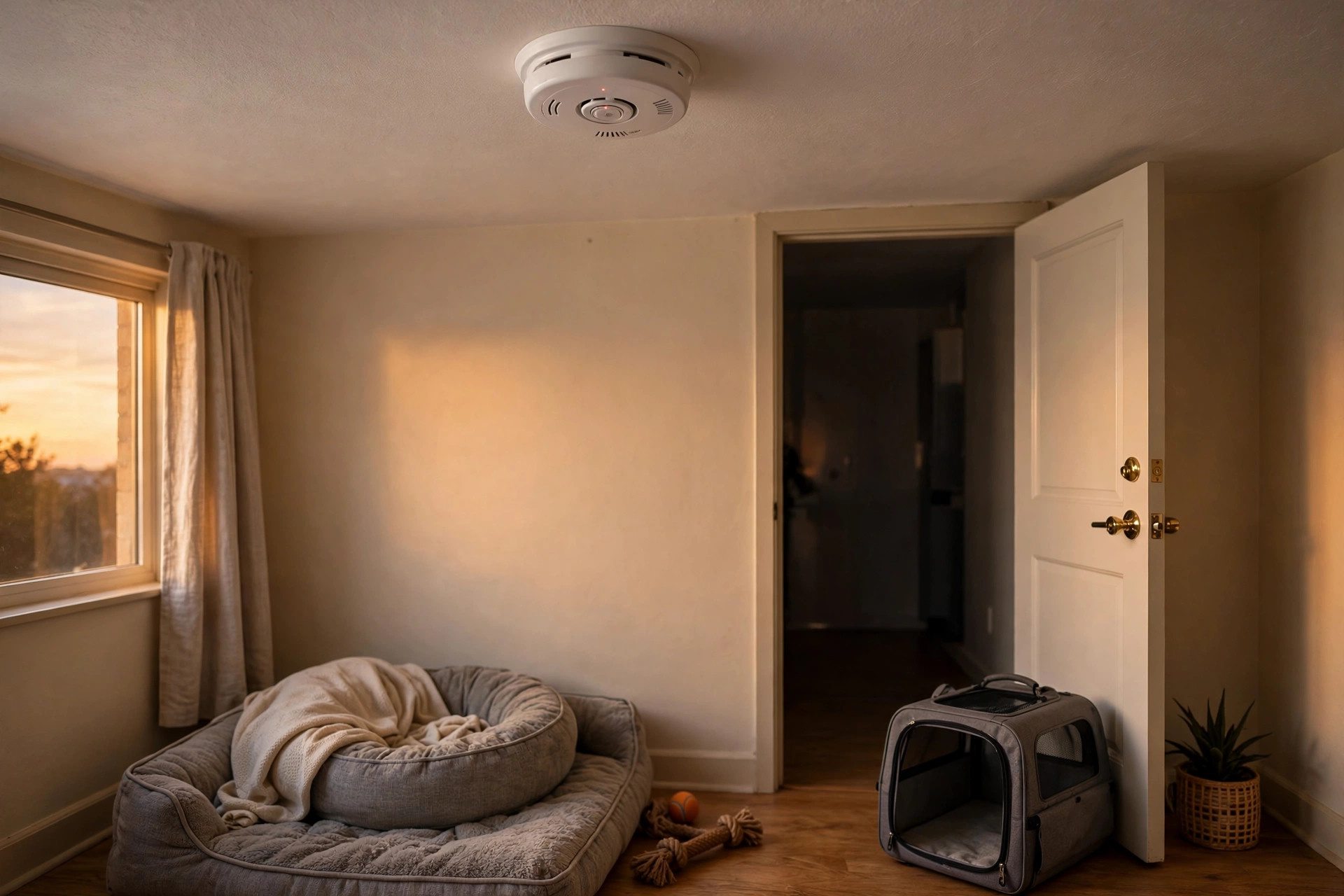
Your apartment’s smoke alarm was installed for a person who sleeps in a bed, wears shoes by the door, and can work a window latch. Your pet sleeps on the floor in the smoke layer, cannot open anything, and — if you are at work — cannot leave at all. Smoke and carbon monoxide (CO) are the two emergencies where the pet version of the plan differs from the human version in almost every detail. Here is how to close that gap for under $100.
Why smoke and CO hit pets first
Smoke rises, then banks down. In a developing fire, the clear air near the floor disappears faster than at standing height — and the floor is where every dog bed and cat tree sits. Pets also breathe faster per pound of body weight than adults, so they take in smoke and carbon monoxide at a proportionally higher rate. By the time a sleeping person smells smoke, a cat on the floor may already be impaired enough not to run, and hiding — under beds, inside closets, behind washers — is the default pet response to scary sounds and smells.
Carbon monoxide is the quieter problem. It is colorless and odorless, produced by faulty furnaces, gas stoves and ovens used for heat, blocked flues, and idling cars in attached garages. A human at a desk notices a headache and dizziness. A pet notices nothing describable — it just gets sleepy. Small animals and birds are affected fastest, which is why a canary in a coal mine was a monitoring system, not a metaphor. In an apartment, your practical early-warning system is not the pet. It is a detector, placed and maintained correctly — and in rentals, that detail is often nobody’s job until you make it yours.
Two rental realities make this worth an evening of attention. First, detectors in older buildings are frequently expired — sensors have a service life, typically 7–10 years, printed on the back of the unit — and neither landlord nor tenant notices until a test fails or worse. Second, single-station battery alarms in hallways do nothing for a pet locked in a bedroom with the door closed. The fixes below assume a renter: everything is screw-light, removable, and lease-safe.
Detectors: what to buy, where to put them, what they cost
You need two detection jobs done: smoke and CO. They can share a box. Current widely sold options, at typical 2026 street prices:
| Option | Typical price | Power | Apartment note |
|---|---|---|---|
| Kidde Nighthawk-type plug-in CO alarm with battery backup | $30–$50 | Outlet + battery | CO-only; outlet height is fine for CO; digital display shows levels. |
| Kidde or First Alert combination smoke + CO alarm (10-year sealed battery) | $35–$60 | Sealed battery | Best renter default; no battery changes for a decade; check manufacture date. |
| Google Nest Protect (2nd gen)-type smart alarm | $110–$130 | Battery or wired | Phone alerts matter if the pet is home alone; voice warnings reduce pet panic versus a pure siren. |
| Standalone photoelectric smoke alarm, 10-year | $18–$30 | Sealed battery | Photoelectric sensors false-alarm less near kitchens and catch smoldering fires earlier. |
Placement rules that matter for pets:
- One smoke alarm inside every room the pet sleeps in with the door closed, one outside sleeping areas, one per level. Hallway-only coverage fails the bedroom-door test in real fires.
- Mount smoke alarms on the ceiling or high on the wall (within 12 inches of the ceiling) — smoke rises. Keep them at least 10 feet from the stove to cut cooking false alarms, or choose photoelectric for near-kitchen spots.
- CO alarms go at knee-to-bed height near sleeping areas and near any fuel-burning appliance. CO mixes fairly evenly with air, so plug-in height is acceptable; one on each level, and one in the room with the gas stove or near the furnace closet door. If your building heats with a shared boiler, your in-unit risk is mainly your own stove, oven, and any space heater — see our space heater safety guide for the heater side of this.
- Check the date. Pull each existing unit down and read the manufacture date on the back. Smoke sensors past 10 years and CO sensors past 7–10 years get replaced, not argued with — about $35 each, and in many jurisdictions this is the landlord’s legal duty, so ask before you buy.
If the pet is regularly home alone, the smart alarm earns its premium for one feature: the phone alert. A siren protects a sleeping human. A push notification to an owner at work — who can call the building, a neighbor with a key, or 911 — is the only version of the alarm that protects a pet in an empty apartment.
The 3 a.m. plan: finding a hiding pet and getting out
Detectors buy minutes. This plan spends them well. The single most important fact: in smoke, pets hide low and silent, usually in a short list of favorite spots. Finding them is a memorized circuit, not a search.
- Know the hiding circuit by heart. For most cats: under the bed, inside the closet, behind the washer or sofa, inside any open cabinet. Walk it once on a calm day, carrier in hand. In an emergency you will do it by touch with a flashlight.
- Keep the carrier staged, not stored. A carrier buried in a closet under luggage is furniture. Keep it out, door open, with a worn t-shirt inside, near the exit path — cats that see the carrier daily stop treating it as a vet-day threat, and a staged carrier converts a 6-minute wrestle into a 40-second scoop. Keep a slip leash clipped next to it for dogs.
- Grab order: pet, then leash/carrier, then nothing. Shoes, phone chargers, and documents all lose to smoke. If you cannot find the pet within about a minute in worsening smoke, get out and tell firefighters exactly where the pet hides — they carry thermal cameras and oxygen masks sized for pets, and re-entering yourself is how owners become the second rescue.
- Window clings or a door sticker noting the number and type of pets inside ($5–$10, or free from many fire departments and the ASPCA) tell responders a pet is in the unit even when you are not home. Put the pet count on it honestly and update it when the household changes.
- Never go back in. This is the rule that overrides every instinct. Tell the first firefighter you see, specifically: “There is a cat inside, she hides under the bed in the back bedroom.” That sentence, delivered once, is the most effective rescue tool you own.
Rehearse the sequence twice a year when you test the alarms — press the test button, then walk the carrier to the door. Pets also learn from rehearsal: a cat that has heard the test beep with treats afterward panics less during the real alarm, which, as our fire escape plan with pets details, is often the difference between scooping and chasing.
Preventing the CO event in the first place
Detection is the backstop. These habits remove most apartment CO sources before they matter:
- Never heat the apartment with a gas oven or stovetop. It is the most common residential CO mistake and it defeats the appliance’s design assumptions within hours.
- Run the kitchen exhaust when cooking with gas, and treat a persistently yellow, lazy burner flame (instead of blue) as a service call, not a quirk — it signals incomplete combustion.
- Keep the furnace or boiler closet unblocked and report rust streaks, soot, or a sweet chemical smell near heating equipment to management in writing. In most rentals, combustion appliances are the landlord’s maintenance duty; a dated email creates the paper trail that gets them serviced.
- Be careful with the attached garage: never idle a car in it “just to warm up” with the door between garage and home ajar, and be skeptical of generator use anywhere near windows during outages — outage-season CO poisonings cluster exactly there.
- Know the household symptom pattern: multiple people (or a person and a pet) with headache, nausea, and dizziness that improves outdoors is CO until proven otherwise. Get out first, then call 911 or the gas utility from outside. Do not open windows and investigate; leave that to responders with meters.
The candle corner of fire safety deserves one line here: open flames and pet tails share apartments badly, and some fragranced products add airway irritation on top of the fire risk — candle and essential oil safety for pet apartments covers that trade-off. The short version matches this guide’s theme: the safe setup is the one that works when nobody is thinking about it.
Test alarms monthly, read the manufacture date yearly, and replace the whole unit at 10 years. A detector with a dead sensor and a fresh battery is the most dangerous object in this entire guide, because it looks like protection.
FAQ
Where should I put a carbon monoxide detector in an apartment with pets?
Near sleeping areas at roughly knee-to-bed height, plus one near any fuel-burning appliance such as a gas stove or furnace closet, and one on each level. CO mixes with air fairly evenly, so plug-in outlet height is acceptable. Combination smoke-plus-CO units with 10-year sealed batteries ($35–$60) are the easiest renter option.
Do I need a separate smoke alarm in the room where my pet sleeps?
Yes, if the door is closed at night. A hallway alarm may not wake you in time, and smoke fills the pet’s floor-level air first. Put a photoelectric smoke alarm inside every closed-door sleeping room, outside sleeping areas, and on each level, mounted on the ceiling or within 12 inches of it.
My landlord’s detectors look old. What should I check?
Take the unit down and read the manufacture date on the back. Smoke alarm sensors are typically rated 10 years and CO sensors 7–10 years; past that, replace the unit. In many jurisdictions working detectors are the landlord’s legal responsibility, so send a written request first — then replace it yourself at about $35 if there is any delay, and keep the receipt.
What is the most important thing to do if the alarm goes off and my pet is hiding?
Run your memorized hiding circuit once — under the bed, closet, behind the washer — with the carrier staged by the door. If you cannot secure the pet in about a minute in worsening smoke, get out and never re-enter. Tell the first firefighter the pet’s exact hiding spot; crews have thermal cameras and pet oxygen masks and will act on that information immediately.