Low-Clutter Pet Routines for Studio Apartments
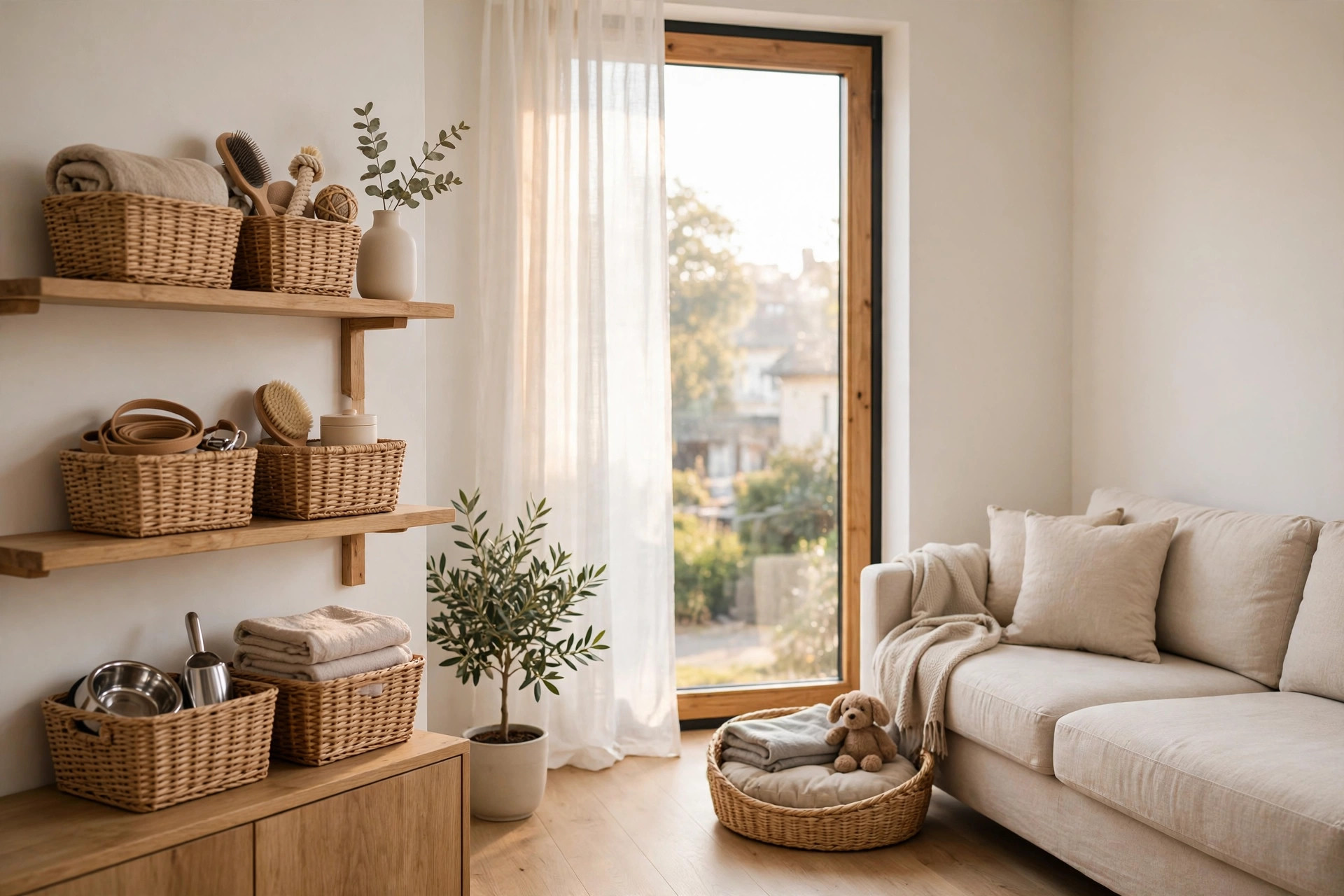
In a studio, there is no spare room to absorb mess — the dog's toys are in your kitchen, the litter area shares air with your bed, and one skipped day of tidying turns 400 square feet into a pet supply warehouse. The fix isn't more storage bins. It's a routine: small, timed resets that keep every item in its zone so clutter never compounds.
- Clutter in a studio is a flow problem, not a storage problem: items need a home and a daily return trip.
- The whole system costs about 20 minutes a day, split into three resets: 6 minutes in the morning, 3 at midday, 10 in the evening.
- Three zones cover everything: a feeding dock, a gear dock, and a waste station. Each fits in about 2 square feet.
- The "one-touch rule" does most of the work: never set a pet item down outside its zone — put it away in the same motion.
- Dogs and cats need slightly different dial settings; the timetable below includes both branches.
Step zero: give everything a 2-square-foot home
Routines fail without destinations. Before the timetable, set up three zones — each roughly 2 square feet, each with a hard boundary (a mat, a tray, a basket) so "put away" has a visible meaning:
- The feeding dock. A washable mat (about 24×18 inches) holding food and water bowls, plus the food container beside it — not across the room. Everything about a meal happens on this mat: filling, eating, wiping. When the mat is the boundary, kibble scatter stays on the mat instead of migrating across the studio. For cats, elevate this: a feeding station on a low shelf or counter keeps dogs (and ants) out and reclaims floor space. See our cat feeding station guide for small-kitchen layouts.
- The gear dock. One basket or lidded bin — roughly shoebox to milk-crate size — that holds leash, harness, waste bags, brush, and towel. It lives by the door for dogs, or in a closet nook for cats (grooming tools, nail clippers, carrier). The rule: the leash never drapes over a chair; it lives in the dock. Our pet supply storage guide has renter-friendly mounting ideas when floor space is truly zero.
- The waste station. For cats: the litter zone with scoop, sealed waste container, and spare litter within arm's reach. For dogs: a small lidded trash can by the door for used waste bags, plus a towel hook. Waste is the category that punishes delay most — a full, open waste bag in a studio announces itself within hours.
Total new footprint: about 6 square feet, most of it vertical or against walls you weren't using. The zones are the infrastructure; the routine below is the maintenance crew.
The 6-minute morning launch
Do this while the coffee brews. The goal is simple: reset the apartment to "neutral" before the day starts, so the evening reset has less to fix.
- Feed on the dock (2 min). Bowls filled on the mat, not carried dripping across the room. While the pet eats, you do step 2.
- Scoop or bag (1 min). Cat: quick litter scoop into the sealed container. Dog: grab yesterday's used bags from the door can and tie them off. Morning waste removal matters disproportionately in a studio — odor compounds in small air volume, and starting the day at zero keeps the whole day fresher.
- Toy sweep (1 min). Walk the studio once with the gear-dock basket: every toy goes in the basket. Not "most toys" — every toy. A single pass with a basket takes sixty seconds; hunting for the squeaky toy at 11 p.m. takes ten minutes and wakes the neighbors.
- Bowls and mat (2 min). Rinse bowls, wipe the feeding mat. Dried food cemented to a mat becomes a scrubbing project by Friday; a daily rinse keeps it a non-event.
Dog branch: add a 30-second gear check — leash, bags, and treats in the dock before the morning walk, so you're never patting empty pockets in the hallway. Cat branch: swap step 2's emphasis — refresh water (cats drink more from clean, freshly filled bowls) and check the litter depth while scooping.
The midday 3-minute sweep (two versions)
If you work from home: set a phone reminder for 1 p.m. Walk the toy sweep again (one minute), wipe the feeding mat if breakfast got enthusiastic (one minute), and do a 10-second sniff check near the litter zone or door can — if it smells at 1 p.m., it will be unbearable by 7 p.m., so deal with it now (one minute).
If you're at the office: the midday sweep becomes a camera-check habit instead. A cheap pet camera or even a scheduled photo from a smart plug won't tidy anything, but it tells you whether the dog shredded a pillow at noon (come home to triage) or slept all day (evening reset stays at 10 minutes). The physical 3 minutes shift to the moment you walk in: shoes off, bag down, toy sweep before you sit down. The rule is entry triggers reset — never "I'll do it after dinner," because after dinner becomes tomorrow.
The studio golden rule: every pet item touched gets put back in the same motion. Leash off the dog, leash in the dock. Toy thrown, toy back in the basket at the next pass. One-touch handling prevents 80% of studio clutter without any extra time.
The 10-minute evening reset
This is the big one — the reset that makes mornings easy. Tie it to an existing habit (right after dinner, or when the evening walk ends) so it runs on autopilot:
- Dinner on the dock, bowls washed after (3 min). Same as morning, but wash properly with soap — one real wash a day prevents the biofilm that makes bowls smell.
- Second scoop (2 min). Twice-daily scooping is the single highest-impact habit for studio odor. Evening is non-negotiable because the waste then sits for 8+ hours overnight.
- Floors: the 3-minute pass (3 min). A stick vacuum or even a handheld around the feeding dock, litter zone, and pet bed. In a studio this is maybe 150 square feet of actual floor — three minutes, once a day, prevents the grit-underfoot feeling that makes small spaces feel dirty.
- Reset the zones (2 min). Gear dock inventoried (bags restocked?), feeding mat wiped, waste station tidy. The apartment should now look pet-free to a guest walking in — that's the test.
Dog branch: the evening walk doubles as the reset trigger — leash in dock, towel the paws (rainy-day protocol in our entryway guide), then run the 10 minutes. Cat branch: add a 5-minute play session before the reset — a tired cat sleeps through the night instead of parkouring off your bookshelves at 3 a.m., which is its own form of clutter control.
The Sunday 20-minute deeper reset
Daily resets handle flow; weekly resets handle buildup. Twenty minutes, once a week:
- Litter: full assessment (5 min). Dump and replace if it's the 2–3-week mark; otherwise top up and stir. Wash the scoop. Check the sealed container's gasket and the bag supply.
- Textiles (5 min). Pet bed cover, feeding mat, and any blankets in the wash. Rotate: one set in use, one set clean. This is also when you discover which "washable" items actually survive the machine.
- Gear dock audit (5 min). Toss destroyed toys (the ones with exposed squeakers or stuffing coming out), restock waste bags, check treat expiration dates, wipe down the basket itself.
- Floors and surfaces (5 min). Vacuum properly including under the bed and behind the feeding dock — the spots the daily 3-minute pass skips. Wipe the windowsill or shelf the cat uses as a highway.
Put it on the calendar as a recurring event. "Sunday reset" survives; "whenever it looks dirty" doesn't, because in a studio it always looks slightly dirty and you stop noticing.
Cat people vs. dog people: adjust the dials
The skeleton is identical; the emphasis shifts:
- Cats generate static clutter; dogs generate dynamic clutter. Cat mess is litter scatter, hair on everything, and knocked-over objects — it accumulates steadily, so the midday sweep and weekly textile wash matter most. Dog mess is muddy paws, chewed items, and toy explosions — it arrives in bursts, so the entry-triggered reset and gear dock discipline matter most.
- Odor profiles differ. Cat odor concentrates at the litter zone and rewards sealed storage plus twice-daily scooping. Dog odor distributes through textiles and rewards the weekly wash cycle plus air circulation. If you have both, you need both systems — there's no shortcut.
- Two pets multiply, not add. Two cats don't double the litter maintenance — they roughly triple the speed at which litter saturates. Budget an extra 3 minutes on the evening scoop and move full litter changes a week earlier. Two dogs (or a cat plus a dog) mainly multiply toy and textile volume: upsize the gear dock to a lidded bin and keep a second set of bed covers in rotation.
When the routine breaks down — a brutal work week, a sick pet, houseguests — don't try to catch up on everything. Run the messy-day reset protocol once, then restart the daily timetable the next morning. One clean restart beats a week of guilty half-resets.
FAQ
I barely have 20 minutes a day. What's the minimum viable version?
Keep the evening 10-minute reset and the morning scoop — drop the midday sweep. That's 12 minutes protecting odor and floors, which are the two things guests actually notice. Add the rest back when life calms down.
My studio is under 350 sq ft. Do the three zones still fit?
Yes, but they stack vertically: feeding dock under a counter overhang, gear dock as a wall-mounted basket by the door, waste station in the bathroom. In micro-studios the zones are defined by containers, not floor area — a lidded bin is the zone.
How do I get a partner or roommate to follow the routine?
Assign zones, not tasks: one person owns the feeding dock, the other owns the waste station. Zone ownership is visible (the dock is either reset or it isn't) while task lists invite negotiation. The evening reset works best done together — ten minutes with two people is five.
The routine worked for a month, then I fell off. How do I restart?
Don't resume mid-week — do one full Sunday-style reset on any day, then start the daily timetable the next morning. And shrink it: run the minimum viable version for two weeks before adding the midday sweep back. Routines fail from over-ambition, not laziness.