How to Store Pet Supplies in a One-Bedroom Apartment
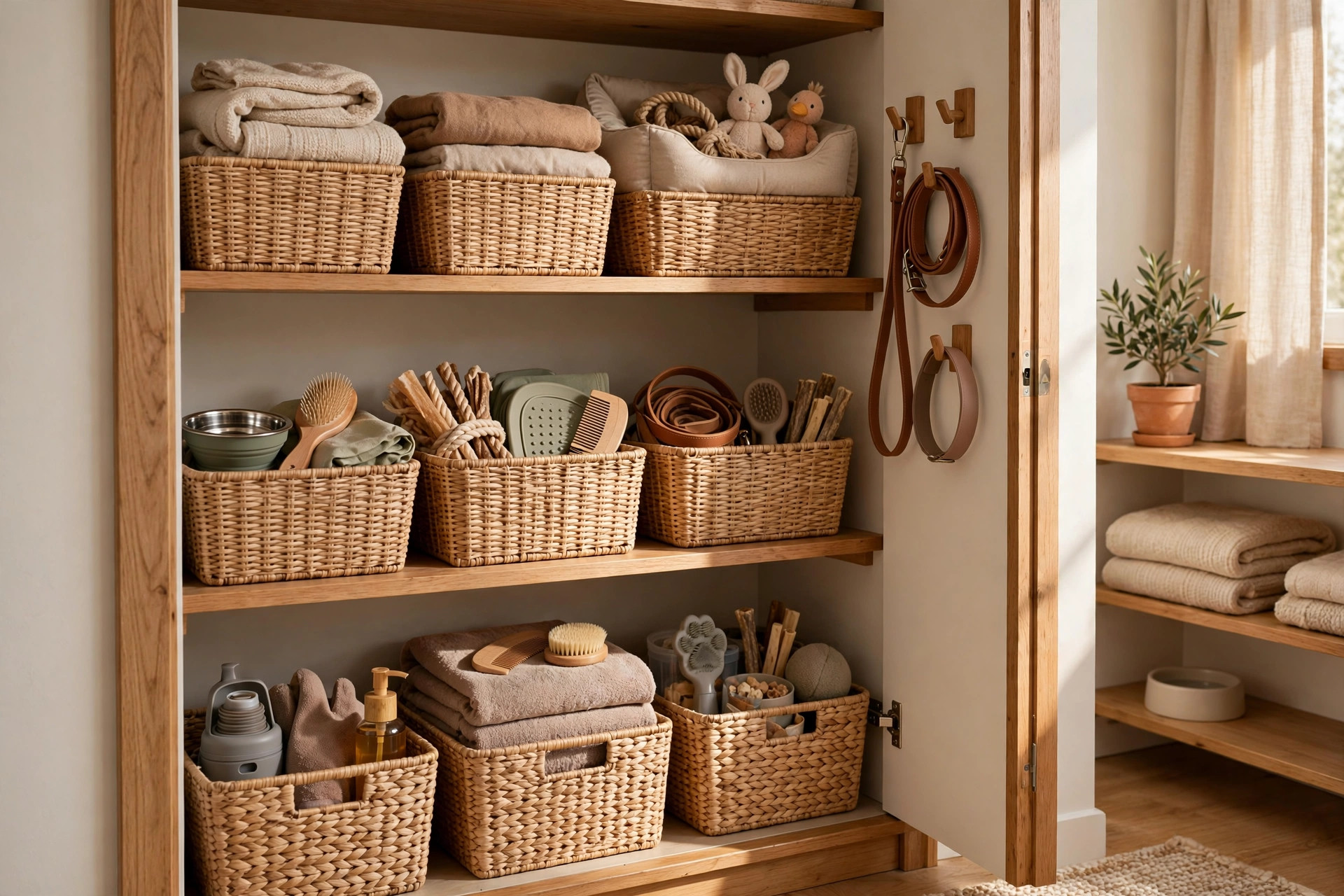
Most storage advice for pet owners starts with buying bins. In a one-bedroom apartment, start with subtraction instead: measure what you own, sort it by how often you touch it, and only then buy containers for the dead spaces your flat already has. Done in that order, a 600-square-foot apartment can hold a full dog or cat setup without looking like a pet store.
Step 1: Run a supply audit before you buy anything
Pull everything pet-related out of every drawer, shelf, and bag, and lay it on the bed. It feels dramatic; that is the point. You are probably storing two half-finished treat bags, toys nobody has touched since February, and three harnesses when the animal wears one. Sort the real inventory into four groups:
- Feeding: dry food, wet food, bowls, mat, measuring cup, spare water bowls.
- Care: litter and scoop (cats), poop bags (dogs), wipes, pet-safe cleaner, lint roller, brush, nail clippers, shampoo, towels.
- Gear: leash, harness, collar, carrier, winter coat, travel bowl, gate.
- Fun: toys, puzzle feeders, lick mats, training treats.
Now estimate the footprint. A 15-pound kibble bag is roughly 18 x 12 x 8 inches, about 2 cubic feet; a 20-pound litter box is similar. Most one-pet households own 6–9 cubic feet — roughly one wardrobe box. If yours totals more, donate extras instead of buying organizers. Half-chewed tennis balls and vet freebies leave today.
- Keep one of everything you use weekly; donate or toss duplicates and expired items.
- Stale, long-opened treats go in the trash — they invite pantry moths.
- Retired toys (stuffing out, squeaker dead) get replaced, not stored "for later."
Step 2: Sort everything by touch frequency, not by category
Category bins fail in small apartments because you open the "pet stuff" bin eight times a day for poop bags and the treats fall out every time. Sort by how often your hand reaches for the item, and give each frequency its own station:
- Daily (within arm's reach): leash, poop bags, walk treats, scoop and litter, bowls, measuring cup, a rotation of 4–6 toys. These live out in the open, in small open containers or hooks — never behind a lid.
- Weekly (one grab-able bin or drawer): grooming brush, nail clippers, wipes, cleaning spray, spare poop-bag rolls, treat refills, backup toys. One lidded bin or one dedicated drawer holds all of it.
- Monthly or rare (out of the way): carrier, travel gear, seasonal coat, the unopened reserve bag of food, extra litter, spare collar, bulk cleaning supplies. These can live behind closed doors or above eye level, because you visit them on purpose.
The frequency sort is the whole trick: daily items have no lids to fight, weekly items have one container to open, and monthly items disappear entirely. When something feels hard to reach, it is almost always filed under the wrong frequency, not in the wrong room.
Step 3: Claim five dead spaces every one-bedroom already has
Most one-bedrooms waste these five voids. Measure each with your phone's tape before buying anything.
1. Behind any door (about 4–5 inches deep)
An over-the-door rack roughly 20 inches wide and 60 inches tall, with pockets about 4 inches deep, holds poop-bag rolls, grooming wipes, a brush, treat pouches, and a lint roller at standing height on the inside of a closet or bathroom door. Check the gap between door and frame first: doors that sit flush to the wall need flat hooks rather than thick brackets, or the door will not close.
2. Under the bed (usually 6–8 inches of clearance)
Measure from floor to the underside of the frame — most frames give 6 to 8 inches, enough for flat boxes about 24 x 16 x 6 inches. This is prime space for the "weekly" bin: spare poop bags, treat refills, backup bowls. Wheeled boxes beat lidded totes here because you can pull them out without kneeling. Leave the two feet nearest your pillow clear; that is your hand zone and anything stored there becomes clutter.
3. The top of the wardrobe or closet (12–18 inches above the rod)
The shelf above hanging clothes is usually 12 inches deep and holds the "monthly" category: carrier, seasonal coat, travel litter box, the unopened reserve food bag. Put the carrier up there with its door facing forward so it reads as luggage. If the shelf is deeper than 14 inches, add a fabric box at the front so you can pull the whole box down instead of reaching over small items.
4. The entryway wall (a 24 x 12-inch footprint)
One wall-mounted panel with 4–6 hooks and a small lidded bin, about 24 inches wide by 12 inches tall at elbow-to-shoulder height, turns walks into a 5-minute dash: leash, harness, and treat pouch on hooks; poop-bag rolls, a microfiber towel, and paw wipes in the bin. Renters: use adhesive hook strips rated for at least 7 pounds so the harness hook survives a full leash plus harness.
5. The balcony or utility cabinet (weather-proof only)
A narrow outdoor cabinet, roughly 24 x 18 x 36 inches, works for sealed overflow: extra litter, bulk paper towels, spare poop bags. Only sealed, non-food items belong outside — heat and humidity destroy kibble and open litter within weeks, and most landlords ban food storage on balconies.
Step 4: Handle the big two — bulk kibble and cat litter
Two items cause 80% of storage complaints: the 15-to-30-pound kibble bag and the big box of litter. Both need the same discipline: airtight, off the floor, and bought in the right size.
Size the bag to your pet's appetite. Opened dry food stays fresh for about 4–6 weeks, then the fats start going rancid even if it still smells fine. A 30-pound dog eating 3 cups a day finishes a 15-pound bag in 3–4 weeks — perfect. For a single cat or small dog, buy 5-to-7-pound bags instead of a stale economy bag.
Never pour kibble straight into a bin. The bag's foil-lined interior blocks light, oxygen, and moisture far better than plastic. Roll the top tight, clip it shut, and set the whole bag inside an airtight container — the container stops pantry moths and smells, the bag stops staleness. Wash the container with warm soapy water between refills, because rancid fat residue can taint the next bag.
Litter gets the same airtight treatment. Unopened, dry litter keeps for years, but opened bags absorb moisture and odors from apartment air. In a humid home, clumping litter can start caking in the bag within a few months. Decant opened litter into a gasket-lidded bin, keep it off bathroom floors where humidity pools, and use opened litter within about 6 months. If a sealed bag feels rock-hard from moisture caking, replace it — caked litter clumps poorly and tracks worse.
The freshness test: smell the kibble halfway through each bag. Sour, paint-like, or fishy notes mean the fats have oxidized — stop serving it. Never store food on a sunny balcony.
Step 5: Buy only after you have measured — 4 organizers worth the space
Buy the airtight food container first, then organizers for the spaces you measured. Prices are typical US street prices.
| Product | Best for | Typical price | Small-space notes |
|---|---|---|---|
| IRIS USA Airtight Pet Food Storage Container | The kibble bag goes inside, bag and all | Usually $30–$45 | 33-quart size swallows a rolled 15-pound bag; gasket lid blocks smells and pantry moths. |
| Frisco Stackable Storage Bins | The "weekly" bin: grooming, treats, cleaning | Usually $15–$25 | Low profile fits most closets; stack vertically instead of spreading flat. |
| mDesign Plastic Stackable Storage Bins | Open daily-access bins for entryway or closet shelves | Usually $20–$30 | Open-front design for grabbing treats without a lid; 6-inch widths tile a shelf neatly. |
| IKEA SKUBB Storage Case | Flat under-bed storage for monthly items | Usually $8–$15 | About 5 inches tall fits most bed frames; cheap enough to replace instead of reorganize. |
Expect roughly $60–$115 total for one pet, and skip whatever your layout already covers.
Step 6: Keep one go-bag packed, always
The items you need in an emergency — a vet dash at 11 p.m., a fire-alarm evacuation, a surprise weekend trip — are exactly the items scattered in five places on a normal Tuesday. Pack a small backpack or tote and hang it in the entryway or on the closet door:
- Two days of food in a sealed pouch, plus the measuring scoop.
- Collapsible travel bowl, one toy, and a familiar-smelling blanket or shirt.
- Vaccination records and your vet's phone number on paper, not just on your phone.
- One week of medications, labeled with the dose schedule.
- For dogs: spare leash, poop bags, towel. For cats: a few litter liners and a zip bag of litter.
Refresh the food pouch on the first of every month; the go-bag doubles as your travel kit.
FAQ
How long does dry dog food stay fresh after I open the bag?
Plan on 4–6 weeks. After that the fats oxidize even in a sealed container. Buy a bag size your pet finishes inside that window — for a single cat or small dog that usually means 5-to-7-pound bags, not the big economy sack.
How long does opened cat litter last?
Stored dry in a gasket-lidded bin off the floor, opened litter stays usable for about 6 months. In humid homes or on damp bathroom floors it can cake in the bag within a couple of months, so keep it in the driest corner you have.
Should I pour kibble out of the bag into the storage container?
No — set the whole bag inside the airtight container. The bag's foil lining protects against light and oxygen better than plastic, and you keep the lot number and feeding chart in case of a recall. Roll the bag top tight and clip it first.
How do I keep pantry moths out of the kibble?
The airtight container does most of the work, but moths usually arrive inside the bag from the store. Inspect new bags for webbing or tiny holes, use each bag up within 4–6 weeks, and wash the container between refills. If you find webbing, throw the whole bag away — the larvae are already through it.
Can I store pet food on a hot balcony to save space?
No. Heat above 80°F (27°C) turns kibble rancid faster and cakes litter solid; moisture makes both worse. The top of an interior closet is the coolest, driest spot in most one-bedrooms — that is where the reserve food belongs.