Best Small Apartment Dog Toy Storage Ideas
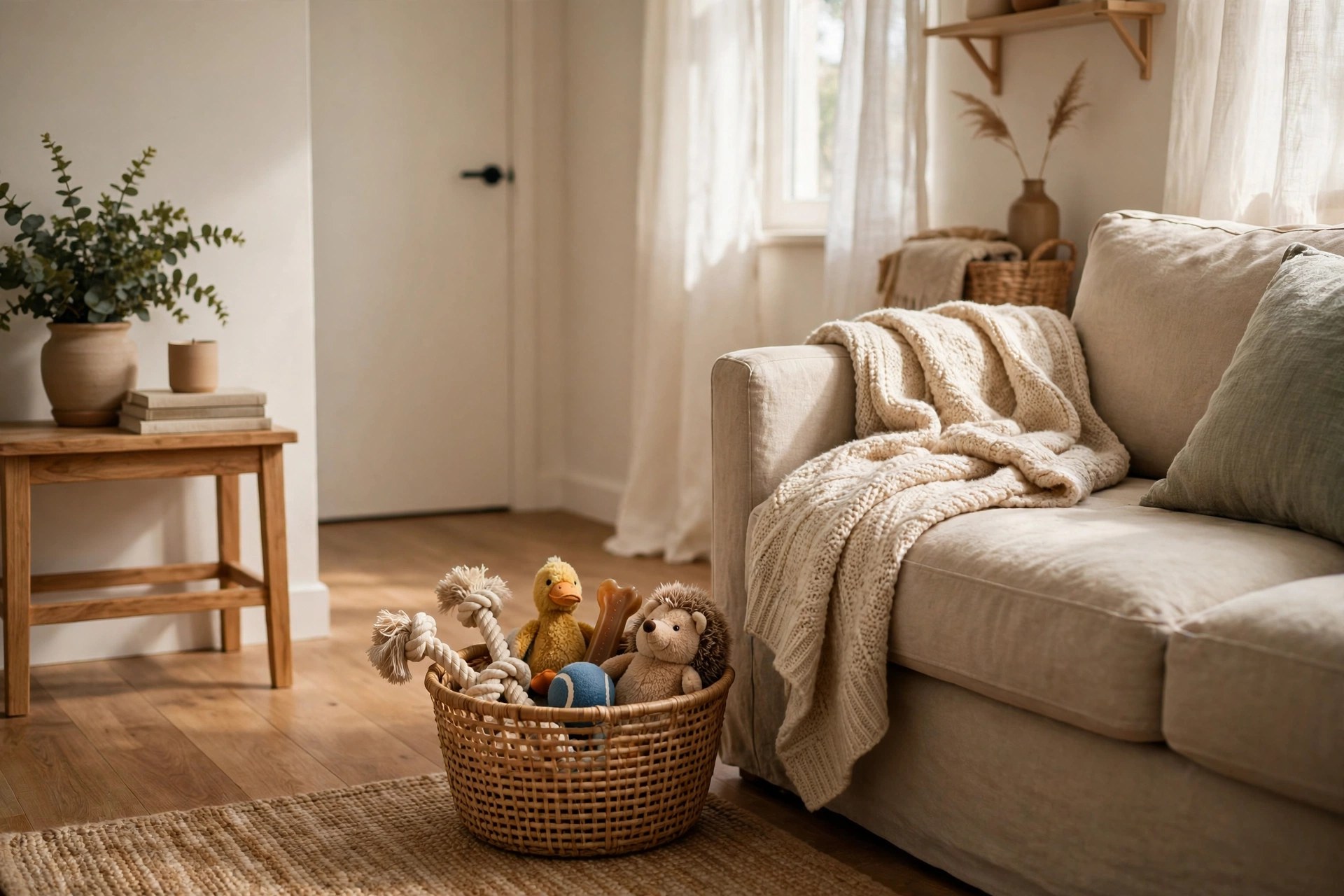
A dog’s toy collection expands to fill whatever space it is given — and in a 500-square-foot apartment, that means the whole living room. The fix is not a bigger bin. It is a system: every toy gets a category, every category gets a zone, and a ten-minute weekly rotation keeps the whole thing running. Here is the complete setup, with the exact sizes that fit small apartments.
- Only Quadrant 1 toys — daily, quiet, small — live out full-time.
- Loud toys are by appointment: out during play, stored the second play ends.
- Six to eight toys out at once. Everything else lives in a closed bin.
- Every toy has exactly one home, and resetting the room takes five minutes.
- Inspect weekly, wash plush toys weekly, and retire anything damaged immediately.
Step 1: Sort every toy into four quadrants
Dump every toy onto the floor and sort them along two axes: how often the dog uses it (daily vs. occasional) and how disruptive it is (quiet and small vs. loud or bulky). That gives you four quadrants, and each one gets a different storage rule:
- Quadrant 1 — Daily drivers, quiet and small. Chew bones, rubber Kongs, snuffle mats, a favorite small plush. These are the only toys allowed to live out in the open full-time. They are also the only toys that belong in the living room basket.
- Quadrant 2 — Daily fun, loud or bulky. Squeakers, crinkle toys, tug ropes, flirt poles. This is the apartment-danger zone: a squeaker at 11 p.m. is a neighbor complaint, not enrichment. Rule: managed access — out during a play session, back in the closed bin the moment play ends. No unsupervised squeaking, ever.
- Quadrant 3 — Occasional. Puzzle feeders, training props, seasonal toys, the costume from Halloween. These live in a closet, come out on rotation days or training days, and never clutter the living room.
- Quadrant 4 — The retired bench. Toys waiting to rotate back in, toys to donate, and toys that are done. Be ruthless here: a toy with an exposed squeaker or torn seam is a choking and intestinal-blockage risk and goes straight in the trash, not back in a bin.
Most owners discover that 60–70% of their toys are Quadrant 3 or 4 — which is exactly why the room feels chaotic. The clutter was never a storage problem. It was a sorting problem.
Step 2: Give each quadrant a zone
Apartments punish storage that eats floor space, so every zone below uses dead space: doors, sofa edges, entries, and under-furniture gaps. Measure before you buy — a bin that does not fit under your sofa is just expensive clutter.
- Zone 1 — The door organizer. A standard over-door pocket organizer (about 19 x 64 inches, 20+ pockets) hangs inside a closet or bedroom door and holds Quadrant 1 small toys, treat pouches, and poop-bag rolls. Zero floor space, everything visible, and the dog cannot self-serve the good stuff. Keep toys in the top rows.
- Zone 2 — The sofa-side cart. A three-tier rolling cart (the standard size is roughly 17 x 12 x 30 inches) parks next to the sofa where play actually happens. Top tier: tonight’s Quadrant 1 toys. Middle: chews and lick mats. Bottom: cleanup — lint roller, pet wipes, a small towel. When guests come, the whole cart rolls into a closet in ten seconds.
- Zone 3 — The entryway basket. One sturdy woven basket, 14–16 inches in diameter and 12–14 inches tall, holding the leash, one Quadrant 1 chew, poop bags, and a paw towel. Apply the five-minute departure test: can you leave the house grabbing everything from this one spot? If not, the station is wrong.
- Zone 4 — The under-sofa bin. A flat bin under 6 inches tall slides under most sofas and beds (typical clearance is 4–7 inches — measure yours). This is Quadrant 2’s home: close enough for play sessions, invisible the other 23 hours of the day. Out of sight is what makes the managed-access rule actually work.
- Zone 5 — The closet-top rotation bins. Stackable latch-top bins — the 12-quart (about 16 x 11 x 7 inches) and 19-quart sizes fit on most closet shelves — hold the Quadrant 3 stash and the rotation bench. Label them: “in rotation” and “seasonal.” If a bin has not been opened in two months, its contents get donated.
The five-minute reset: when play ends, every toy goes back to its one home. If resetting the room takes longer than five minutes, you do not have too little storage — you have too many toys out. Put half of Quadrant 1 back in the rotation bin and try again.
Step 3: The Sunday rotation (10 minutes)
Rotation is what makes a small collection feel like a big one — dogs treat a toy they have not seen in two weeks like it is brand new, which means you buy fewer toys, not more. Once a week:
- Gather (2 minutes). Collect every Quadrant 1 and 2 toy from its zone. This is also when you discover the tennis ball that rolled behind the radiator.
- Inspect (2 minutes). Squeeze every squeaker, check seams, flex rubber toys for cracks. Anything torn, cracked, or with an exposed squeaker goes in the trash now — not “later.”
- Swap (3 minutes). Retire two or three of the six-to-eight toys that were out, and pull fresh ones from the rotation bins. Puppies and easily bored dogs do better with three swapped; calm adults with two.
- Wash (3 minutes). Toss plush toys into the laundry pile, give rubber toys a quick rinse, and put everything back in its zone.
Add the one-in-one-out budget rule: after your rotation stash reaches about 12–20 toys total, every new toy means an old one gets donated or trashed. The stash stops growing, the apartment stays calm, and the dog never notices the difference.
Step 4: The cleaning routine
Dog toys are chew objects that live on the floor — treat them like the hygiene items they are:
- Plush toys: machine wash weekly in warm water, then air dry. Skip the dryer — heat melts squeakers and weakens seams, which is how stuffing ends up on your floor.
- Rubber and nylon toys: ten-minute soak in warm soapy water, scrub, rinse. Dishwasher-safe toys can go on the top rack monthly.
- Rope toys: machine wash warm and air dry. Frayed ropes go in the trash — ingested string is a veterinary emergency, not a wear pattern.
- Lick mats and slow-feeder bowls: wash after every use, like dishes. Dried peanut butter in crevices goes rancid and breeds bacteria.
- Monthly audit: if a dog can pull stuffing through a hole, or a squeaker is reachable through torn fabric, the toy is done — no matter how much it cost.
Three products worth buying
You do not need a designer toy chest. The whole five-zone system runs on three inexpensive pieces:
- IRIS USA latch-top bins (12-quart usually $8–$12, 19-quart usually $12–$15): stackable, sturdy enough for closet-top duty, and the latches keep determined noses out of the rotation stash. The 12-quart is the sweet spot for most closets.
- mDesign over-door pocket organizer (usually $15–$25): the standard 20-pocket fabric organizer fits any interior door and turns dead door space into the Zone 1 station. Use the top rows for toys so the dog cannot help itself.
- A woven pet toy basket (Chewy’s Frisco house brand runs them regularly, usually $10–$20): the entryway landing basket. Any sturdy 14–16 inch basket with handles works — pick one that matches your hallway, because it lives in plain sight.
Notice what is not on the list: the $60 wooden toy box. It holds exactly the same toys as the $15 basket, takes up more floor, and the lid becomes a chore within a week. In a small apartment, open-top and pocket storage beats lidded furniture every time.
FAQ
How many dog toys should stay out at once in a small apartment?
Six to eight for most adult dogs, four to five for puppies and easily overstimulated dogs. The rest live in the rotation bins. Fewer toys out means each one gets more attention, the room resets in five minutes, and the weekly rotation brings genuine novelty without buying anything new.
Are squeaky toys okay in an apartment with shared walls?
Yes, with rules: daytime only, supervised play only, and stored in a closed bin (Zone 4) the moment play ends. That is the Quadrant 2 managed-access rule. A squeaker that lives on the floor will get squeaked at 11 p.m.; a squeaker that lives in a bin under the sofa gets squeaked on your schedule, not the dog’s.
How often should I actually wash dog toys?
Plush toys weekly in the machine (warm water, air dry). Rubber and nylon weekly to biweekly with a warm soapy soak. Lick mats and food-dispensing toys after every single use. And inspect everything weekly — a torn seam or exposed squeaker retires the toy immediately, no matter when you bought it.
Should the leash and toys live together at the front door?
Yes — that is the Zone 3 entryway basket: leash, one chew, poop bags, paw towel, all in one grab-and-go spot. But only one basket lives at the door. The full toy collection stays in the living room zones; the entry is a departure station, not a second toy box.