Best Quiet Dog Toys for Apartments and Shared Walls
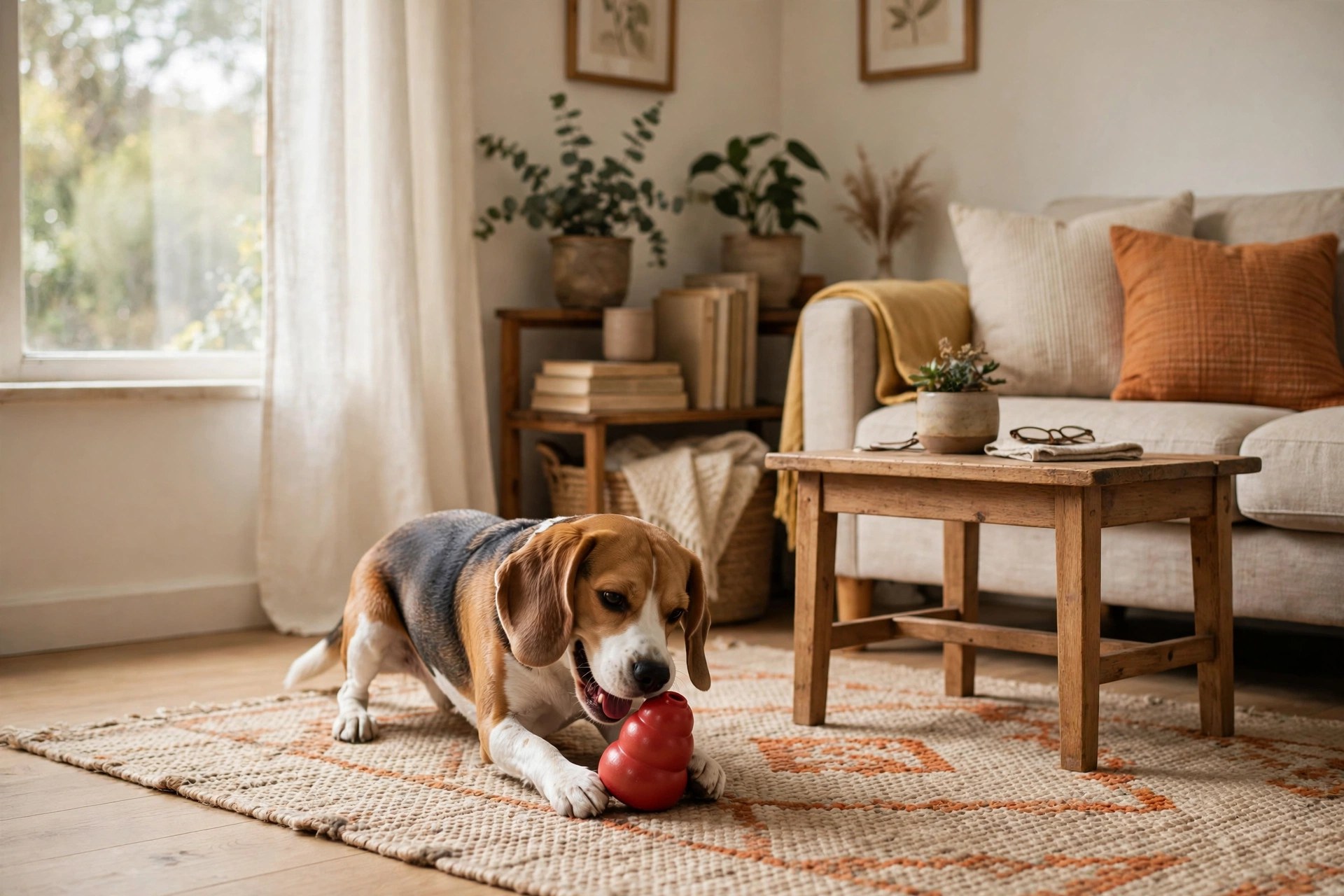
Here is the uncomfortable truth about dog toys in apartments: the toys dogs love most — squeakers, hard bouncing balls, tug ropes slammed into floors — are exactly the ones your neighbors hear. The fix is not fewer toys. It is quieter physics: soft materials, food-based puzzles, and play that happens on rugs instead of hardwood.
Why apartments punish noisy toys
Sound in an apartment travels through two paths: air (barking, squeaking) and structure (thumps, bouncing, skidding). A squeaker toy attacks both — the squeak itself is designed to be piercing, and an excited dog slamming it into a wood floor sends impact noise straight to the unit below. Normal conversation sits around 60 decibels; a squeaker at close range can top 90, roughly as startling as a blender switching on next to your ear. Through a shared wall or floor, that reads as an emergency, not playtime.
There is also a lease dimension most guides skip: many apartment leases and condo HOAs have nuisance clauses, and "the dog's toys" is a surprisingly common trigger for a formal noise complaint. Choosing quiet toys is not just courtesy — it is risk management for keeping your dog in your home.
- Kong Classic — the stuffable workhorse; rubber thud, not a crack.
- West Paw Toppl — softer Zogoflex; quieter on hard floors than a Kong.
- Nina Ottosson Dog Brick — stationary puzzle; nearly silent on a rug.
- PAW5 Wooly Snuffle Mat — nose-work with zero impact noise.
The noise spectrum: what actually bothers neighbors
Think of every toy on a spectrum from silent to eviction-notice. Where a toy lands depends on material, movement, and surface — and you can shift most toys one notch quieter just by moving play onto a rug.
- Silent tier: snuffle mats, lick mats, stuffed frozen Kongs, chew toys worked on a dog bed. Only sounds are chewing and the occasional sigh. Safe at midnight.
- Low tier: soft rubber toys (Toppl, Kong) rolled gently on rugs; fabric puzzle toys. Audible in the room, unlikely to cross a wall.
- Medium tier: hard rubber bouncing on wood floors, rope tugs with enthusiastic shaking, plastic puzzle pieces slid across hard surfaces. Fine at 3 p.m., questionable at 10 p.m.
- Loud tier: squeakers, hard balls bounced indoors, anything thrown against walls. This is the tier that generates complaints.
The practical rule: anything in the loud tier lives at the park, not in the living room. Everything else is negotiable based on your building's construction — concrete high-rises forgive more than wood-frame walk-ups.
Four quiet picks, with honest noise profiles
Kong Classic — the stuffable workhorse
The red snowman-shaped rubber toy is the most recommended dog toy in existence for a reason: stuff it with peanut butter and kibble, freeze it, and you get 20–40 minutes of focused, nearly silent work. The rubber produces a dull thud rather than a crack when dropped, and most of the "play" is licking and nosing, which is inherently quiet. Typical price is usually $10–$25 depending on size — buy by jaw strength (the black "Extreme" version exists for power chewers) rather than by breed charts alone.
Noise profile: silent tier when stuffed and frozen; low tier when thrown empty on hard floors. Apartment verdict: the single highest value-per-decibel toy you can own. Keep two and rotate one from the freezer.
West Paw Toppl — the softer Kong
West Paw's Toppl is made from Zogoflex, a squishier rubber compound than the Kong's. That softness matters in apartments: it lands quieter on wood and tile, and its wide opening is easier to stuff (and clean) than the Kong's narrow neck. It is also dishwasher-safe and, like all West Paw Zogoflex, carries a notably generous replacement guarantee. Typical price is usually $15–$25.
Noise profile: silent to low tier; the softest landing of any stuffable on hard floors. Apartment verdict: the best pick if your floors are hardwood or tile and you play indoors daily. Less durable than a Kong Extreme for truly destructive chewers.
Nina Ottosson Dog Brick — the stationary puzzle
Nina Ottosson's puzzles (the Dog Brick is the classic starter) turn mealtime into a 10–15 minute brain workout: sliding compartments and flip lids the dog must manipulate with nose and paw. Because the dog works in one spot, there is almost no impact noise — the only sound is plastic pieces sliding, which disappears entirely on a rug or mat. Typical price is usually $15–$30. Start at the easiest difficulty; a frustrated dog will pick the whole thing up and shake it, which defeats the purpose.
Noise profile: silent tier on a rug; low tier on bare floors. Apartment verdict: the best "tired brain, quiet apartment" trade for rainy days. Supervise — it is a puzzle, not a chew toy, and determined dogs can gnaw the sliders.
PAW5 Wooly Snuffle Mat — nose work, zero impact
A snuffle mat is a fabric mat with hundreds of fleece strips; you scatter kibble into it and the dog "hunts" with its nose. Ten minutes of snuffling is widely reported by trainers to tire a dog comparably to a much longer walk, and the activity is completely silent — no throwing, no bouncing, no squeaking. The PAW5 Wooly is the best-known branded version and is machine-washable, which matters because snuffle mats collect drool. Typical price is usually $40–$50; unbranded versions run $15–$30 with thinner fabric.
Noise profile: silent tier, full stop. Apartment verdict: the ultimate late-night and early-morning toy. Wash weekly — a smelly snuffle mat gets ignored, and an ignored toy is a wasted toy.
The rotation system that makes 4 toys feel like 12
Dogs habituate: the same four toys available 24/7 become furniture within a week. Toy rotation — keeping half the toys put away and swapping weekly — restores novelty without buying anything. In apartments it has a second benefit: you control which toys are out at noise-sensitive hours.
- Split into two bins: Bin A (daytime) and Bin B (evenings/mornings). Each bin gets one stuffable, one puzzle or snuffle mat, and one chew.
- Swap every Sunday. The "new" toys get a full wash first — clean toys read as novel to a dog's nose.
- Match the bin to the hour. Loud-tier toys never enter either bin; they live in the park bag. Medium-tier toys stay in Bin A for weekend afternoons only.
Total cost of this system: the four picks above, roughly $70–$130 depending on sales, covering months of enrichment. Compare that to a monthly subscription box of squeakers your neighbors will hate.
What to retire (or relegate to the park)
- Squeaker plush toys: the number-one complaint generator. Keep one for outdoor play if your dog is obsessed; indoors, they are a liability.
- Hard plastic balls bounced on wood: the bounce is the problem, not the ball. The same ball rolled on a thick rug drops a full tier on the noise spectrum.
- Rope tugs after dark: the toy is fine; the issue is the dog shaking it against furniture and floors at 11 p.m. Tug is a daytime, supervised, on-the-rug game.
- Unstuffed "flat" squeakers: marketed as quieter, but the squeaker is still there. "Flatter" is not "silent."
FAQ
My dog only likes squeakers. What now?
Do not go cold turkey — you will get a frustrated, louder dog. Transition in steps: first move squeaker play to daytime only and onto a thick rug; then introduce a frozen stuffed Kong alongside the squeaker so the dog builds a second habit; then restrict the squeaker to outdoor walks over two to three weeks. Most dogs transfer their enthusiasm once the food toy reliably pays out.
Are puzzle toys really quieter than balls?
Yes, by design. A ball's fun is movement and impact; a puzzle's fun is stationary problem-solving. A Nina Ottosson puzzle on a rug produces essentially no neighbor-audible sound, while a hard ball bounced on wood flooring transmits through the structure. The trade-off is supervision: puzzles are not chew toys and need to be put away after the session.
How many toys does an apartment dog actually need?
Four to six, rotated — not twenty. One stuffable (Kong/Toppl), one puzzle, one snuffle or lick mat, and one or two chews covers every enrichment category. More toys mostly means more clutter in a small space and faster habituation, which is the opposite of what you want.
Can quiet toys really tire out a high-energy dog?
They help, but they are not a substitute for exercise. Mental work (15 minutes of puzzle or snuffle) plus a solid walk tires most dogs more than an hour of chaotic indoor fetch — and the walk is where the loud, physical play belongs anyway. Think of quiet toys as the "settle" half of the equation, not the whole workout.