How to Stop a Dog From Barking at Hallway Noise in an Apartment
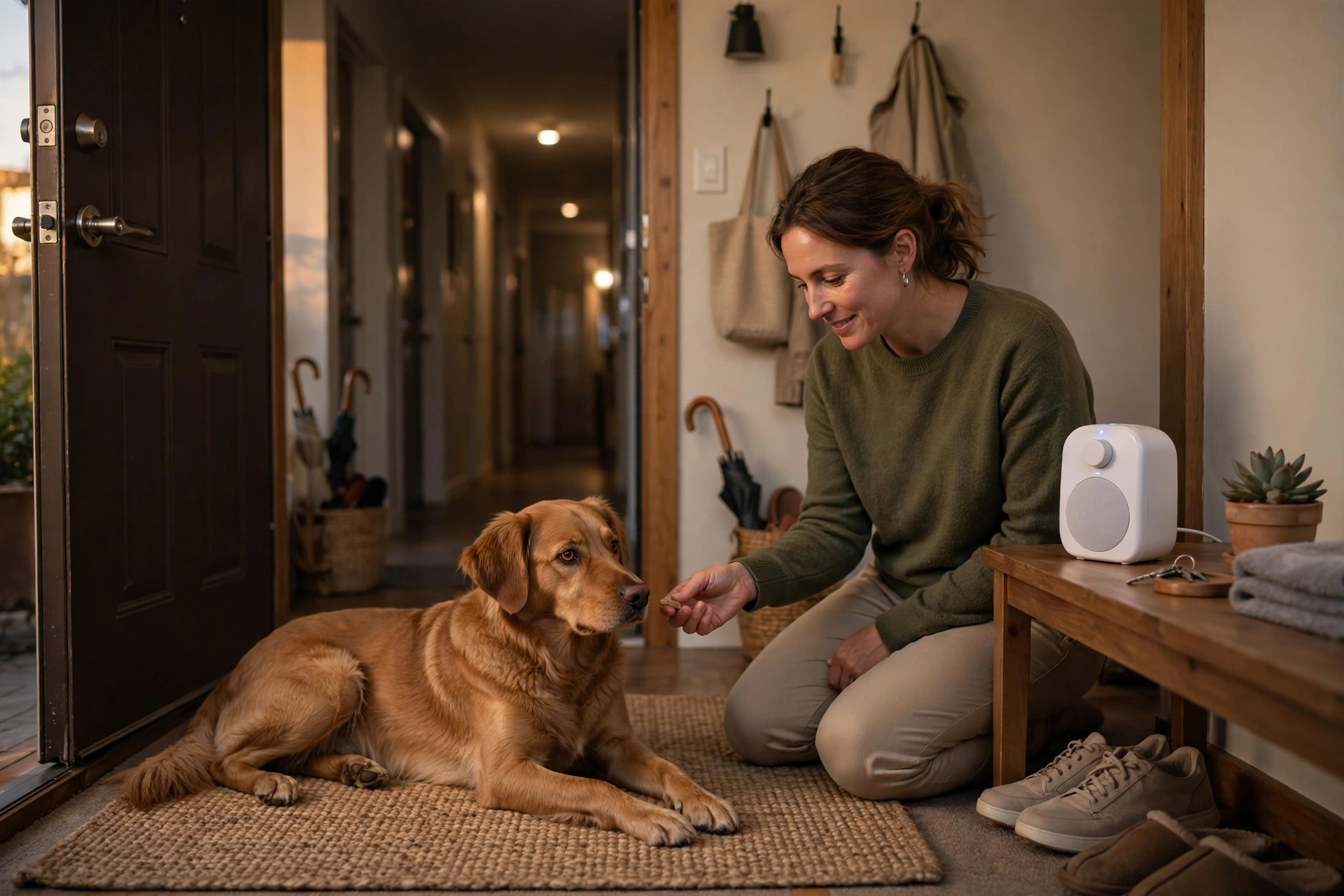
Hallway barking is an apartment-specific behavior problem: your dog is not being "bad," it is guarding a front door that rattles 40 times a day. This is a 14-day plan — week one removes the triggers you can control, week two retrains the response to the ones you cannot. No shock collars, no yelling, no magic.
Why apartment doors make dogs crazy
Understand the mechanism and the fix becomes obvious. Your dog hears a hallway sound (footsteps, keys, elevator ding), cannot see what it is, and the sound stops at your door. From the dog's perspective, something approaches the den and then vanishes — every single time. Barking "works" because the sound always goes away afterward, which accidentally rewards the barking with relief. After a few hundred repetitions, you have a dog on a hair trigger.
- The trigger is ambiguous sound + territorial doorway. Dogs that are silent on walks can be hallway monsters at home.
- Every unanswered bark rehearses the habit. Management (week 1) matters as much as training (week 2).
- Apartments amplify it: thin doors, echoing hallways, and 6 a.m. neighbor departures you cannot control.
Week 1: Management — remove what you can (days 1–7)
Do these before any training. Each one reduces daily barking episodes, which means fewer rehearsals of the habit:
- Sound masking, immediately. A white noise machine (Yogasleep Dohm ~$50, or any ~$25 model) placed near the front door, running whenever you are home. It does not need to be loud — just constant enough to blur the edges of hallway sounds.
- Block the door gap. A draft stopper under the door (~$10–15) cuts both sound and the scent/smell cues that put dogs on alert. It also lowers your heating bill — easy sell.
- Move the dog's station. If the bed or crate is right by the front door, relocate it to the farthest quiet room. Distance from the trigger is the simplest desensitization there is.
- Frost the door viewer area. If your dog can see feet through a glass panel or sidelight, cover the lower half with frosted film (~$10). Removing the visual half of the trigger often halves the reaction.
- Pre-empt the predictable ones. If the upstairs neighbor leaves at 6:40 every morning, have a stuffed Kong ready at 6:35. You cannot stop the trigger, but you can change what the dog is doing when it fires.
Week 2: Retrain the response (days 8–14)
Now teach the dog a new job for hallway sounds. The protocol is "hear it, look at me, get paid" — formally called desensitization with counter-conditioning:
The sound hierarchy
Work from easiest to hardest. Do not advance until the dog is bored at the current level (2–3 sessions, 5 minutes each):
| Level | Sound | How to practice |
|---|---|---|
| 1 | Recorded hallway sounds, low volume | Play phone recordings of footsteps/keys at low volume; treat for calm or looking at you |
| 2 | Recorded sounds, real volume | Same recordings at realistic volume; reward disengagement within 3 seconds |
| 3 | Real sounds, far room | Dog in the back room with you during actual hallway traffic; treat calm behavior |
| 4 | Real sounds, near the door | Practice near the door at off-peak hours; the final exam |
The 3-second interrupt (for real-life episodes)
Training sessions are practice; real hallway noise is the game. When a real bark starts:
- Interrupt once, calmly: say the dog's name or use a trained cue ("enough," "place") — one time, normal voice. Never yell; yelling sounds like barking along.
- Redirect within 3 seconds: cue a known behavior (go to bed, touch your hand). The dog cannot bark and hold a down-stay simultaneously.
- Reward the quiet: the instant the dog disengages, mark and treat. You are paying for the decision to stop, which is the behavior you want more of.
What not to do
- Do not yell "quiet." To the dog, you are barking together. It validates the alarm.
- Do not use shock or citronella bark collars as a first resort. They suppress the symptom without addressing the anxiety, and in apartments the dog cannot escape the trigger sounds — suppression plus inescapable stress is a recipe for worse behavior.
- Do not comfort-flood either. Frantic soothing ("it's okay baby!") during barking can reinforce the arousal. Calm, boring redirection beats emotional reassurance.
- Do not skip week 1. Training a dog that is still rehearsing 30 barking episodes a day is like bailing a boat without plugging the hole.
Neighbor diplomacy (do this on day 1)
While the plan runs, protect your lease: introduce yourself to adjacent neighbors, acknowledge the barking honestly, and tell them you are actively training with a two-week plan. People tolerate enormous amounts of noise from someone who is visibly trying. They tolerate almost nothing from someone who seems oblivious. If your building has quiet hours, know them exactly and be extra strict during those windows.
Is your building the real problem?
Sometimes the honest answer is environmental. Before blaming the dog, score your setup:
- Door quality: a hollow-core interior-style door on an apartment entry transmits far more sound than a solid fire door. If you can hear full conversations through yours, the dog hears everything — management (week 1) matters more than training.
- Hallway traffic: ground-floor units near the lobby or elevator bank get 10× the triggers of a top-floor corner unit. If you are choosing between units, this is a legitimate selection criterion for dog owners.
- Your schedule: a dog alone 10 hours with no midday break will bark more than the same dog with a walker visit. Sometimes the "barking problem" is an exercise problem wearing a costume.
If the building is genuinely extreme (paper-thin walls, constant traffic), be realistic: management tools plus a solid routine can reduce barking dramatically, but no training plan makes a territorial breed silent next to an elevator bank. Set the goal as manageable, not silent.
FAQ
How long until the barking actually stops?
Management (week 1) usually cuts episodes noticeably within days. The retrained response (week 2) typically takes 3–6 weeks of consistent practice to become reliable. Dogs with a year+ of rehearsed hallway barking take longer than puppies — habits have momentum.
Will a bark collar work faster?
It may suppress barking faster, but suppression is not training — and in an apartment the triggers never stop coming, which makes fallout behaviors (anxiety, redirected aggression) more likely. Try the 14-day plan first; it addresses the cause.
My dog only barks when I'm not home. Does this plan still apply?
Yes, but add a camera to confirm the pattern and lean harder on week-1 management (white noise on a timer, Kong before departure). Alone-time barking overlaps heavily with separation anxiety — if the dog is also destructive or drooling, read our separation anxiety guide too.
What if my neighbor has already complained to management?
Respond in writing: acknowledge, describe your specific training plan with a timeline, and give them your number for direct contact. A documented good-faith effort is your best protection if it escalates. Then actually follow the plan — management can tell the difference.