How to Stop a Dog From Guarding the Front Door
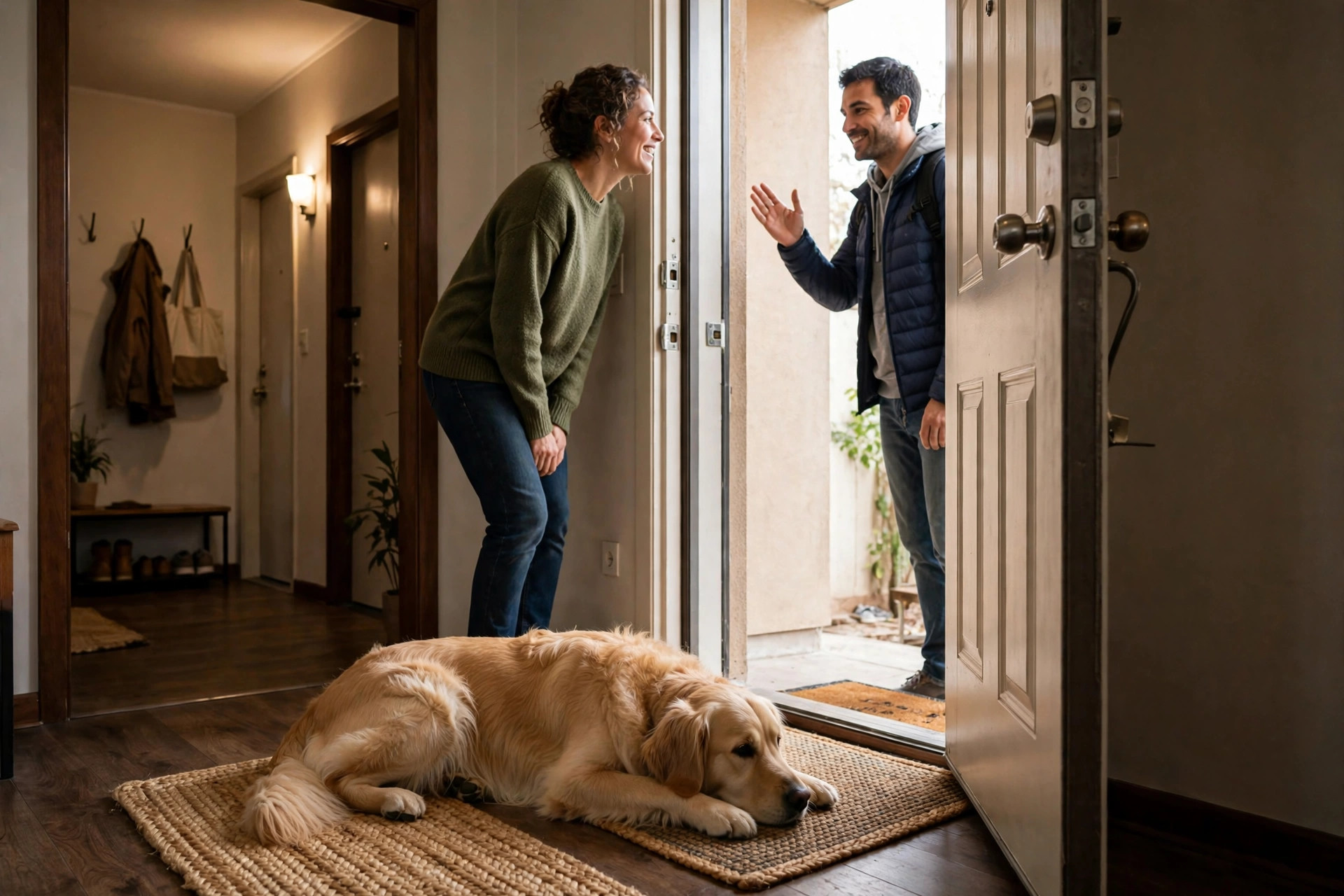
There is a difference between a dog that barks at the door and a dog that owns the door. The barker makes noise; the guarder stations itself in the entryway, stiffens when anyone approaches the threshold — including you — and treats every knock, guest, and delivery as a territorial event. In an apartment, where the front door is ten feet from the couch and the hallway outside belongs to everyone, guarding escalates fast: neighbor complaints, scary moments with visitors, and in the worst case, a bite at the threshold. This guide separates guarding from ordinary alert barking, then rebuilds the dog’s door behavior from safety-first management up.
- Guarding is not dominance — it is anxiety about losing control of a high-value zone. Punishing it usually makes it worse.
- Manage first: no unsupervised door access, leash or gate at the threshold, and visitors who never reach past the dog.
- Change the emotional response with desensitization: knock sounds and door motion predict high-value treats, not confrontations.
- Give the dog a trained “door job” — a mat settle away from the threshold — so calm behavior has somewhere to go.
- Stiffening, hard stares, or snapping over the doorway are professional-territory signs. Get a certified trainer before it escalates.
Guarding vs. alert barking: know which one you have
Accurate diagnosis decides the plan. Alert barking is noisy but loose: the dog barks at the knock, runs to the door, maybe jumps, then de-escalates once you acknowledge it. Body language stays bouncy — wagging tail, play bows mixed in, easily redirected with a treat or a toy. That dog needs the quiet cue and impulse control, covered in how to teach a dog the quiet command in an apartment.
Guarding looks and feels different. The dog positions itself at the door unprompted — lying across the entryway, sleeping with its head toward the threshold. When someone approaches, the body goes still and stiff rather than bouncy. You may see a hard stare, a closed mouth, raised hackles along the shoulders, or a low growl that was not there a month ago. The dog may block family members from the door, not just strangers, and may escalate when people move quickly through the entryway. If your dog has snapped, lunged, or bitten at the threshold — or if you are unsure which category fits — skip the DIY section below and read when to call a professional first.
Safety first: manage the threshold
Guarding is rehearsed every time the dog successfully controls the doorway, so the first step is removing the rehearsal — not through confrontation, but through architecture. The dog should not have free access to the front door zone until the new behavior is trained.
Gate the entryway. A tension-mounted pet gate ($40–$80) or a freestanding exercise-pen panel across the hallway keeps the dog a few feet back from the actual door. This single change does three things: it prevents the dog from practicing the charge-and-block, it gives visitors a safe buffer, and it lowers the dog’s arousal because the “territory” it must defend just shrank. In a studio where gating the door is impractical, a leash tethered to a heavy piece of furniture (never tied to the dog’s collar for long periods — use a harness) achieves the same distance during high-traffic times.
Change the visitor mechanics. Until training progresses, guests do not reach toward, over, or past the dog — they toss treats behind the dog so it turns away from the door to collect them. You answer the door with the dog already behind the gate, leashed, or settled on its mat. Delivery drivers get a “please leave at door, do not knock” note (more on this in our hallway-noise barking guide). Every safe, boring doorway crossing is a rep the old habit does not get.
Never punish the growl. A growl is information — the dog’s warning system working as designed. Punishing growling does not remove the underlying discomfort; it removes the warning, leaving a dog that goes from stiff to snap with no audible signal. If the dog growls, calmly increase distance and note what triggered it. That trigger list becomes your desensitization curriculum.
The knock-means-treats protocol
Desensitization changes the emotion, not just the behavior. The goal: door sounds and door motion predict wonderful things, until the dog’s gut response to a knock shifts from “threat” to “payday.” Work in short sessions (5 minutes, 2–3 times daily), and keep the dog below the reaction threshold the entire time — if the dog is already stiff and staring, you are too close to the trigger and need more distance or a quieter sound.
Week 1: sound at low volume. Play recorded knock and doorbell sounds from your phone at a volume so low the dog notices but does not react — ears up, then back to what they were doing. Each sound earns a high-value treat (real meat, cheese — kibble will not cut it for this work). Ten reps per session. Gradually raise the volume across the week, always staying under the reaction threshold.
Week 2: real door motion, no visitors. Walk to the door, touch the handle, open it two inches, close it — treat each step. Then open it fully to an empty hallway, treat, close. Then step out and back in, treat. You are decoupling “door moves” from “intruder arrives.” If the dog stiffens at any step, drop back to the previous step for another day; progress is measured in calm repetitions, not in steps completed.
Week 3: staged visitors. Recruit a friend. They knock softly, you treat the dog for noticing calmly, the friend enters, tosses a treat behind the dog, and leaves without fanfare. Over sessions, the knock gets normal volume and the visitor stays a minute longer. The visitor never pets, reaches for, or crowds the dog — boring guests are the goal. Ten to fifteen calm visitor reps across the week rewires the association for most mild guarders.
| Sign | Alert barking | True guarding |
|---|---|---|
| Body at the door | Bouncy, loose, wagging | Still, stiff, weight forward |
| Positioning | Runs to door when triggered | Stations at door unprompted |
| Toward family | Friendly, redirectable | May block or stiffen at family too |
| Growling | Rare, play-adjacent | Low, sustained, or escalating |
| After trigger passes | Settles in minutes | Stays aroused, patrols |
Teach the door job: mat settle away from the threshold
A dog with no assigned behavior at the door will invent one, and “guard” is the default invention. The replacement is a mat settle positioned away from the door — six to ten feet back, ideally around a corner or with a partial sightline rather than a front-row seat. A dog that can lie down and watch calmly is a dog that is not practicing territorial control.
Train it in three phases. Phase 1 (days 1–5): the mat pays generously for simply being on it — treat every few seconds at first, then stretch the intervals. Train at calm times, nowhere near the door. Phase 2 (days 6–12): move the mat to its door station and rehearse “door happens, you go to mat” with staged low-intensity triggers (you walking to the door, touching the handle). Phase 3 (week 3+): real knocks and real visitors, with the dog sent to the mat before you open the door. The sequence becomes ritual: knock → mat → treats rain → visitor enters boringly. Rituals are powerful because they give an anxious dog a script — and a dog running a script is not improvising guard duty.
Pair this with how to teach a dog to settle on a mat if the settle itself needs foundation work first.
The visitor script that doesn’t undo your training
Guests are the wildcard, because every visitor arrives with their own dog theory (“let him sniff my hand!”). Send a 30-second text before anyone comes over: “We’re training door manners — when you arrive, please ignore the dog completely, don’t reach for him, and I’ll toss him treats. He’ll settle faster if he’s boring to you.” Most people comply happily once they understand it helps.
For the dog, the guest protocol is fixed: dog behind gate or on mat before the door opens; guest enters, tosses a treat behind the dog (turning it away from the threshold), sits down; dog is released only when loose and calm, and the guest continues ignoring until the dog disengages first. No entryway wrestling, no “say hi to the doggy” pile-ons. It feels formal for two weeks and then becomes the house normal.
Hallway encounters need their own rule, since apartment hallways are shared territory the dog may try to extend its guard zone into. Keep hallway transits short, leashed, and businesslike — no lingering at the door chatting while the dog scans. The elevator etiquette guide covers the same principle for the building’s other shared chokepoints.
Guarding is an anxiety behavior wearing a tough costume. The dog that stiffens at the door is not confident — it is worried about what comes through it. Every protocol here works by reducing that worry: smaller territory to defend, predictable rituals, and visitors who turn out to be treat dispensers. Confidence is built, not demanded.
When to call a professional
DIY desensitization handles mild to moderate guarding — stiffening, blocking, grumbling that de-escalates with distance. Call a certified professional (look for CPDT-KA, IAABC, or a veterinary behaviorist DACVB) if you see any of these: snapping or biting at the threshold, guarding that extends to furniture or people (not just the door), guarding that appeared suddenly in an adult dog (rule out pain first with a vet visit), or any incident where someone was frightened or hurt. Be wary of any trainer who recommends dominance-based corrections, alpha rolls, or punishment for growling — those approaches suppress warning signals and are associated with increased bite risk. A good behavior professional will do exactly what this guide does — management, desensitization, replacement behavior — with a plan calibrated to your dog and your floor plan.
FAQ
Is my dog guarding the door or just being protective of me?
“Protective” implies the dog is defending you from real threats; guarding is about controlling a space regardless of actual danger. The practical test: does the dog also stiffen or block when family members approach the door, or when a friend you clearly welcome comes in? If yes, it is guarding a zone, not protecting a person — and it needs the protocol above, not praise for loyalty.
Should I punish the growling at the door?
No. Punishing growling removes the warning without removing the underlying discomfort, which can produce a dog that skips straight to snapping. Treat growling as data: note the trigger, increase distance, and add that trigger to your desensitization plan at a lower intensity.
How long does the desensitization protocol take?
Mild guarding often shows clear improvement in 3–4 weeks of consistent short sessions. Moderate cases take 6–12 weeks. If you see zero change after 3 weeks of correct practice — staying under threshold, high-value rewards, managed rehearsals — that is useful information that the case needs professional assessment, not more of the same.
My dog is fine with guests once they’re inside. Is that still guarding?
Yes — threshold-specific guarding is the most common pattern. The doorway is the contested zone; once the visitor is “inside the territory,” the dog’s concern drops. The protocol still applies, because the risk moment (the threshold crossing) is exactly where incidents happen.