Best Portable Pet First Aid Kits for City Walks
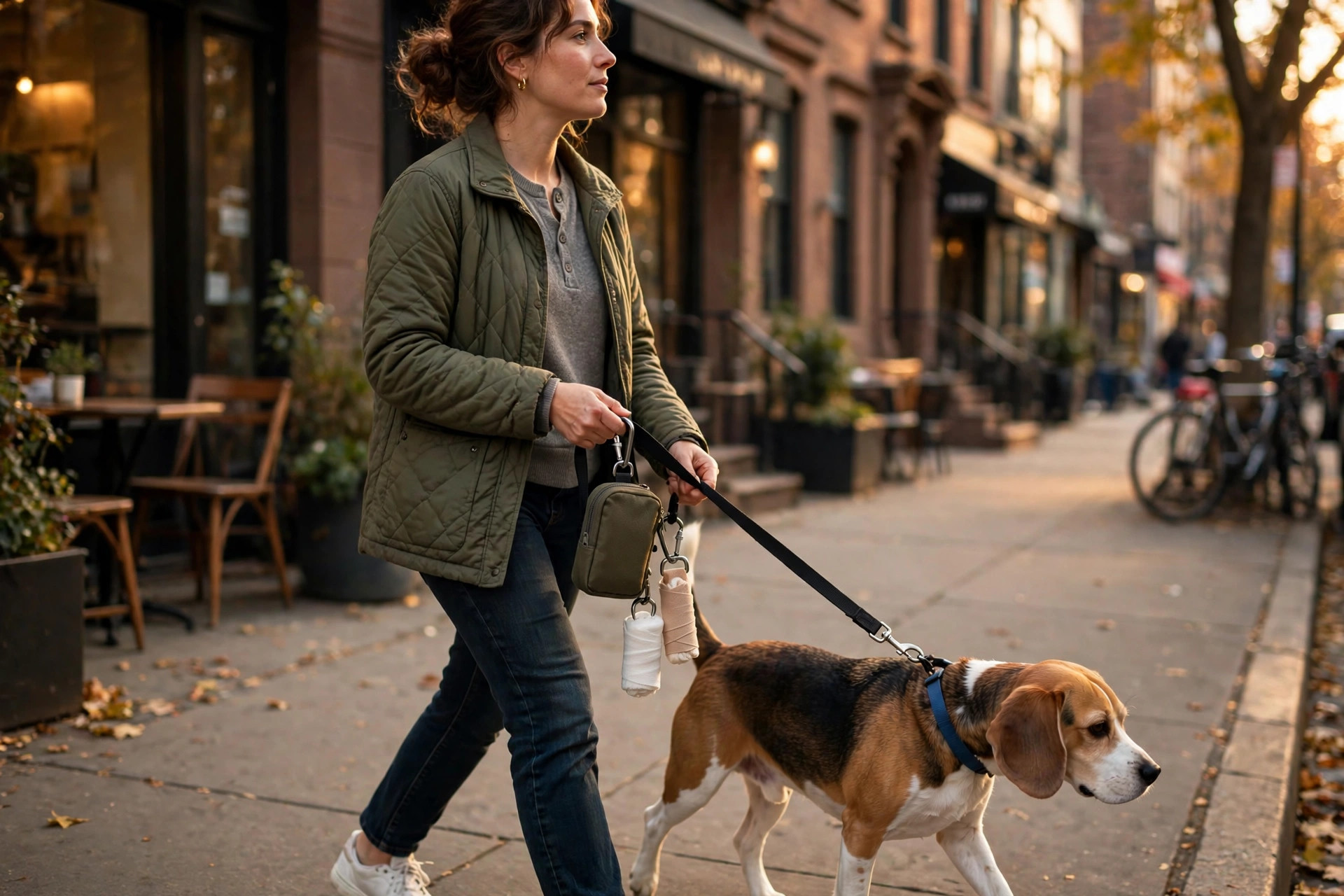
City sidewalks are an obstacle course for paws: broken glass by the bus stop, a discarded chicken bone, winter salt that burns pads, the occasional off-leash surprise. Your apartment’s full first-aid kit is a fifteen-minute walk away when something happens at the far end of the route. A portable kit — a pouch no bigger than a phone, clipped to the leash or living in your treat bag — closes that gap. It will not replace a vet. It will turn a panicked bleed into a controlled ten minutes.
What actually happens on city walks
Walk-injuries in cities cluster around a short list, and a portable kit is built for exactly these:
- Cut pads. Broken glass, metal can lids, and sharp gravel are the top walk injury. A pad cut bleeds dramatically — paws are vascular — and a dog that will not bear weight three blocks from home needs a pressure bandage now, not at home.
- Torn nails. A nail catching on a metal stair tread or a sidewalk grate edge tears at the quick. Styptic powder stops it in seconds; without it, the dog paints the sidewalk and you learn how long a nail bleeds (a long time).
- Salt and chemical irritation. Winter de-icing salt burns pads and, worse, gets licked off and ingested. A water rinse on the spot plus paw balm afterward is the protocol — which means carrying water and wipes.
- Minor bites and scrapes. Off-leash encounters happen even in leash-law cities. Small punctures need cleaning and covering until a vet sees them the same day.
- Stings and allergic swelling. Bees work the same flower beds your dog sniffs. A muzzle swelling shut on the walk home is an emergency-vet situation, but antihistamine (only with prior vet dosing guidance) buys time.
Notice what is not on this list: anything requiring diagnosis. A walk kit stabilizes and covers. The decision of “vet now or vet tomorrow” is covered in our apartment pet first-aid basics guide, which is the companion read to this one — build the home kit there, carry the walk kit here.
Four portable kits worth carrying
| Kit | Size / weight | Typical price | Best for |
|---|---|---|---|
| Adventure Medical Kits Dog Series — Trail Dog | ~4×6 in, 5 oz | Usually $22–$28 | The benchmark; leash-clippable pouch, real contents. |
| RC Pet First Aid Kit | ~5×7 in, 7 oz | Usually $20–$26 | Built by a pet-gear company; better bandage selection. |
| Arf Pets Pet First Aid Kit | ~6×8 in, 9 oz | Usually $28–$35 | Largest of the portable kits; good if you also hike. |
| DIY treat-bag build | Fits any pouch you own | Usually $12–$18 in parts | Zero bulk; contents matched to your dog’s actual risks. |
Adventure Medical Kits Trail Dog — the one to beat
Adventure Medical Kits makes human wilderness first aid, and their dog kit inherits that discipline: every item earns its weight. The Trail Dog pouch clips to a leash or belt loop and holds gauze, self-adhesive wrap, antiseptic wipes, tweezers, a tick remover, and an emergency muzzle — the last being the item most pet kits skip and the one you most need, because even gentle dogs bite when in pain. The included booklet is a genuinely useful field reference, not filler. At $22–$28 and five ounces, there is no excuse not to carry it. Restock the used items after each incident; the pouch is designed to be refilled, not replaced.
RC Pet First Aid Kit — the pet-company take
RC Pet Products built their kit around the injuries their customers actually report: the bandage selection is stronger than the Trail Dog’s (more wrap, better pads), and it includes a digital thermometer — unusual in a portable kit and genuinely useful, since fever is the field test that decides “vet now.” Slightly larger and heavier at seven ounces, but still treat-bag territory. The zip pouch is water-resistant, which matters when it lives in a bag with a water bottle. Typical price $20–$26.
Arf Pets Pet First Aid Kit — the maximalist portable
The Arf Pets kit is the biggest you can still call portable: roughly twice the contents of the Trail Dog, including a cold pack, an LED light, and more dressing variety. It suits owners whose “city walk” extends into ravine trails and greenways where help is farther away — the cold pack, for instance, matters for a sprain a mile from the car. At nine ounces it is too bulky for a treat pouch; clip it to the leash handle or carry it in a jacket pocket. $28–$35.
The DIY build — twelve dollars, zero excuses
A pre-made kit is convenience; a DIY build is precision. Assemble this in any zip pouch you already own, for about $12–$18 in parts from a pharmacy:
- Self-adhesive vet wrap, 2-inch ($4–$6). The single most useful walk item: holds a pressure pad on a paw without tape.
- Two non-stick gauze pads ($2). For the cut pad: pad, pressure, wrap.
- Styptic powder stick ($5–$8). Torn nails stop in seconds.
- Alcohol-free antiseptic wipes, 4-pack ($2). Clean the wound before you wrap it.
- A spare slip leash ($8–$12) or 3 feet of paracord. A collar can break or slip; a backup leash turns an escape into an inconvenience.
- Poop bags (you already carry these). Double as emergency gloves, a water scoop, and a dirty-bandage bag.
Tape your vet’s number and the nearest 24-hour emergency hospital address inside the pouch lid on an index card. Phones die; paper does not.
The walk kit’s job is ten minutes of calm: stop the bleeding, cover the wound, keep the dog still, and get home or to the vet without panic. Everything in it should be usable one-handed while the other hand holds the leash — if it needs two hands and a flat surface, it belongs in the home kit.
How to actually carry it (so it’s there when it counts)
The best kit is the one on the walk. Three carrying systems that survive real routines:
- Clipped to the leash. A carabiner through the pouch’s loop onto the leash handle. Always there, never forgotten, adds five ounces you stop noticing in a week. The downside: it swings, and small pouches can work the clip loose — check it monthly.
- In the treat pouch. If you walk with a treat bag (training, reactive-dog work), the DIY contents fit inside alongside treats. One bag, one clip, everything for the walk.
- The grab-and-go hook. Hang the kit on the same hook as the leash by the door. The rule is binary: leash leaves the hook, kit leaves the hook. No decisions, no forgetting.
Whatever system you choose, audit it twice a year: used-up wrap, dried-out wipes, and expired ointment are the silent killers of kits that have been “ready” for two years. Tie the audit to something you already do — smoke-detector battery day, or the spring/fall clock change.
Three field protocols to memorize
Read these once, calmly, at home. In the moment you will not be reading anything.
Cut pad. Sit the dog (treat for compliance). Press a gauze pad firmly onto the cut for a full 3 minutes — no peeking. Wrap with vet wrap: two turns above the ankle, spiral down over the pad, two turns below. Snug, not tight: you should be able to slide a fingertip under the wrap. Head home. If blood soaks through within minutes, add wrap on top and head to the vet instead.
Torn nail. Press the styptic stick directly into the nail tip for 10–15 seconds of steady pressure. It looks worse than it is — nail beds bleed dramatically from small tears. If the nail is dangling or bleeding restarts after you release, that is a same-day vet visit.
Salt-burned pads. Rinse each paw with clean water (carry a squeeze bottle in winter, or buy one at the corner store). Do not let the dog lick the salt off — ingestion is the bigger risk. Apply paw balm when home; our paw cleaner guide covers the rinse-then-balm routine in detail, and dog boots for winter sidewalks prevent the problem entirely.
FAQ
Can I just carry my phone and call the vet instead of a kit?
A phone does not stop bleeding. The vet is fifteen minutes away; a pressure bandage is fifteen seconds away if it is on your leash. Carry both — the kit stabilizes, the phone gets you advice and directions.
How often should I replace items in a portable kit?
Audit twice a year and after every use. Antiseptic wipes dry out, vet wrap loses its stick in heat, and styptic powder clumps with moisture. A kit that has sat in a hot car or a damp entryway for two years is decoration, not equipment.
Should I carry Benadryl for stings?
Only with a pre-arranged dose from your vet — the correct dose is weight-dependent, and the wrong formulation (anything with xylitol or added decongestants) is dangerous. Ask your vet at the next visit: “what should I carry for a sting on a walk, and what dose?” Then carry exactly that.
What about a muzzle — my dog would never bite.
Every dog can bite when in severe pain; it is reflex, not temperament. A fabric emergency muzzle (or a strip of gauze as an improvised one) protects you while you treat a wound. The Trail Dog kit includes one for exactly this reason. Never muzzle a vomiting, coughing, or overheated dog.