Best Dog Boots for City Sidewalks in Winter
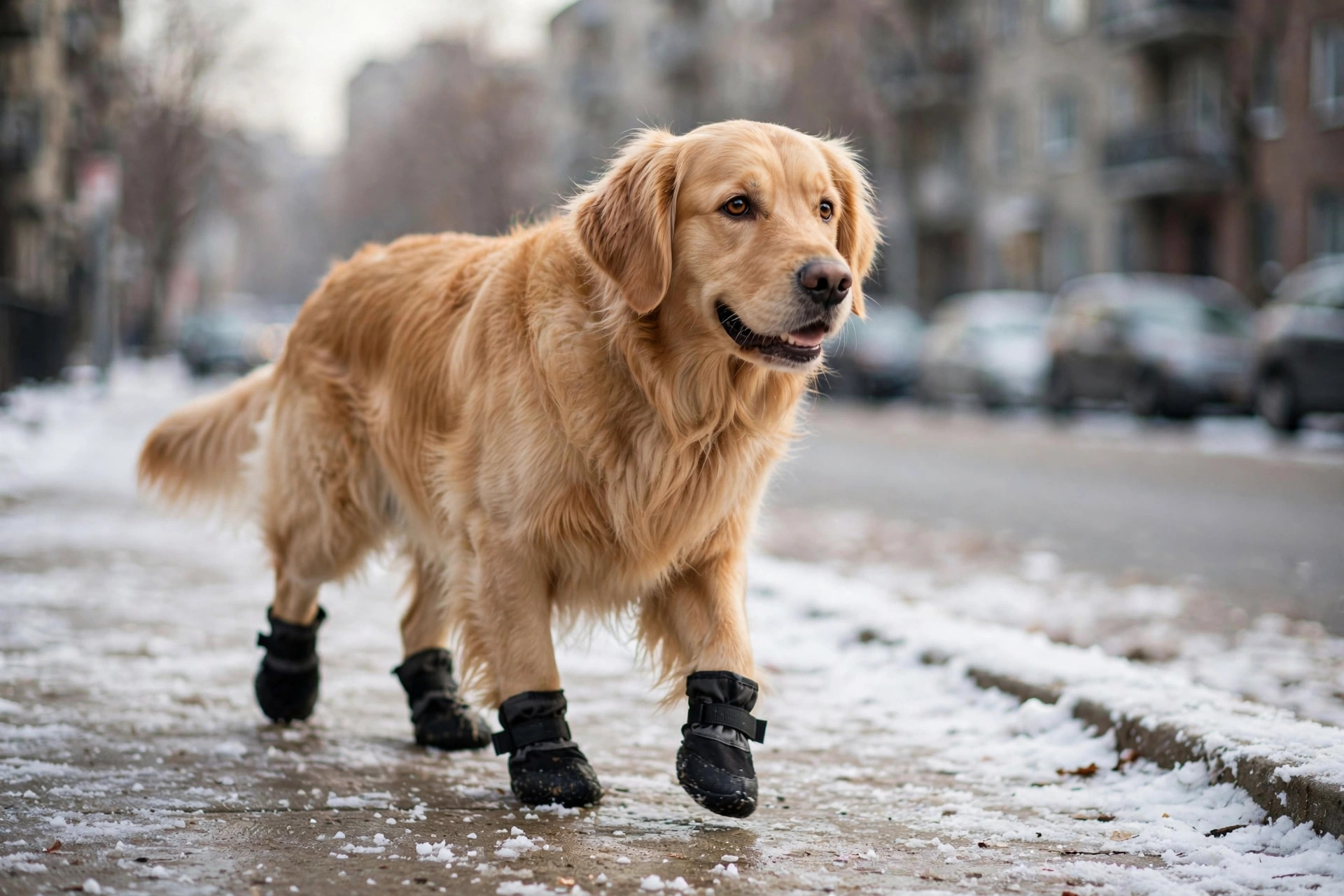
City sidewalks in January are not a natural surface. They are a slush of road salt, de-icing chemicals, antifreeze drips, and meltwater that refreezes into razor-sharp ridges. For an apartment dog that walks the same three blocks three times a day, boots are not a fashion statement — they are the difference between a willing walker and a dog that limps home licking cracked pads. The catch: most boots fail at the one job that matters in the city, which is staying on for a full walk.
- Boots exist to block salt and chemicals first, cold second. If your sidewalks get salted, your dog benefits from boots regardless of breed.
- Stay-on design matters more than insulation. A loose boot left on a sidewalk is a lost boot; a boot that rotates causes rub sores.
- Budget $20–$55 for a set of four. Disposable rubber boots cost less per pack but add up over a winter of daily walks.
- Measure the paw width in inches — never buy by breed chart alone. Front and back paws are different sizes on most dogs.
- Expect a 3–5 day getting-used-to-it period. Start indoors on carpet before the first sidewalk walk.
Why city sidewalks are harder on paws than snow
A dog running in a snowy field is dealing with one problem: cold. A dog walking a salted city block is dealing with four:
- Road salt (sodium chloride). The cheap white crystals cities spread by the ton irritate paw pads, dry the skin between the toes, and cause the classic mid-walk limp-and-lick. Salt also stings any existing crack, which is why a dog that walked fine in December starts struggling in February.
- De-icing blends (magnesium and calcium chloride). These work at lower temperatures than rock salt, so they dominate the coldest weeks. They are more irritating to paws than plain salt and more toxic if licked off — another reason paws need covering rather than just rinsing.
- Antifreeze and road grime. Puddles in winter collect ethylene glycol drips from parked cars along with oil residue. Antifreeze is extremely toxic to dogs in small amounts, and a dog that licks slush off its paws is dosing itself with whatever the street left behind.
- Freeze-thaw texture. Meltwater refreezes overnight into ridged, sharp ice that abrades pads with every step. This is the mechanism behind the hairline cracks that show up as bleeding pads two days after a walk you thought went fine.
Rinsing paws at the door — a paw cleaner cup handles this in about a minute — is still essential for chemical removal, but rinsing cannot undo a full walk of salt exposure. Boots prevent the contact in the first place.
Five boots that survive real sidewalk winters
Every boot below is a real, widely sold product with a track record on actual winter streets — no costume footwear, no single-review novelties. Prices move with sales; treat the ranges as typical street prices for a set of four.
| Boot | Best for | Usually | Sidewalk note |
|---|---|---|---|
| Ruffwear Grip Trex | Most city dogs | $45–$55 | Vibram sole, secure closure; the stay-on champion |
| Pawz Water-Proof Dog Boots | Budgets and reluctant wearers | $15–$20 per 12-pack | Balloon-style rubber; disposable, surprisingly secure |
| Canada Pooch Soft Shield Boots | Dogs that kick off everything | $35–$50 | Suspender system over the back; nearly impossible to lose |
| Ultra Paws Durable Dog Boots | Wide paws and seniors | $30–$40 | Wide opening, foam padding; easy on/off for stiff dogs |
| Kurgo Blaze Cross Dog Shoes | Night walkers | $35–$45 | Reflective trim, breathable mesh; good all-winter pick |
Ruffwear Grip Trex — the everyday pick
The Grip Trex is the boot other boots get compared against for a reason: a Vibram rubber sole with real tread, a hook-and-loop closure that cinches above the ankle where the leg narrows (the anatomical trick that keeps them on), and a breathable mesh upper that does not turn into a sweat sock. On salted sidewalks the sole puts a genuine barrier between pad and chemicals, and the tread helps on the icy patches bootless dogs skate across. They run about an hour of getting-used-to-it awkwardness, then most dogs forget them. The price stings, but a set that survives three winters costs less per walk than disposables.
Pawz Water-Proof Dog Boots — the cheap experiment
Pawz are thick rubber balloons that stretch over the paw like a sock — no straps, no soles, no structure. They sound ridiculous until you see how well they stay on: the rubber grips the fur and the paw’s own shape does the rest. At roughly a dollar a boot, they are the perfect first experiment to answer the question “will my dog tolerate anything on its feet?” They also work as a liner under fancier boots in the coldest weeks. Downsides: zero insulation, zero traction on ice, and they wear through on rough concrete in a few walks. Treat them as single-digit-use consumables, not season gear.
Canada Pooch Soft Shield Boots — the stay-on pick
Some dogs are escape artists — every boot lasts one block. The Soft Shield system solves this with suspenders: the four boots connect to adjustable straps that cross over the dog’s back, so a boot physically cannot be kicked off and abandoned on the sidewalk. The boots themselves are soft-shell with a grippy sole, comfortable enough for daily use. The tradeoff is a slightly longer fitting routine at the door (threading four suspenders takes practice) and the straps need periodic re-tightening. For serial boot-losers and long-legged breeds whose ankles taper sharply, this is the fix.
Ultra Paws Durable Dog Boots — the wide-paw pick
Big, wide, or arthritic paws struggle with narrow boot openings — forcing a stiff senior paw into a tight neoprene cuff is nobody’s idea of a good morning. Ultra Paws opens wide, slides on easily, and closes with a combination of velcro and an elastic toggle; foam padding around the ankle prevents the rub sores that end many boot experiments. The sole is a coated fabric rather than molded rubber, so traction is middling on ice, but for salt protection and ease of use on a less-mobile dog, they are the kindest option here.
Kurgo Blaze Cross Dog Shoes — the night-walk pick
Winter means the 6 a.m. and 7 p.m. walks happen in full dark. The Blaze Cross wraps reflective trim around every boot — visible from the sides, which is the angle drivers actually see at crosswalks — on top of a breathable mesh-and-synthetic upper with a molded sole. The dual closure (velcro strap plus a cinch cord) stays put on medium-energy walkers. They are less rugged than the Ruffwear for daily heavy use, but as an all-rounder for a dog that mostly needs salt protection and visibility, they hit a sensible middle.
Boot budget math for one winter: a $50 reusable set used 200 times costs $0.25 per walk. A $17 pack of 12 Pawz used for the same 200 walks costs about $1.42 per walk — and generates 200 pieces of rubber waste. Reusables win on cost by the second winter; disposables win only for dogs that destroy everything.
The 90-second paw-measuring guide
Buying by the breed label on the package is the number-one reason boots end up in a drawer. Two measurements settle it — do this in the evening, when paws are at their fullest after a day of standing:
- Trace the paw. Have your dog stand on a piece of paper with the paw flat and the nails relaxed. Mark the widest point and the longest point (heel to nail tip). Measure both in inches.
- Do all four paws. Front paws are almost always wider than rear paws — often by half a size. Buying one size for all four feet guarantees two boots that swim and two that pinch.
- Compare width first. Most sizing charts list length, but width is what decides whether the boot stays on. If the length fits but the width does not, the boot will rotate no matter how tight you cinch it.
Between sizes? For salt protection (not deep cold), size up — a slightly roomy boot with a snug ankle closure still works, while a tight boot cuts circulation and the dog starts dreading the routine. For the coldest weeks, a snugger fit with a Pawz liner underneath beats a loose single boot.
The 5-day boot acceptance plan
Almost every dog does the comedy high-step when boots first go on. That is normal — it is not rejection, it is surprise. What turns surprise into acceptance is a short indoor protocol, not a forced march:
- Day 1: one boot, five minutes. Put a single boot on a front paw, treat generously, walk around the apartment. Remove before the dog gets frustrated. Goal: boots predict treats.
- Day 2: two front boots, ten minutes. Short indoor play session. Most dogs start walking normally within minutes once the novelty fades.
- Day 3: all four, twenty minutes indoors. Practice your at-the-door routine — sitting for each boot, standing for the cinch. Keep it cheerful and fast.
- Day 4: all four, one short block. The first outdoor walk should be short and boring. Bring treats; reward ignoring the boots and walking normally.
- Day 5: normal walk. By now the high-step is usually gone. If one boot keeps coming off, the size or closure on that paw needs adjusting — do not just tighten everything and hope.
Dogs that freeze and refuse to move are almost always reacting to a boot that pinches or to all four going on at once on day one. Back up a step, go slower, and check the fit on the paw that gets chewed first — chewing one boot means that one boot hurts.
Three winter-boot mistakes that end the experiment
2. Skipping the dry-out between walks. Three walks a day means three rounds of damp boots. A boot that never fully dries breeds odor and, worse, gets put onto the paw damp and cold next time — which is how you create a dog that hates boots. Rotate two sets, or at minimum air-dry on a rack between walks.
3. Using boots as a substitute for paw checks. Boots protect against salt, not against the small cut picked up on an icy curb or the ice ball packed between the toes. After every winter walk, boots off first, then a 30-second paw inspection: pads, between the toes, nail length. The entryway routine stays the same — the boots just make it shorter.
FAQ
Does my dog really need boots, or is this overkill for city life?
If your city salts its sidewalks, boots earn their keep for most dogs. Salt irritation is cumulative — pads that handle it in December can be cracked and bleeding by February. Small, short-haired, and senior dogs benefit most; thick-coated northern breeds on unsalted paths may genuinely not need them.
Can I just use paw wax instead of boots?
Paw wax helps against cold and minor dryness, but it does not create a real barrier against dissolved salt and de-icing chemicals — which is the main winter sidewalk hazard. Think of wax as a supplement for the days boots feel like overkill, not a replacement on salted streets.
My dog chews one boot off every walk. What is wrong?
Almost always a fit problem on that specific paw, not defiance. Re-measure that paw — it is usually wider than you assumed — and check for a strap edge rubbing the ankle. Dogs target the boot that hurts; the other three staying on is the clue.
How do I clean winter boots between uses?
Shake off loose salt, wipe with a damp cloth, and air-dry — never on a radiator, which melts adhesives and stiffens rubber. Once a month, rinse fabric boots in warm water with a drop of mild soap. A boot that smells like a swamp is a boot the dog will start resisting.