Best Dog Raincoats for City Walks
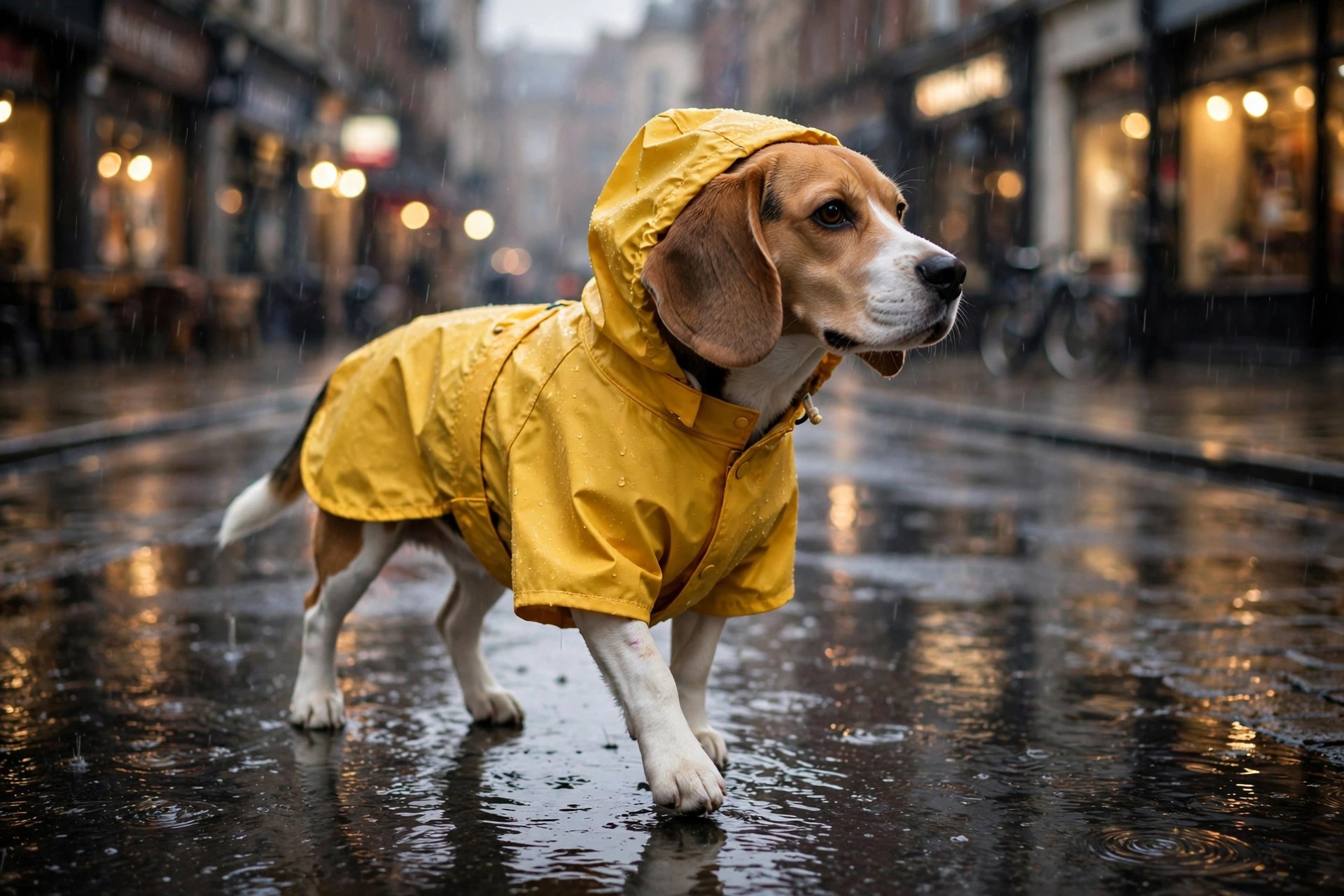
A rainy Tuesday walk in the city is its own special chaos: puddle water with a faint rainbow sheen, a hallway that turns into a slip-and-slide, and that wet-dog smell moving into your one-bedroom like it pays rent. Let’s be honest up front: no raincoat keeps a dog dry. What a good one does is turn a 20-minute dry-off into a 5-minute one, keep road grime off the belly and legs, and save your hallway rug from a daily beating. For apartment life, the right raincoat is also one that dries fast on a hook and does not take over the entryway.
Why city rain is different from park rain
A raincoat that works fine on a suburban trail can be the wrong tool on a city block. The differences are all in the details:
- Puddles are not water. Curbside puddles collect motor oil, de-icing residue, fertilizer runoff, and cigarette runoff. A coat that covers the belly and upper legs keeps this cocktail off the skin — a back-only cape does not. This is the single biggest reason city dogs benefit from more coverage than trail dogs.
- Splash-back is constant. Concrete throws water back up from below with every step. Dogs walking on pavement get wetter from underneath than from above, which is why belly wraps and leg coverage matter more than hood size.
- Elevators and neighbors. You share tight spaces with strangers seconds after coming inside. A dog in a coat that sheds water at the door is a courtesy; a dog shaking pond-scented water in a 6-person elevator is a reputation.
- Drying space is scarce. There is no mudroom and no garage. The coat needs to dry on a single hook, over a drip tray, in a hallway — ideally within a few hours, because it will be needed again at the next walk.
- Winter adds salt. In cold cities, rain gives way to slush mixed with road salt, which irritates paws and bellies. A full-coverage coat in slush season is not about comfort — it is about how much salt you are rinsing off the dog at the door.
Five raincoats worth the entryway hook
Every coat below is a real, widely sold product with a track record on actual dogs — no costume-grade novelties, no marketplace no-names with 14 reviews. Prices move with sales; treat the ranges as typical street prices.
| Raincoat | Best for | Usually | City-walk note |
|---|---|---|---|
| Kurgo Rainshell Dog Jacket | Most apartment dogs | $30–$45 | Harness slot, packs into its own pocket, dries fast |
| Hurtta Downpour Suit | Dogs that swim in puddles | $55–$80 | Full-body coverage with legs; the maximum-protection option |
| Ruffwear Sun Shower Rain Jacket | Premium pick, night walkers | $90–$110 | High storm collar, full side coverage, excellent reflectivity |
| Canada Pooch Torrential Tracker | Hard-to-fit bodies | $40–$55 | Leg loops + adjustable straps fit deep chests and odd proportions |
| PUPTECK Dog Raincoat | Light rain, tight budgets | $12–$18 | Surprisingly decent shell for drizzle; not a storm coat |
Kurgo Rainshell Dog Jacket — the everyday pick
Kurgo’s Rainshell hits the sweet spot for daily city walks: a waterproof-breathable shell with a harness slot (a zippered port on the back so the leash clips to the harness underneath, not over the coat), adjustable belly strap, and a stuff-sack pocket it packs into when the sky clears. The coverage is back-and-sides with a belly flap — enough to block splash-back without turning into a full snowsuit routine at the door. It dries on a hook in a couple of hours, which matters when walks happen three times a day. The fit runs true if you measure the back length (see the sizing section), and the price lands where most owners stop flinching.
Hurtta Downpour Suit — the maximum-coverage pick
For the dog that treats every puddle as a swimming pool, the Downpour Suit is the nuclear option: a full-body suit with four legs, a high collar, and a waterproof-breathable membrane. The belly and legs stay genuinely dry, which means the post-walk routine shrinks to paws and a face wipe. The tradeoff is real: it takes a minute longer to put on (four legs to thread), it needs the right size more than any other coat here — too loose and it drags, too tight and it restricts — and at $55–$80 it is an investment. Reserve this for dedicated puddle-seekers and slush season; it is overkill for a dog that politely steps around water.
Ruffwear Sun Shower Rain Jacket — the premium pick
Ruffwear built the Sun Shower for serious weather: a high storm collar that actually shields the neck and ears without a hood most dogs would shake off, full side coverage, non-restrictive leg loops, and reflective trim that is genuinely visible on dark winter walks. The fit system (girth straps at three points) accommodates athletic builds that swim in generic coats. It is the most expensive option here by a clear margin, so it makes sense for owners who walk in real rain regularly — commuters doing the 6 a.m. and 10 p.m. rounds in a rainy city — rather than occasional drizzle.
Canada Pooch Torrential Tracker — the adjustable-fit pick
Deep-chested breeds (greyhounds, whippets, some doodles) and barrel-bodied ones (bulldogs, pugs) break standard sizing charts. The Torrential Tracker’s leg loops plus multiple adjustment points let you dial in a fit that stays put without chafing, and the full-coverage cut with a high collar handles splash-back well. Reflective piping runs the length of the coat. It takes a bit of fiddling the first two or three times to get the straps right — photograph your settings once you nail them — but for odd-proportioned dogs it is the difference between a coat that stays on and one that rotates sideways by the second block.
PUPTECK Dog Raincoat — the budget pick
At under $18, the PUPTECK is the honest cheap option: a lightweight waterproof shell with a hood (which your dog will almost certainly shake off — plan on using the collar instead), belly strap, and reflective strips. It handles drizzle and light rain perfectly well and dries in about an hour on a hook. What it is not: a storm coat. The material is thin, heavy rain eventually soaks through at the seams, and the sizing is approximate — read the size chart in inches, not the breed labels. As a first coat to find out whether your dog tolerates wearing one, it is a cheap experiment.
- Most city dogs: Kurgo Rainshell — the best balance of coverage, drying speed, and price.
- Puddle-seekers and slush season: Hurtta Downpour Suit — nothing else keeps the legs and belly this dry.
- Regular all-weather walkers: Ruffwear Sun Shower — premium, but the fit and reflectivity earn it.
- Odd body shapes: Canada Pooch Torrential Tracker — the adjustment points solve fit problems other coats cannot.
- Just testing the concept: PUPTECK — cheap enough to be a no-regrets experiment.
The 60-second measuring guide
Guessing the size — or trusting the breed label on the package — is the number-one reason raincoats end up donated. A coat that is too tight chafes at the armpits on a 40-minute walk; one that is too loose rotates, drags, and trips the dog. Two measurements settle it:
- Back length. With your dog standing square, measure from the base of the neck (where the collar sits) to the base of the tail. This is the primary sizing number for almost every brand. The coat should end at or just before the tail base — longer and it interferes with, well, bathroom business.
- Chest girth. Measure around the widest part of the ribcage, just behind the front legs. Compare this against the brand’s chart, not the weight range. A 45-lb greyhound and a 45-lb bulldog need completely different coats.
Between sizes? Size up if your dog is deep-chested or long-bodied — a slightly roomy coat with adjustable straps still works, but a tight one chafes within a week and the dog starts dreading the sight of it. Size down only if the brand is known to run large (check the 1- and 2-star reviews for “runs big” before you decide).
Leg loops deserve a note: on coats that have them, adjust so you can slide two fingers between the loop and the leg. Too tight and they saw at the skin on long walks; too loose and they catch on things. And if your dog walks in a harness (most city dogs should, for neck safety in traffic), either choose a coat with a harness port or size the coat to go over the harness — measure the chest girth with the harness on.
The features that actually matter
Product pages compete on colors and cute hoods. On a wet sidewalk, these six things decide whether the coat earns its hook:
- Coverage pattern. Three schools: back-cape (fastest on/off, least protection), belly-wrap (the city sweet spot — blocks splash-back without leg threading), and full suit with legs (maximum protection, slowest to put on). Match the coverage to your dog’s puddle behavior, not your aspirations.
- Leash attachment. A harness port — a zippered or velcro slot on the back — is the cleanest solution for harness walkers. Collar slits work but let rain in around the neck. Sizing the coat over the harness is fine too, as long as you measured with the harness on.
- Adjustability. Belly straps and neck drawstrings are what keep a coat from rotating or riding up. Elastic-only closures stretch out within a season; look for buckles or velcro you can actually tighten.
- Drying speed. Unlined nylon shells dry on a hook in 2–4 hours indoors. Fleece-lined or cotton-backed coats can take 8+ hours and smell musty in a small apartment if they never fully dry. For multi-walk days, fast-drying wins over cozy.
- Reflectivity for dark walks. In winter, the 6 a.m. and 10 p.m. walks happen in full dark. Reflective piping or patches are not a fashion detail — they are how drivers see a dark-coated dog at a crosswalk. Check that the reflective bits are on the sides and rear, not just a tiny logo.
- Hood versus high collar. Here is the industry’s open secret: most dogs hate hoods and shake them off within a minute, and a hood that will not stay up is just a wet flap. A high storm collar that shields the neck and ears stays put and does 90% of the job with none of the drama.
The post-walk dry-off routine for small entryways
The coat does the heavy lifting, but the routine at the door is what keeps the apartment livable. Set this up once and it runs itself:
- Shake outside the door. Before you cross the threshold, give the coat a shake while it is still on the dog — most of the water comes off in three good shakes. Your hallway will thank you.
- Coat off, onto the hook. Unclip, slide the coat off, and hang it on its dedicated hook over a drip tray or boot mat. A coat that goes straight onto a hook dries in hours; one balled up in a corner develops a smell that never fully leaves.
- Paws and face. The coat covers the body, not the feet or muzzle. A quick paw wash — a paw cleaner cup at the door handles this in about a minute — plus a wipe of the face and ears.
- Towel the edges. Belly edges, leg loops area, and anywhere the coat’s hem sat will be damp. One pass with a microfiber towel finishes the job. Keep a dedicated rainy-walk towel setup by the door so you are not hunting through the linen closet.
- Release the dog. Only after the routine is done does the dog get full apartment access. Dogs learn this sequence within a week, and most start offering their paws voluntarily.
Total time: about five minutes, versus twenty-plus for an uncoated dog on a real rainy day. Over a wet week with three walks a day, that is roughly five hours of your life back — and a hallway that does not need mopping daily. For the full entryway picture, see how to keep a dog entryway cleaner in a rainy apartment.
Three raincoat mistakes that ruin the experiment
2. Choosing fashion over fit at the armpits. The make-or-break spot on every raincoat is where the front leg meets the chest. Too tight there and the coat saws at the skin on every stride — the dog will start freezing at the sight of the coat within days. You should be able to slide two fingers under the edge all the way around.
3. Never washing it — or machine-drying it. Road grime, salt, and body oils break down waterproof coatings over time, so a coat that never gets washed slowly stops repelling water. But machine-drying melts those same coatings. The correct care: rinse or machine-wash cold with mild detergent, then hang-dry. Reproof with a spray-on DWR treatment once a season if water stops beading.
FAQ
Does my dog really need a raincoat, or is it just a cute accessory?
It depends on the dog and the city. Short-haired, small, senior, or low-to-the-ground dogs genuinely benefit — they get cold and soaked fast, and cold wet dogs are miserable walking companions. A thick-coated husky in drizzle does not need one. The honest test: after a rainy walk, is the dry-off routine eating 20 minutes and the apartment smells like wet dog for hours? A coat fixes that regardless of fashion.
Won’t a raincoat make my dog overheat?
In cool or cold rain, no — an unlined shell breathes enough for a normal walk. In warm rain (above about 70°F), skip the coat or choose the lightest unlined shell, and keep the walk short; dogs cool themselves by panting, and any garment traps some heat. If your dog is panting heavily while standing still in the coat, take it off.
How do I get a dog that hates wearing clothes to accept a raincoat?
Do not start on a rainy day when you are in a hurry. Lay the coat on the floor, treat for sniffing it, drape it over the back for three seconds, treat, remove. Build to full wear over 5–7 short sessions, always ending before the dog gets frustrated. Most objections are about the handling — legs being grabbed, straps pulled tight — not the coat itself, so keep your movements slow and pay generously with treats.
Can I machine wash a dog raincoat?
Usually yes, on cold with mild detergent and no fabric softener — but check the label, because some waterproof membranes have specific rules. Always hang-dry; the dryer degrades waterproof coatings. If water stops beading on the surface after a season or two, a spray-on DWR (durable water repellent) treatment restores it.