Best Automatic Dog Ball Launchers for Indoor Play
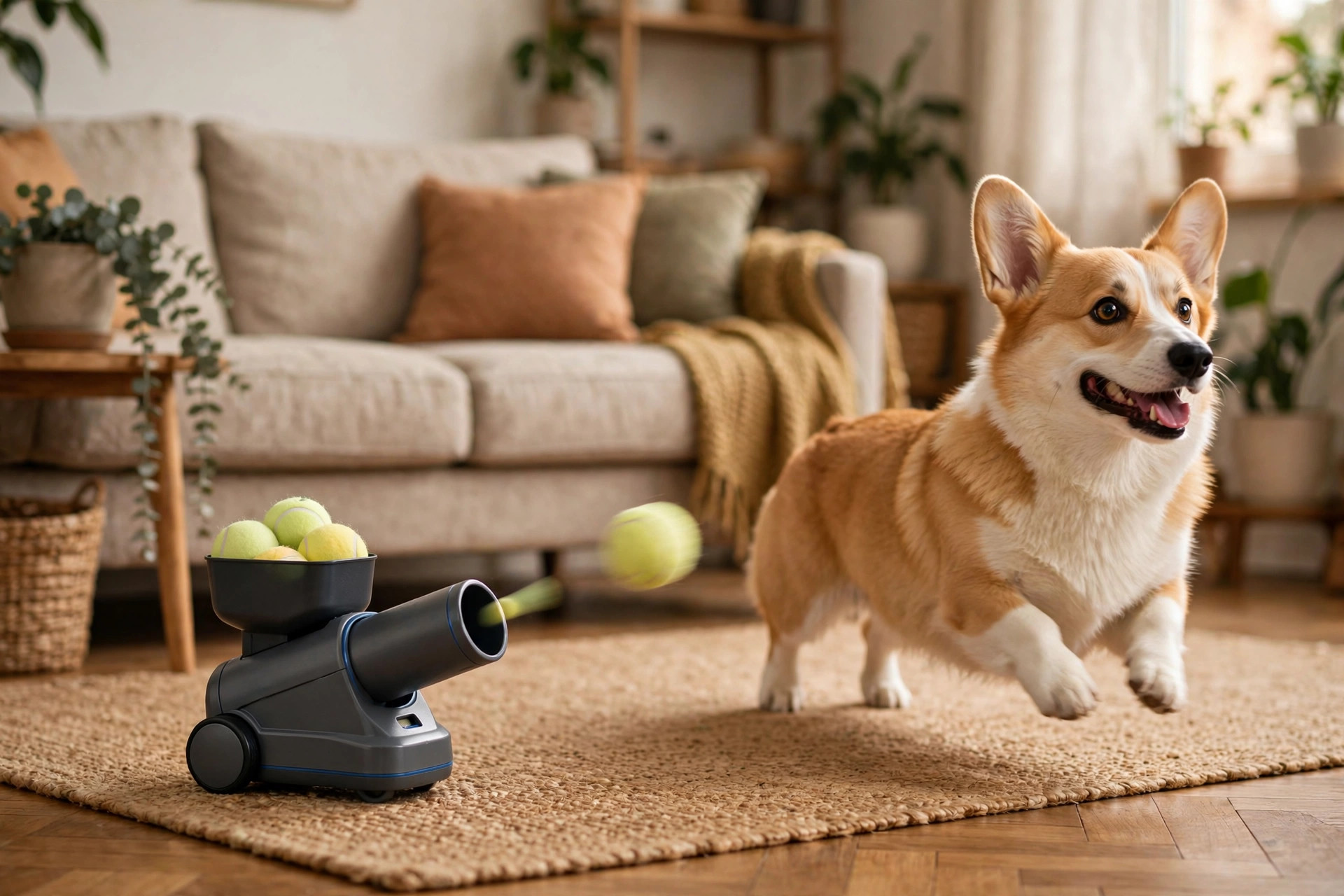
An automatic ball launcher indoors sounds like a recipe for a broken lamp and an angry downstairs neighbor — and with the wrong machine, it is. But the compact launchers built for small dogs throw a soft mini ball 10 to 20 feet down a hallway, which is exactly the fetch lane most apartments already have. Used with the right rules, it is one of the few devices that can genuinely tire out a high-energy dog when the weather is awful and the dog park is a subway ride away.
- Only small-ball launchers (1.5–2 inch balls) belong indoors. Full-size tennis-ball machines are outdoor equipment — the physics do not fit a living room.
- Minimum distance setting of 10 feet is the indoor requirement; 20–30 foot settings are for hallways and open-plan rooms only.
- Supervise every session. Launchers are not babysitters: dogs chew jammed balls, and repetitive fetch injures shoulders and teeth.
- Cap sessions at 15–20 minutes. Fetch is high-impact sprinting; more than that risks soft-tissue injury, especially on hard floors.
- Noise varies wildly: check decibel reports before buying if you share walls — some launchers thump like a drum.
Four launchers that work indoors
| Launcher | Ball size | Typical price | Indoor note |
|---|---|---|---|
| iFetch Frenzy | 1.5 in mini | $120–$160 | Gravity-fed, no batteries in the unit; quietest option. Best for small dogs. |
| iFetch Too | 2.5 in (small tennis) | $160–$200 | Adjustable 10/20/30 ft; for small-to-medium dogs. Louder launch thump. |
| PetSafe Automatic Ball Launcher | 2.5 in (small tennis) | $140–$200 | 9 distance settings (8–30 ft) + motion sensor safety. Most adjustable. |
| All For Paws Hyper Fetch Mini | 1.75 in | $90–$140 | Budget mini launcher; 3 distances. Build quality is the trade-off. |
iFetch Frenzy — the quiet apartment pick
The Frenzy is unusual: it has no motorized launch mechanism at all. The dog drops a mini ball in the top, and gravity plus an internal spiral rolls it out at a gentle, unpredictable angle — more "ball dispenser with personality" than cannon. That makes it by far the quietest option here, which is the deciding factor in apartments with thin walls. The trade-off is range: balls dribble out a few feet rather than flying, so it suits small dogs in small rooms rather than hallway fetch. For a Chihuahua or Yorkie that just needs movement games, it is perfect; for a Jack Russell that needs to sprint, look at the motorized options.
PetSafe Automatic Ball Launcher — the most adjustable
Nine distance settings from 8 to 30 feet with an angle adjustment is what makes this one indoor-viable: you can tune it to exactly your hallway’s length instead of accepting three presets that do not fit. The motion sensor pauses launching when it detects something within 7 feet of the mouth — a genuine safety feature for dogs that crowd the machine waiting for the ball. It runs on AC or batteries, and the included small tennis balls are the right size for beagles, corgis, and similar. The launch thump is audible through walls on the longer settings; keep it at 8–10 feet after 8 p.m.
iFetch Too — the hallway sprinter
For small-to-medium dogs with a real fetch drive, the iFetch Too’s 10/20/30-foot settings deliver actual sprinting distance down a long hallway or open-plan living room. It handles standard small tennis balls, and dogs learn the drop-in-the-top loop within a few sessions — most owners report the dog self-serving within a week. Two caveats: it is the loudest of the indoor-suitable options (the launch mechanism clacks), and determined chewers can destroy the plastic housing, so it is a supervised-use device, full stop.
What to skip
Full-size launchers built for standard 2.5-inch tennis balls at 40+ foot ranges (the big backyard machines) have no business indoors — the ball speed at close range can injure eyes and break things, and the noise is a neighbor complaint waiting to happen. Also skip any launcher without a minimum distance under 15 feet, and skip no-name motorized launchers: jammed mechanisms plus a frustrated dog chewing the housing is a vet-visit combination.
The indoor rules that keep it safe
A launcher is safe indoors only inside a rule set. Break these and the device becomes a hazard instead of enrichment.
- Clear the lane. The fetch path needs 10–20 feet free of furniture edges, with the launcher aimed down the longest straight line — usually a hallway. Move the coffee table, not the dog.
- Rugs under the sprint zone. Hardwood plus sprinting plus hard stops is how cruciate injuries happen. A runner rug ($20–$40) down the hallway gives traction for launch and braking.
- Soft balls only. Use the low-compression mini balls the machine ships with. Standard tennis balls are abrasive to teeth over hundreds of reps and bounce unpredictably off walls.
- Supervise, always. Dogs chew balls that jam, crowd the launch mouth, and play through pain. You are the session manager: watch for limping, heavy panting that does not resolve, or obsessive fixation.
- 15–20 minute cap. Fetch is interval sprinting — the highest-impact exercise most pet dogs do. End the session while the dog still wants more; a dog that quits on her own has overdone it.
- Not for every dog. Skip launchers for puppies under 12 months (growth plates), seniors with arthritis, and dogs with known shoulder or elbow issues. Brachycephalic breeds overheat fast — halve the session.
Teach "drop it" before you buy the launcher. A dog that will not release the ball turns the machine into a $150 paperweight — the whole self-serve loop depends on the dog returning and dropping the ball into the hopper voluntarily.
Tired-dog math: what 15 minutes buys you
Owners consistently report that 15 focused minutes of hallway fetch equals roughly a 30–40 minute walk for energy expenditure — sprint intervals burn far more than steady trotting. That makes the launcher a weather backup, not a walk replacement: it covers the cardiovascular need on rainy or polar-vortex days but provides zero sniffing, socialization, or mental decompression, which is what walks are really for. Best practice is launcher sessions on bad-weather days plus a snuffle mat or treat-dispensing toy for the mental half of tiredness. For the full bad-weather exercise playbook, our high-energy indoor exercise guide layers fetch with training games and stair routines (where a ramp protects joints on the way back down).
FAQ
Will the noise bother my neighbors?
The launch thump plus a dog sprinting and skidding is genuinely audible. The iFetch Frenzy (gravity, no motor) is the neighbor-safe choice; motorized launchers are fine during daytime on the shortest setting with a rug down, but avoid early mornings and late evenings in thin-walled buildings.
Can my dog use it alone while I’m at work?
No — every manufacturer and every trainer says supervised use only. Unattended risks include chewed balls (choking/obstruction), mechanism jams the dog attacks, and overexertion with no one to call the session. Use a pet camera to check in, not a launcher to entertain.
How long do the balls last?
The soft mini balls last a few weeks of daily use before they get slimy and chewed — buy a spare pack ($10–$15 for 6–12). Replace any ball the dog can compress to half its diameter; that is a choking-size ball for a determined chewer.
My dog is scared of the launch sound. Can I fix that?
Usually, yes: run the machine empty for treats over several days (sound predicts food), then launch at the shortest distance with the dog starting 15+ feet away, gradually closing the gap. If the dog remains stressed after a week, the launcher is not for her — switch to hand-thrown hallway fetch.