Best Folding Dog Ramps for Apartment Stairs
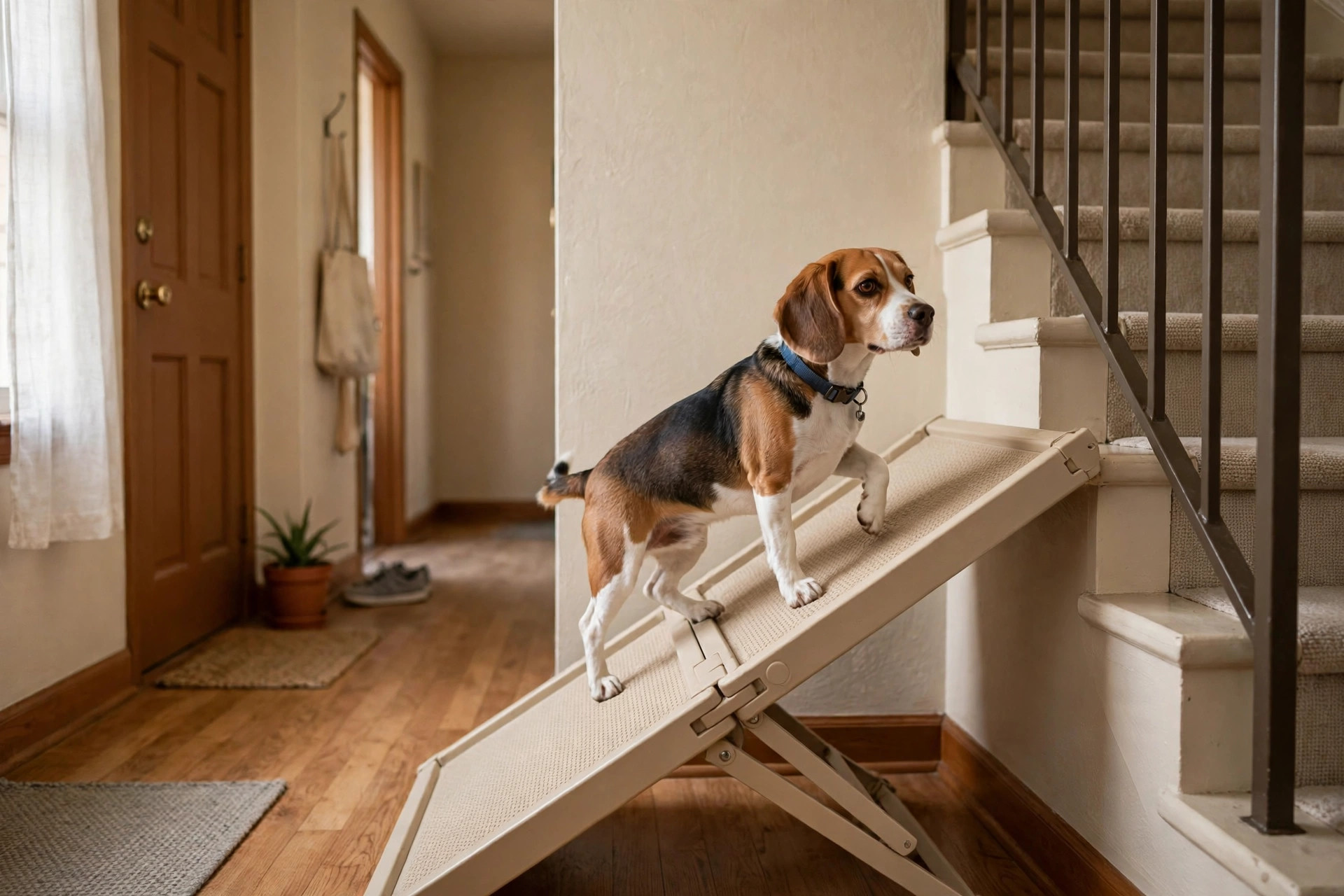
A senior dachshund, a corgi with a bad disc, a puppy who has not grown into the staircase yet — apartment stairs are hard on dogs that cannot take them one bound at a time. A folding ramp turns four steep steps into a gentle walk, and folds flat enough to live behind the hall closet door. The catch: most ramps are built for car tailgates, not the tighter geometry of indoor stairs, so you need one that is long enough, grippy enough, and narrow enough for a hallway.
- Telescoping ramps win in apartments: they extend to the length your stairs actually need and collapse small enough to stash in a closet.
- Target a slope of 20–25 degrees. That means a ramp roughly 2.4x the vertical height of the stairs it covers.
- Weight ratings are marketing’s favorite exaggeration. Pick a ramp rated at least 1.5x your dog’s weight, and check that the surface stays rigid when you press the middle.
- Traction surface matters more than brand: sandpaper-style grit, carpet tread, or deep ribs all beat smooth plastic.
- Budget 5 days to train it. Most "he won’t use the ramp" stories are really "nobody trained the ramp" stories.
Five ramps that work on apartment stairs
Every model below is widely sold, has years of reviews from dog owners, and folds flat enough for apartment storage. Prices are typical street prices and shift with sales.
| Model | Type | Typical price | Apartment note |
|---|---|---|---|
| PetSafe Happy Ride Telescoping | Telescoping, 39–87 in | $130–$190 | Best length range; 18 lbs, rated to 400 lbs. Gold standard for stairs. |
| Pet Gear Tri-Fold | Tri-fold, 71 in | $110–$150 | Carpet tread included; folds to 24 in. Rated 200 lbs. |
| Alpha Paw PawRamp | Solid wood, adjustable | $90–$140 | Looks like furniture; no sliding parts. Best for couch/sofa use too. |
| Gen7Pets Natural-Step | Bi-fold, 72 in | $100–$140 | Poly-grass surface; folds flat like a board. 250-lb rating. |
| PetSafe Happy Ride Half Ramp II | Half-length, 41 in | $70–$100 | For 2–3 porch steps only; skip for full staircases. |
PetSafe Happy Ride Telescoping — the best all-rounder
This is the ramp most stair situations converge on, and for good reason. It slides from 39 to 87 inches, which covers everything from a two-step stoop to a full flight landing-to-landing run in a walk-up. At 87 inches extended it weighs about 18 lbs — not light, but manageable — and the high-traction surface works for nervous dogs that balk on smooth plastic. The 400-lb rating is overkill for most pets, which is exactly what you want: stiffness under a 60-lb dog at the midpoint is the real test, and this one passes. Collapsed to 39 inches it fits a standard hall closet.
Pet Gear Tri-Fold — the closet-friendly pick
If your staircase has a fixed height and you would rather not fiddle with a sliding mechanism, the Pet Gear tri-fold folds into a tidy 24 x 16-inch slab with a built-in handle. The carpet tread gives excellent grip, especially for dogs with long nails that click on plastic ramps. The trade-off: fixed 71-inch length, so measure your stairs first — if your rise is more than about 30 inches, the angle gets steep. For short interior flights and exterior porch steps it is excellent value.
Alpha Paw PawRamp — the furniture-looking one
A solid wood ramp with adjustable height (12–24 inches) that was designed for beds and sofas but shines in apartments because it does not look like medical equipment in your living room. No sliding tracks to pinch paws, no wobble. The limitation is height: it will not span a full staircase, but for the two or three steps up to a sunken living room, a raised entry, or a tall bed, it is the most attractive option and folds essentially flat.
Gen7Pets Natural-Step — the flat-folder
Bi-fold design, so it folds like a closing book into a flat board about 4 inches thick — ideal for sliding between the wall and a bookshelf. The poly-grass (astroturf-style) surface is the grippiest of the bunch for wet paws, a real advantage if your building’s stairs are near the entry and the dog comes in from rain. At 250-lb rated it handles medium and large dogs, and it stays rigid better than cheaper bi-folds.
What to skip
Ultra-cheap folding ramps under $50 tend to fail exactly where stairs are demanding: they flex in the middle, the hinge pins loosen within months, and the surface is smooth plastic that terrified dogs refuse to walk on. Also skip narrow "cat walkway" ramps for dogs — anything under 16 inches wide leaves no margin for a dog that drifts sideways on descent.
Slope math: how long a ramp your stairs actually need
Measure the vertical rise from the bottom floor to the top step in inches, then multiply by 2.4 — that is your minimum comfortable ramp length for a gentle 22-degree slope. A typical apartment stair step has a 7-inch rise, so four steps = 28 inches of rise = roughly 67 inches of ramp. Measure twice: many people buy a 62-inch ramp for a 30-inch rise and end up with a 29-degree slide their dog refuses.
- Width: at least 16 inches for dogs under 40 lbs, 20+ inches for larger dogs. Hallway stairs are often only 36 inches wide total, so do not buy a 24-inch ramp you cannot angle into position.
- Surface: grit or carpet beats smooth plastic. If the ramp is too slick, self-adhesive stair treads (about $15 for a pack) fix it in an afternoon.
- Landing room: you need roughly 2 feet of flat floor at the top and bottom for the dog to step on and off calmly. If your stair base sits against a wall, position the ramp diagonally.
- Securing the top: most ramps hook or rest against the top step. On hard floors, a rubber mat under the bottom end stops the whole thing sliding out — this is the single most common ramp failure indoors.
The 5-day ramp training plan
Dogs do not intuitively trust ramps. Rushing day one is how ramps become expensive closet art.
- Days 1–2, flat on the floor: Lay the ramp flat in a hallway with treats scattered along it. Let the dog walk across freely for meals and snacks. Goal: the ramp predicts good things.
- Day 3, tiny incline: Prop one end on a book or a single stair step (4–6 inches of rise). Walk the dog up on leash, treat heavily at the top. Keep sessions to five minutes.
- Day 4, half height: Prop it against the second or third stair. Most dogs hesitate here — lure with a high-value treat trail, never drag. End while it is still going well.
- Day 5, full stairs: Full position, leash on, you walking beside with treats. Go up first (easier), then down (harder). Two or three repetitions is plenty.
- Week 2: Fade the treats to every other trip, then to the occasional jackpot. The ramp becomes furniture.
Train the descent separately from the climb. Dogs accept going up ramps far faster than going down — the visual drop triggers caution. If your dog masters up but freezes on down, you are normal; repeat day-4 height for descents only.
When a ramp is the right call (and when it is not)
Ramps pay off for seniors with arthritis, breeds prone to disc disease (dachshunds, corgis, French bulldogs), post-surgery dogs on restricted activity, and puppies in the first year while growth plates are open. They are less useful for: healthy young large breeds that will launch off the ramp like a ski jump (a harness and leash on every trip is non-negotiable there), spiral staircases with no flat landing, and dogs over the ramp’s honest weight limit — for a 120-lb mastiff, a professionally installed stair lift or a ground-floor unit is the real answer. For aging-dog comfort beyond stairs, our orthopedic bed guide covers the other half of joint care, and keep vet records current since stair injuries are an ER-visit category.
FAQ
Will my dog actually use the ramp, or will he just jump off the side?
Side-jumping is a training issue, not a product issue. During the first two weeks, walk him on leash every time and treat at the bottom. Most dogs that "refused" the ramp were asked to use it at full height on day one with no training.
Can I leave the ramp set up permanently?
Yes if it does not block the stairs for humans — most apartment stairs are too narrow for a permanent ramp plus foot traffic. That is exactly why folding matters: set it up for the dog’s trips, fold it away in 10 seconds.
Are ramps or stairs-with-steps better for small dogs?
Ramps, almost always. Pet stairs have 4–5-inch rises that are still jumps for a dachshund or a senior; a ramp spreads the same height over a gentle walk. Stairs are only better where floor space is too tight for a ramp’s length.
How do I clean a carpet-tread ramp?
Vacuum it like carpet, then spot-clean with pet enzyme spray. Poly-grass surfaces hose off in the tub. Avoid soaking wooden ramps — wipe them down instead.