Pet-Safe Indoor Plants for Apartments (Full List)
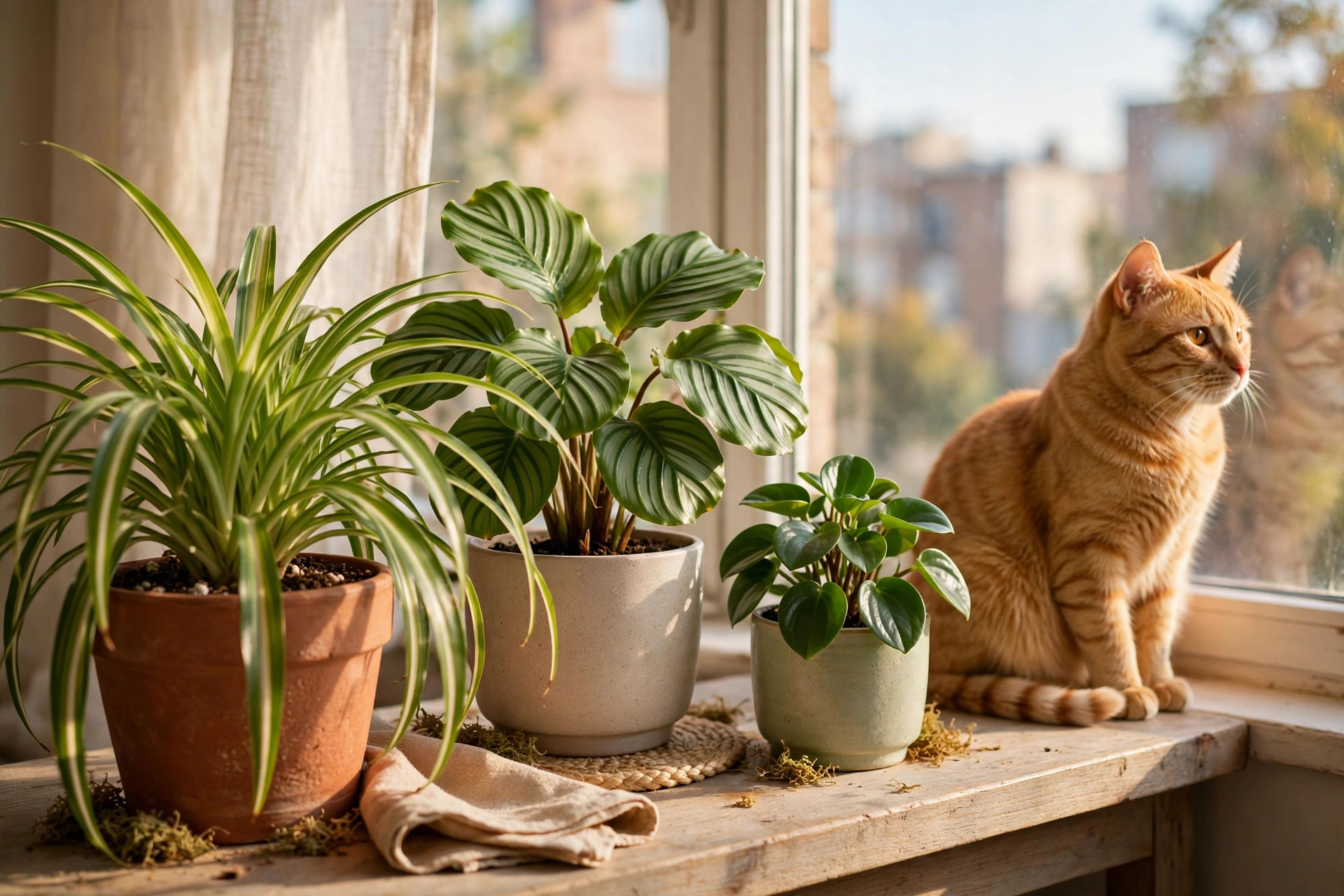
In a small apartment, every plant sits at pet height in the cat's favorite sunny spot. This guide separates the genuinely dangerous plants from the merely irritating, then gives you a buy list organized by the light you actually have — so the greenery can stay and the emergency vet can be skipped.
Why apartment plant choice is a safety decision, not a decor decision
In a house, a toxic plant often sits on a high shelf or in a room the cat avoids. In a studio or one-bedroom, the plant sits on the same windowsill the cat uses as a highway, at chewing height, in the only sunny spot in the home. That geometry is why plant toxicity injures apartment pets out of proportion to how many plants owners keep. The ASPCA maintains the reference toxicology list for North America; this guide translates it into apartment terms — which plants are genuinely dangerous, which are merely irritating, and which beautiful plants you can buy without a second thought.
Two distinctions matter before the list. First, toxic is a spectrum: some plants (true lilies for cats) can cause fatal kidney failure from a few pollen grains, while others (pothos for both cats and dogs) cause painful mouth irritation that is miserable but rarely dangerous. Treat the first category as non-negotiable exclusions and the second as a risk you manage with placement if you keep the plant at all. Second, cats and dogs differ: lilies are a cat emergency and a lesser concern for dogs, while sago palm is life-threatening to both. The lists below flag the species that matter most for each animal.
Finally, a habit that prevents most incidents: photograph any plant you cannot name and identify it before it comes home. Free plant-ID apps are accurate enough to distinguish a true lily from a daylily look-alike, and the two minutes at the nursery is the cheapest safety step in this entire guide. If you are also setting up outdoor greenery, the same identification habit applies on the balcony — see balcony proofing for cats for which patio plants to exclude.
Never keep these: the high-consequence toxic plants
If a plant is on this list, do not keep it in a pet apartment — not on a high shelf, not in a closed room, not 'just until it finishes blooming.' Cats reach high shelves, doors get left open, and leaves fall to the floor. Each entry notes the animal at risk and the typical price — because these are also, unfortunately, some of the most commonly sold houseplants and bouquets.
- True lilies (Lilium and Hemerocallis species — Easter, tiger, Asiatic, daylilies): CATS — emergency. All parts including pollen are nephrotoxic; a cat that brushes a bouquet and grooms pollen off its coat can develop acute kidney failure within 24–72 hours. Bouquets are the common exposure. If lilies enter your home in a flower arrangement, the arrangement lives outside or is rehomed the same day. Typical bouquet component: $5–$15 stems — not worth the risk at any price.
- Sago palm (Cycas revoluta): CATS AND DOGS — emergency. Seeds are the most toxic part, but all parts contain cycasin, which causes liver failure. It is sold as a small, sculptural 'palm' for bright apartments ($20–$60), which puts its seeds at pet height. True palms (parlor, areca) are safe — see the buy list — so there is no reason to accept this one.
- Oleander, foxglove, lily of the valley: CATS AND DOGS — cardiac toxins. Less common indoors but frequent in bouquets and on patios. Cardiac glycosides affect heart rhythm at small doses. Treat cut stems in mixed arrangements as a reason to separate the pet from the vase, not just from the plant.
- Castor bean and yew: both species, severe. Rare as houseplants but present in decorative dried arrangements and seasonal decor. Yew appears in holiday greenery — which is why we flag it again in seasonal guidance. When in doubt with holiday material, choose artificial or keep it behind a closed door.
- Dieffenbachia, philodendron, pothos, ZZ plant: irritant class. These contain insoluble calcium oxalate crystals — intense mouth pain, drooling, and pawing at the face, occasionally swelling that needs a vet visit. Pothos ($10–$25) is the single most common apartment houseplant, so the practical guidance is placement, not panic: hang it, trail it from a high shelf the cat cannot reach via adjacent furniture, or choose a look-alike safe plant instead. Our indoor cat grass guide covers giving chewers a safe target so the irritant plants get left alone.
If your cat has eaten any part of a true lily, do not wait for symptoms — by the time vomiting or lethargy appears, kidney injury is underway. Call your vet or an animal poison line immediately and bring a photo of the plant. Speed, not severity-watching, is what changes outcomes with lilies.
The buy list: beautiful, genuinely pet-safe plants by light and space
Every plant below is listed as non-toxic to cats and dogs by the ASPCA. They are organized by the constraint apartment growers actually face — light — with typical prices and the sizes that fit small homes. 'Non-toxic' does not mean 'intended as food': any plant material can cause mild stomach upset if eaten in quantity, so the goal is a plant your pet ignores or nibbles harmlessly, not a salad bar.
| Plant | Light | Typical price | Apartment note |
|---|---|---|---|
| Parlor palm (Chamaedorea elegans) | Low–medium | $15–$35 | The classic low-light palm; slow-growing, fits a floor corner at 2–3 ft. |
| Areca palm | Bright indirect | $25–$60 | Fuller and faster than parlor palm; needs a floor pot and humidity. |
| Calathea (prayer plant family) | Medium indirect | $15–$30 | Patterned leaves, folds at night; wants consistent moisture — good for plant-keepers who enjoy a routine. |
| Boston fern | Medium, humid | $12–$25 | Hanging-basket classic; the pet-safe fern (asparagus fern is NOT safe — different plant). |
| Spider plant | Medium–bright | $10–$20 | Nearly indestructible; cats love the dangling babies, which is fine — it is non-toxic. |
| African violet | Bright indirect | $8–$18 | Flowers for months on a windowsill; keep leaves dry when watering. |
| Hoya (wax plant) | Bright | $15–$35 | Trailing, thick-leaved, tolerates missed waterings; a pothos replacement for bright shelves. |
| Peperomia (many varieties) | Medium | $10–$22 | Compact, huge variety, the desk-and-shelf workhorse of pet-safe growing. |
| Orchid (Phalaenopsis) | Bright indirect | $15–$30 | Safe and long-blooming; the gift-plant you can accept without research. |
| Cat grass (wheat/oat/barley) | Bright | $5–$12 | The intentional chew target; grow it deliberately where you want chewing to happen. |
By apartment type: in a dark studio, start with parlor palm and peperomia — they tolerate the light you have rather than the light you wish you had. In a bright one-bedroom, calathea and hoya reward the extra light with growth you can see monthly. For a bathroom with a window, Boston fern uses the humidity other plants merely tolerate. Buy the largest plant your space fits rather than three small ones: one established plant reads as intentional decor and is easier to place out of casual chewing range than a cluster of small pots at pet height.
Placement system: keeping even the safe list out of trouble
Safe plants still need a placement plan, because the goal is a pet that ignores the greenery — not one that treats every leaf as a toy. Four rules handle nearly every apartment layout.
- Break the furniture bridge. A plant on a shelf is only out of reach if the cat cannot reach the shelf. Trace the jump path: floor to sofa arm to shelf is a staircase to a cat. Place plants where the approach requires a vertical jump of more than 4 feet with no intermediate landing, or accept that the plant is at cat level and choose only from the buy list.
- Hang the trailers. Spider plants, hoyas, and ferns in hanging planters ($10–$25 for macramé or simple hooks) remove the two biggest annoyances at once: chewing and knocked-over pots. In rentals, use ceiling hooks in existing holes or tension-rod window hangers; a falling planter is a bigger hazard than the plant in it, so rate the hook for three times the watered weight.
- Give chewing a legal address. A pot of cat grass ($5–$12, reseeded every 2–3 weeks) placed where you want the cat to graze redirects most plant interest within days. Dogs that graze can have a pot too, or a designated herb like wheatgrass on their level. The principle is identical to scratcher placement: the legal option must be closer and more satisfying than the illegal one — see the same logic applied in scratching post placement.
- Stabilize every pot. Use the heaviest pot the plant tolerates, add a layer of large smooth stones (too big to swallow, over 2 inches) on the soil surface to deter digging, and keep small pots off the edges of shelves. A tipped plant is mostly a mess, but soil ingestion is the most common reason 'safe plant' still produces a vet call.
- Is it on the ASPCA toxic list for my species? If yes and it is a lily-class toxin, it does not come home.
- Can my pet reach it via a furniture bridge? If yes, it must be from the safe list.
- Is there a legal chew alternative within 10 feet? If no, add cat grass first.
If they eat something: the first 30 minutes, and what prevention costs
Plant ingestion is common and usually mild — but the first 30 minutes decide whether a scare stays a scare. Keep this sequence somewhere you will find it while stressed, such as on the fridge.
- Remove and identify (minutes 0–5). Move the pet from the plant, clear any material from the mouth if you can do so safely, and photograph the plant and the chewed area. 'Ate some green leaf' is not actionable information; a photo that identifies the species is.
- Call before you watch (minutes 5–15). Call your vet or an animal poison control line with the species, the amount eaten (a leaf? a stem? berries?), and your pet's weight and species. In the U.S., the ASPCA poison line is a paid consultation (around $95 in recent years); many vet clinics advise by phone for existing patients at no charge. For lily exposure in cats, skip the phone queue logic — go to the clinic and call on the way.
- Do not induce vomiting unless directed. For oxalate irritants, vomiting re-exposes the mouth and throat; for other toxins, it is sometimes the right move. This is a decision for the professional on the phone who knows the species involved, not for internet advice.
- Monitor with a clock, not a feeling (hours 1–24). Drooling, pawing at the mouth, vomiting, lethargy, or appetite change are the signs that matter. Write down times. If signs escalate or the plant was a high-consequence species, the pet is seen that day.
What prevention costs: replacing a toxic collection with safe equivalents typically runs $40–$120 for a small apartment (three to five plants from the buy list), plus $10–$25 in hanging hardware and a $5–$12 cat grass habit. A single emergency visit for plant toxicity commonly runs $300–$1,500, and lily-induced kidney failure with hospitalization can exceed $3,000 with no guarantee of outcome. The math is not close. Curate the plants once, place them with the bridge rule, keep the grass pot seeded, and this entire category of emergency leaves your apartment's risk list.
FAQ
Is pothos really dangerous, or is it overrated?
Pothos is an irritant, not a killer: the calcium oxalate crystals cause immediate mouth pain, which usually stops the chewing quickly. It is still worth keeping out of reach, because a determined eater can cause enough oral swelling to need a vet visit — but it is not in the lily/sago emergency class.
Are succulents safe for cats and dogs?
It depends on the species, which is exactly the problem with mixed succulent arrangements. Haworthia and echeveria are generally non-toxic; jade plant is toxic to both cats and dogs. Identify each rosette before buying a mixed bowl, or choose named safe species individually.
My cat ignores plants. Do I still need to worry?
Mostly about guests and bouquets. A cat that ignores your plants may still groom lily pollen off its coat from a gift arrangement. The standing rule costs nothing: lilies and sago palm never enter the home, whatever your cat's current habits.
Can I keep a toxic plant in a closed room?
It is the least-bad option if you must — a room the pet never enters, with the plant never moved for watering through pet space. Be honest about door discipline in a small apartment, though. Most owners find replacing the plant simpler than policing a door for years.