Best Indoor Cat Grass Growing Kits
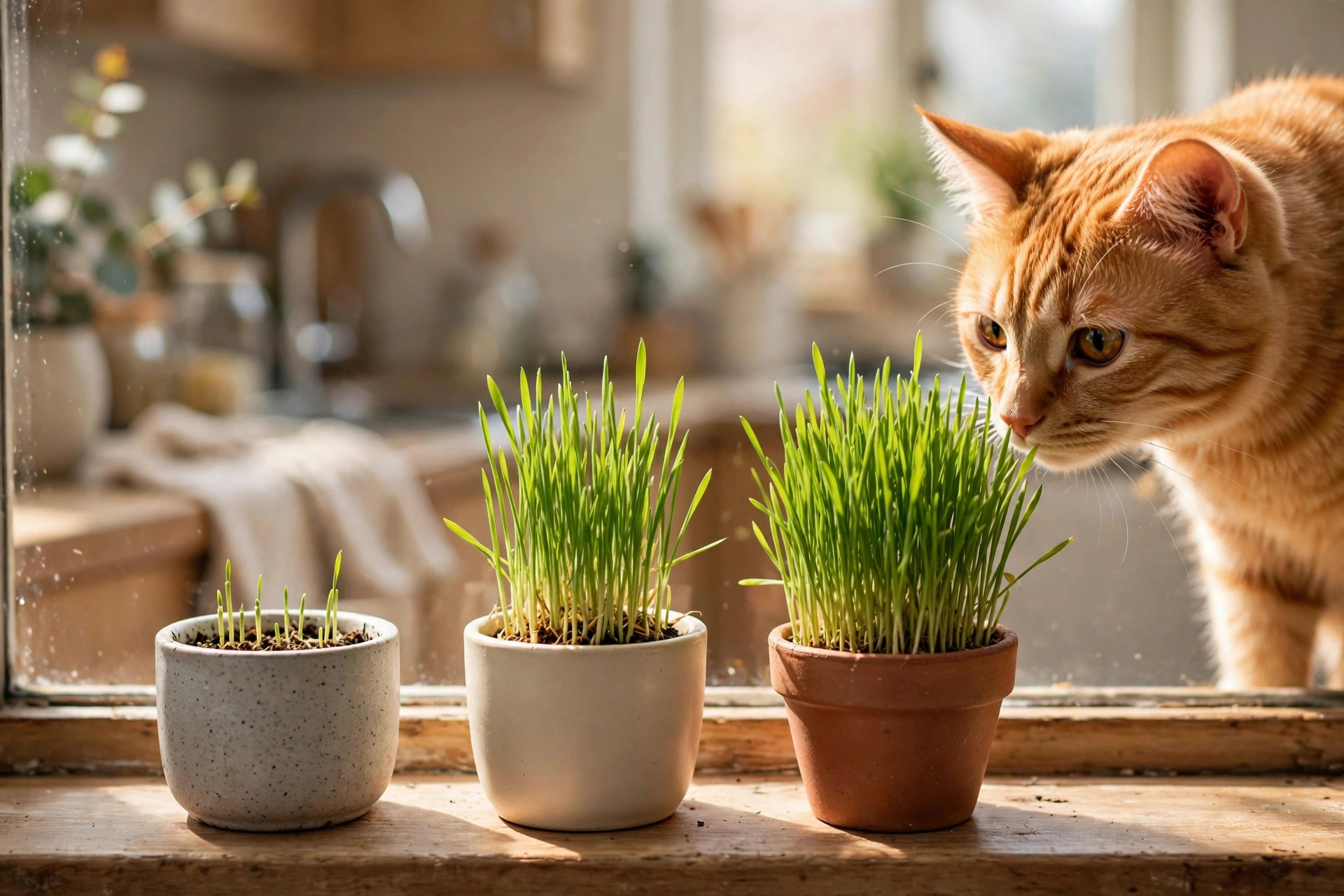
Every indoor cat carries an old instinct to chew green things — watch one stalk a houseplant and the hunter briefly becomes a grazer. In an apartment, that instinct usually ends at your pothos (mildly toxic) or your monstera (genuinely toxic), followed by an anxious midnight search about plant poisoning. A cat grass growing kit redirects the craving to something safe: wheat, oat, rye, or barley grass grown on your windowsill for roughly the price of a bag of treats, ready to nibble in about ten days and endlessly renewable once you learn the rotation.
- Safe seeds only: wheat, oat, rye, or barley grass. Never serve garden-center sod or pre-fertilized lawn grass — the chemicals are the danger, not the grass.
- A kit costs $10–$20 and grows two or three pots; bulk organic seed costs $8–$12 per pound and fills dozens of pots. Kits win the first month, bulk seed wins every month after.
- The timeline: sprouts in 2–4 days, ready to serve at 3–4 inches tall in 7–10 days, compost and resow after 2–3 weeks.
- Run a 3-pot rotation: one sprouting, one ready, one resting — a continuous windowsill supply for about ten minutes of work a week.
- Drainage is non-negotiable. Pots with holes, saucers underneath, water from the bottom. No drainage means mold within days.
Why indoor cats crave greens in the first place
Nobody has fully settled why cats eat grass — wild cats do it too, so it is not a domestic quirk. The leading explanations all make practical sense for apartment life. Grass provides fiber, which appears to help hair move through the digestive tract instead of coming back up as a 2 a.m. hairball on the rug. Many cats vomit shortly after eating grass, and while that looks alarming, behaviorists generally read it as the point: a mild stomach irritation that helps expel indigestible material like swallowed hair. It is also plain enrichment — chewing, pulling, and tasting are sensory activities for an animal whose indoor world can be short on novelty.
The honest framing matters here: cat grass is a well-tolerated, widely used supplement, not a medicine. It will not fix a hairball problem that needs a vet, and a cat that eats grass obsessively and vomits daily should see a veterinarian rather than get a bigger pot. But for the ordinary indoor cat that nibbles plants and coughs up the occasional hairball, a pot of safe grass is one of the cheapest quality-of-life upgrades in pet care. It also protects your houseplants — a cat with its own greens to chew largely loses interest in yours, which matters when yours include lilies (potentially fatal), pothos, philodendron, and monstera (all irritants).
What actually counts as “cat grass”
“Cat grass” is not one plant — it is a category: young cereal grasses grown for chewing. The safe species are wheatgrass, oat grass, rye grass, and barley grass, and for your purposes they are interchangeable. Do not confuse cat grass with catnip: catnip is a mint relative with a mild sedative-euphoric effect, sold dried or as a plant, and it is a different product for a different purpose.
What to avoid matters more than what to buy:
- Garden-center sod and “instant lawn” products. Commercial turf grass is routinely treated with fertilizers, herbicides, and fungicides. The grass itself is harmless; the residue is not.
- Kits with fertilizer pellets included. A few novelty kits ship little fertilizer capsules “for faster growth.” Cat grass grows fast enough on its own; fertilized grass the cat eats defeats the purpose.
- Ornamental grasses from the nursery. Fountain grass, pampas seedlings, and similar decoratives are not food crops — some are sharp enough to injure mouths, and nursery stock is chemically treated by default.
- Anything unlabeled. If the seed packet does not name the species, do not grow it for a cat. “Pet grass blend” from a reputable pet brand is fine; mystery seed from a discount bin is not.
The label you want reads like food: organic, untreated wheat, oat, rye, or barley seed. Human food-grade seed (sold for sprouting or juicing) meets this standard by definition, which is why the DIY route below is so cheap.
Four kits compared — plus the DIY math
All four kits below are real, long-running products with substantial review histories. Typical US street prices:
| Kit | What’s inside | Typical price | Small-apartment note |
|---|---|---|---|
| The Cat Ladies Organic Cat Grass Kit | Organic seed, soil puck, reusable planter | Usually $10–$15 | The best-known organic starter; seed refills sold separately. |
| Priscilla’s Cat Grass Growing Kit | Seed, soil, planter | Usually $8–$12 | Budget pick; straightforward, no frills, gets the job done. |
| SmarTach Cat Grass Growing Kit | Seed, coconut coir medium, pots | Usually $12–$18 | Coir resists mold better than peat-based soil in humid apartments. |
| Window Garden Cat Grass Kit | Seed, fiber soil discs, planter | Usually $15–$25 | Nicest presentation of the four; the one to gift a new cat owner. |
The Cat Ladies Organic Cat Grass Kit — the safe default
This is the kit most people mean when they say “cat grass kit”: a small reusable planter, a compressed soil puck that expands with water, and a packet of certified-organic wheatgrass and oat seed. Everything is sized for a windowsill, the instructions are genuinely clear, and the company sells seed refills so the planter keeps working after the first grow. At roughly $10–$15 it is the kit to buy when you want the highest chance of first-try success with zero guesswork.
Priscilla’s Cat Grass Growing Kit — the budget pick
Functionally the same concept at the lowest price: seed, growing medium, and a planter for usually under $12. There is nothing fancy here — no coir, no designer pot — but cat grass is not a product that rewards fanciness. This is the right choice for multi-cat homes that will burn through pots quickly and for anyone testing whether their cat cares about grass at all before investing further.
SmarTach Cat Grass Growing Kit — the mold-resistant pick
The difference is the medium: coconut coir instead of peat-based soil. Coir drains faster and resists the surface mold that is the number-one killer of indoor cat grass, which makes this the best kit for humid apartments, north-facing windowsills with slow evaporation, or anyone who has already lost a pot to fuzz. Usually $12–$18 for a multi-pot set, so the per-pot cost stays reasonable.
Window Garden Cat Grass Kit — the giftable one
Window Garden’s kit uses compressed fiber soil discs and an attractive planter, and it looks like something from a design store rather than a pet aisle. The growing performance is comparable to the others — you are paying for presentation, which is a legitimate reason if the pot will live on a visible kitchen sill. At $15–$25 it is the priciest per pot, so buy it for the looks, not the agronomy.
The DIY route: seed by the pound
Here is the math the kit makers would rather you not do. A pound of organic wheatgrass seed (human food-grade, e.g. from sprouting suppliers like Food to Live, or seed refills from The Cat Ladies) costs roughly $8–$12 and sows dozens of 4-inch pots. Add a bag of seed-starting mix for about $6 and basic 4-inch terracotta pots at roughly $1 each, and the ongoing cost per pot lands around fifty cents. The honest strategy: buy one kit for the first grow and the reusable planter, then switch to bulk seed for every grow after. Ten minutes of sowing a week keeps the rotation running indefinitely.
The 10-day growing timeline
Cat grass is nearly foolproof if you follow the sequence. Here it is, day by day:
- Day 0 — soak and sow. Soak the seed in water for 4–8 hours (optional, but it buys you roughly a day of germination time). Spread about a tablespoon of seed per 4-inch pot over damp soil, press lightly, and cover with a quarter inch of soil. Mist until evenly damp.
- Days 1–3 — keep it damp and dim. Cover loosely with plastic wrap or a second pot to hold humidity; keep at room temperature out of direct sun. Mist once or twice daily — damp, not soggy.
- Days 2–4 — sprouts. White-green shoots appear. Remove the cover and move to bright, indirect light.
- Days 5–7 — light it up. Move to your brightest windowsill. The grass wants 4–6 hours of decent light daily; this is when weak light produces the pale, floppy blades cats ignore.
- Days 7–10 — serve. At 3–4 inches tall the grass is at peak tenderness. Set the pot where the cat can reach it and let the cat self-harvest.
- Weeks 2–3 — the decline. Chewed grass regrows once if you trim it back to about an inch, but after two to three weeks the blades turn bitter, yellow, and leggy. Compost the pot and resow — this is exactly what the rotation below is for.
The 3-pot rotation: keep three pots in staggered stages — one freshly sown, one growing, one ready to serve. Sow a new pot every 7–10 days and compost the spent one. Total footprint: three 4-inch pots on one windowsill. Total labor: about ten minutes a week. It becomes a background habit like watering any houseplant, and there is always a fresh pot at peak.
Treat cat grass like cut flowers, not houseplants: it has a two-to-three-week prime, and a fresh pot always beats a heroic rescue of a yellowed one.
The apartment windowsill setup
Light is the variable that decides everything. A south- or east-facing windowsill giving 4–6 hours of direct or bright indirect light grows excellent grass with no equipment. A north-facing window or a sill shaded by the building across the street will produce pale, stretched blades — still safe, but less appealing to the cat. The fix is a simple full-spectrum clamp grow bulb, roughly $15–$25, on a timer for 12–14 hours a day; you do not need the $100 panel setups marketed to cannabis growers.
- Drainage first. Every pot needs holes and a saucer. Water from the bottom: set the pot in a shallow dish of water for ten minutes, let it drink, then empty the saucer. Top-watering keeps the surface constantly wet, which is where mold starts.
- Airflow matters. Do not crowd pots tight against winter glass — condensation plus still air equals mildew. A finger’s width of gap and normal room air circulation is enough.
- Temperature. Cereal grasses are comfortable at normal room temperatures, roughly 60–75°F. Keep pots off hot radiators and out of direct air-conditioner blasts, both of which desiccate the soil unpredictably.
- Soil. Plain seed-starting mix or coconut coir. Never reuse spent soil as-is — it is depleted and often harbors mold spores; mix it half-and-half with fresh mix or compost it.
Place the serving pot where the cat already hangs out — near the feeding station or beside a favorite window perch works well — and keep the nursery pots (sprouting and growing stages) somewhere the cat cannot knock over, because a cat absolutely will knock over an unattended pot of dirt. Fold the grass into the broader enrichment rotation: a fresh pot counts as a novelty event for a bored indoor cat.
Five ways people kill their cat grass
- Drowning it. Overwatering is the number-one cause of death — soggy soil grows mold, not grass. If the surface glistens, stop watering. Bottom-watering and drainage holes prevent nearly all of this.
- The no-drainage decorative pot. That cute ceramic pot with no hole is a swamp with a marketing department. Either drill a hole, use it as a cachepot with a nursery pot inside, or accept the mold.
- Serving it at the wrong age. Under two inches the blades are too delicate to interest the cat; past three weeks they are bitter and the cat refuses them. The serving window is roughly days 7–21.
- One pot for three cats. A single 4-inch pot lasts a multi-cat household about two days. Scale the rotation to the household: two pots ready at all times for two or three cats.
- Buying “instant” kits with fertilizer. If the kit includes little nutrient pellets, skip it — the entire point is grass the cat can safely eat, and untreated seed in plain soil grows just as fast.
FAQ
Is it safe for my cat to eat grass every day?
For a healthy cat, yes — ordinary nibbling on wheat, oat, rye, or barley grass is considered safe. The line to watch is behavior: a cat that eats grass obsessively, vomits daily, or loses appetite should see a veterinarian, because grass is a supplement, not a treatment for an underlying digestive problem.
Why does my cat throw up after eating grass?
This is common and usually not a crisis. Grass blades mildly irritate the stomach lining, which can trigger vomiting — and many behaviorists believe that is part of the function, helping the cat expel swallowed hair before it becomes a problem. Occasional vomiting after grazing is normal; frequent vomiting, lethargy, or refusal to eat alongside it warrants a vet visit.
Can I reuse the soil from a spent pot?
Not as-is. After a full grow cycle the soil is nutrient-depleted and often carries mold spores from the damp surface. Compost it, or mix it half-and-half with fresh seed-starting mix. Given that a bag of seed-starting mix costs about $6 and lasts months, fresh soil is the cheapest part of the whole operation.
Wheat, oat, rye, or barley — does the seed type matter?
Barely, for the cat. All four are safe cereal grasses with similar nutrition at the sprout stage. Wheatgrass germinates fastest, oat grass grows slightly sweeter stems that many cats seem to prefer, and rye is the most cold-tolerant if your windowsill runs chilly. Buy whichever certified-organic, untreated seed is cheapest.