How to Stop Puppy Biting During Indoor Play
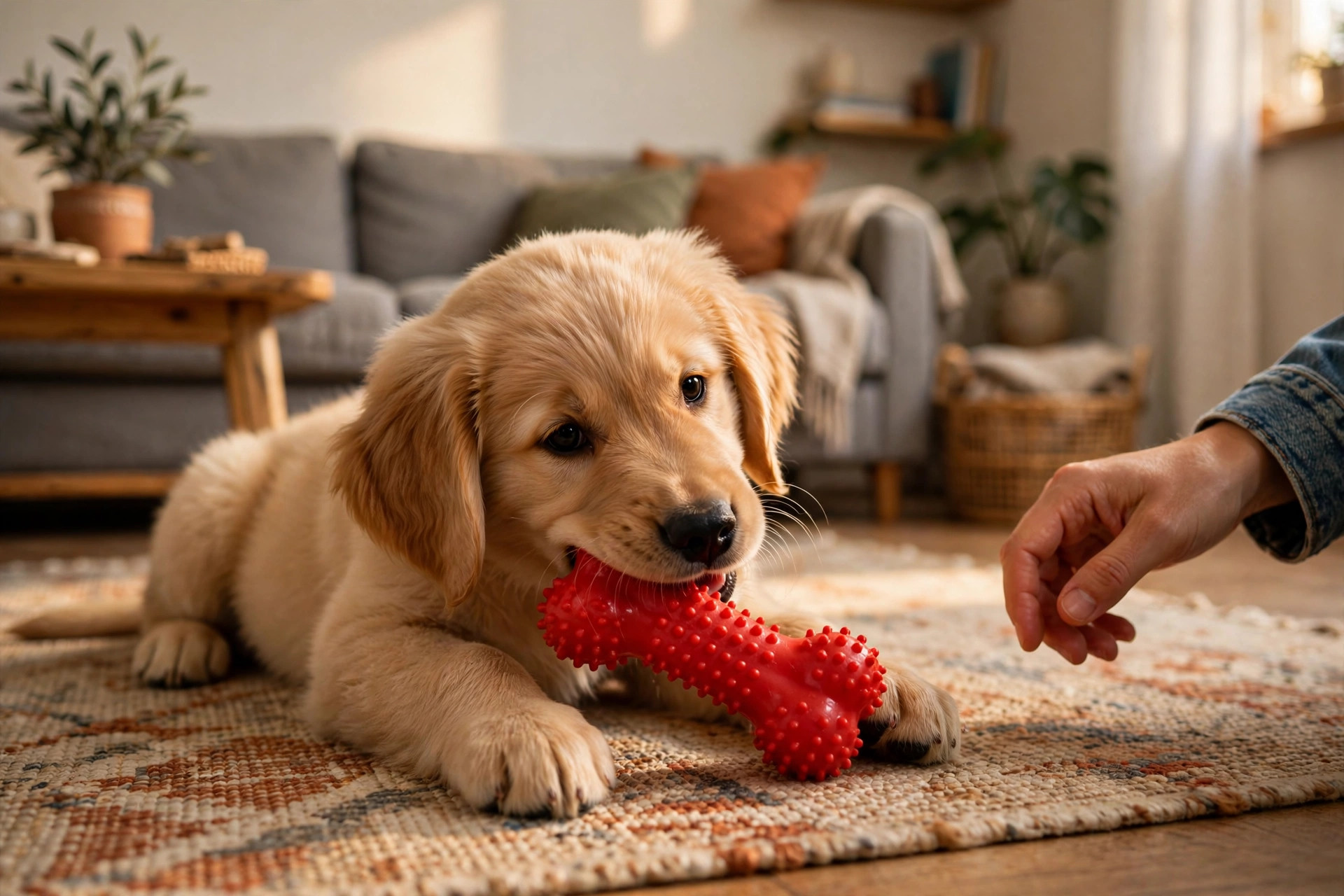
Those needle teeth are not aggression — they are how a puppy explores the world, and in a small apartment, your hands are the most available thing to explore. Puppy biting peaks between 8 and 16 weeks, right when the puppy is also teething and has the least impulse control it will ever have. The goal is not a puppy that never mouths — it is a puppy that learns, through hundreds of tiny feedback moments, that teeth on human skin ends the fun instantly. That lesson lands in three to six weeks if everyone in the household plays by the same rules.
- Biting is normal puppy behavior (8–16 weeks is peak), not dominance or aggression — the fix is feedback, not punishment.
- The core technique: the instant teeth touch skin, play stops. Mark with a calm “ouch” or “too bad,” withdraw attention for 20–30 seconds, then resume.
- Redirect BEFORE the bite when you can: keep a toy in your pocket and offer it the moment the puppy’s eyes lock onto your hands.
- Overtired puppies bite hardest — an 18-week-old puppy needs 18–20 hours of sleep a day. Enforced naps fix more biting than any technique.
- Everyone must follow the same rules. One person who wrestles with hands while another yelps teaches the puppy that rules are random.
Why puppies bite — and why the apartment makes it worse
Puppies bite for three overlapping reasons: exploration (the mouth is how they learn texture), teething discomfort (adult teeth arrive between 12 and 24 weeks, and chewing relieves the ache), and play arousal (the more excited the game, the harder the mouth). In a house with a yard, some of this energy goes into the garden. In a 600-square-foot apartment, every game happens within arm’s reach of human skin, and the puppy is often under-exercised because walks are still short — so the biting concentrates on the only available target: you.
The apartment also amplifies the two biggest biting triggers. Overtiredness: puppies that miss naps turn into bitey gremlins, and apartment puppies miss naps because the household never quiets down — TV, hallway noise, cooking sounds all keep a light sleeper awake. Over-arousal: indoor play in a small space escalates fast because there is nowhere to run it off; a game of tug in a hallway hits maximum excitement in thirty seconds. Understanding this changes the strategy: half of biting management is scheduling sleep and sizing play correctly, not correcting the puppy.
The core technique: teeth on skin ends the fun
This is bite inhibition training, and it has exactly three steps. Step 1: the moment teeth touch skin — any pressure, even gentle mouthing — say “ouch” in a calm, slightly high tone (not a scream; a scream excites some puppies) or use a neutral marker like “too bad.” Step 2: stop everything for 20–30 seconds. Stand up, turn away, tuck your hands under your arms. If the puppy keeps biting your ankles, step over a baby gate or into the bathroom for the half-minute — this is the “reverse timeout,” where you remove yourself instead of banishing the puppy. Step 3: resume play calmly. The puppy learns the equation within days: teeth → fun stops; no teeth → fun continues.
Two details decide whether this works. First, the timeout must be boring and brief — 20 to 30 seconds, not five minutes in a crate. Long banishments teach nothing; the puppy forgets what ended the game. Second, never use the crate as the timeout spot. The crate must stay the safe happy place (see our crate training guide); timeout happens behind a gate or in a puppy-proofed bathroom. Consistency across the household is non-negotiable — hold a five-minute family meeting and agree on the exact marker word, because a puppy getting mixed feedback just gets confused.
Redirect before the bite: the toy-pocket habit
The timeout teaches what not to do; redirection teaches what to do instead. Keep a soft toy in your pocket or within arm’s reach in every room the puppy plays in. The moment you see the pre-bite signals — the stare at your hands, the crouch, the butt wiggle — offer the toy before the teeth arrive. Praise the chomp on the toy like the puppy just won a prize. You are not bribing the puppy away from biting; you are building a habit loop where excitement flows into the toy instead of your fingers.
Stock the right toys for this job. Long, floppy toys the puppy can grab while your hands stay far away work best: rope tugs ($8–$14), stuffed toys with squeakers, and for teething relief, a frozen wet washcloth or a Kong ($12–$18) stuffed with peanut butter and frozen overnight. Rotate the toys every few days — a toy that reappears after a three-day break is exciting again. And keep one “emergency” high-value chew (a bully stick, $3–$5 each, always supervised) for the witching-hour biting sessions that happen every evening around 7 p.m. in overtired puppies.
The puppy is not giving you a hard time — it is having a hard time. Biting peaks when the puppy is tired, teething, or overexcited; fix the state and the teeth follow.
The schedule that prevents most biting
If the technique is the cure, the schedule is the prevention. Enforced naps: puppies need 18–20 hours of sleep per day, and most apartment puppies get far less because the home never goes quiet. Use the crate or pen for scheduled naps: one hour awake, two hours asleep, on repeat through the day. A puppy that has napped bites half as much — owners consistently report the evening bite-fest disappearing once naps are enforced. Right-sized play: keep indoor sessions to 5–10 minutes and end them while the puppy is still happy, not when it tips into wildness. Two short sessions beat one long one. Teething relief on schedule: offer a frozen Kong or frozen carrot during the known witching hours (usually early evening) before the biting starts, not after.
Track the pattern for three days: note when biting is worst. Most owners find a clear spike — the post-dinner zoomies, the pre-nap meltdown — and once you see it, you can pre-empt it with a nap or a chew instead of reacting to it. This is also where an alone-time routine helps: a puppy that can settle itself is a puppy that naps instead of biting.
When biting is not normal puppy biting
Normal puppy biting is inhibited — it hurts a little, the puppy backs off with feedback, and it improves week over week. Three patterns warrant a trainer or vet. No improvement after 4–6 consistent weeks: if every household member followed the rules and the biting is unchanged, get a certified trainer involved. Biting with stiff body language: growling over food or toys, freezing before the bite, or biting that breaks skin regularly past 20 weeks is resource guarding or fear, not play — different problem, different protocol. Sudden escalation: a puppy that was gentle and suddenly starts biting hard may be in pain (teething complications, ear infection); a vet check rules out the medical causes first. For the normal kind, patience plus consistency wins — almost all puppies are dramatically better by six months.
FAQ
Should I yelp loudly when the puppy bites?
A calm “ouch” works; a dramatic scream often excites the puppy more. The feedback that matters is the consequence — play stopping for 20–30 seconds — not the volume of the marker. Pick a neutral word like “too bad” if yelping riles your puppy up.
My puppy bites hardest in the evening. Why?
The evening witching hour is overtiredness, almost always. Puppies that skip afternoon naps melt down around 7–8 p.m. Enforce a late-afternoon crate nap and offer a frozen chew during the witching hour — most owners see the biting drop within days.
Is it okay to hold the puppy’s muzzle shut when it bites?
No — muzzle grabs teach the puppy that hands near the face are scary, which can create hand-shyness or defensive snapping later. The reverse timeout (you leave) is safer and teaches the actual lesson: biting makes the fun human disappear.
At what age should the biting stop?
Most puppies show major improvement by 5–6 months as adult teeth finish coming in and impulse control develops. Mouthing should be rare by 7–8 months with consistent training. If hard biting persists past that, consult a certified trainer.