How to Stop Counter Surfing in Small Kitchens
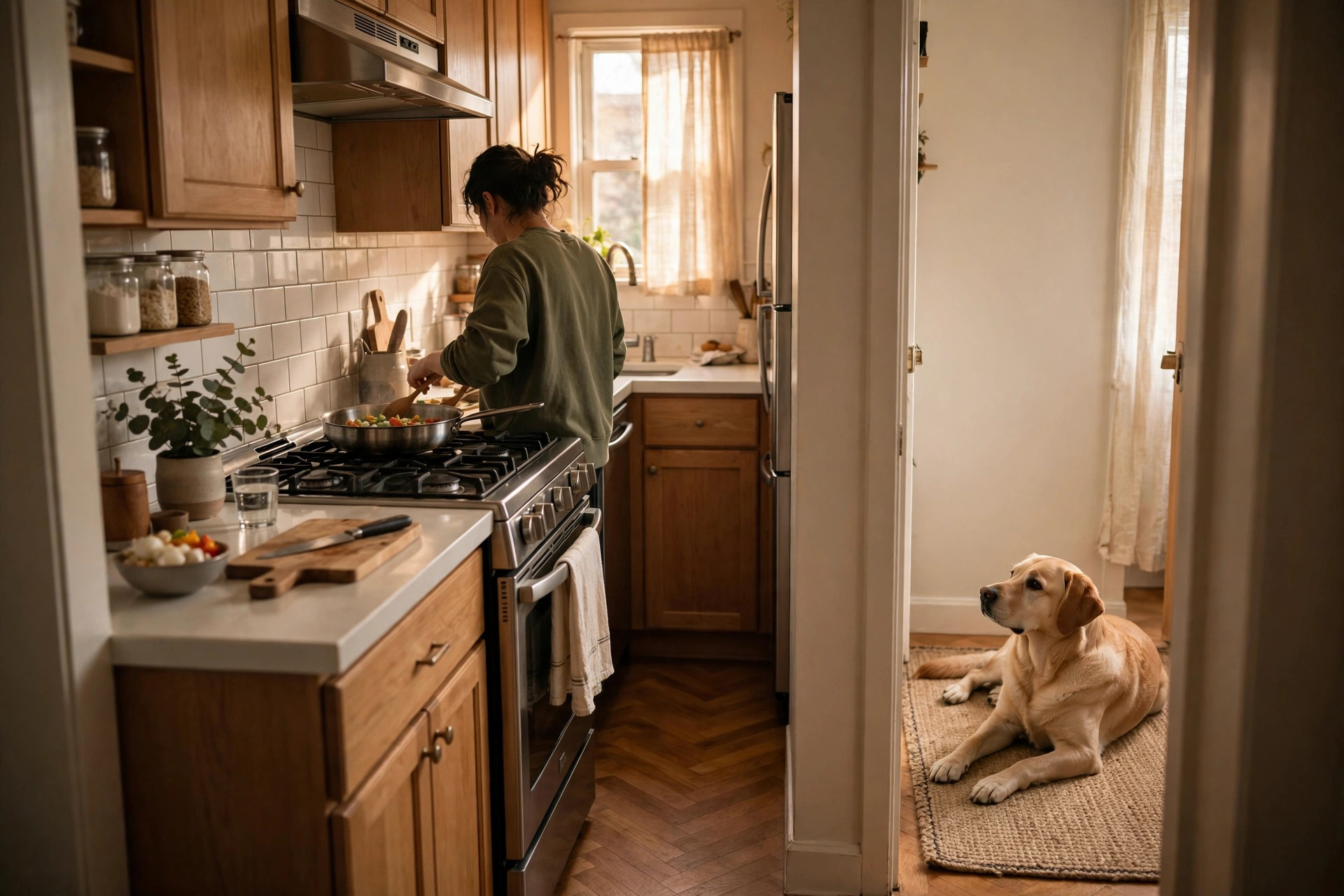
Counter surfing looks like a manners problem. In a small apartment kitchen it is a safety problem wearing a manners costume: the same counter that holds the roast chicken also holds the chef’s knife, the just-used sheet pan, the onion-heavy leftovers, and the sugar-free gum with xylitol. And in a galley kitchen, the dog does not even have to stretch — the counter is right there, at nose height, three steps from the couch. This guide treats the safety side first, because training takes weeks and a single bad grab takes seconds.
- Start with a 48-hour management reset: clear counters, latch cabinets, and remove every payoff. Training cannot compete with a self-serve buffet.
- Know the true danger list: xylitol, onions/garlic, grapes/raisins, hot pans, and knives cause the ER visits — not the stolen sandwich.
- Teach “off” and “leave it” as separate skills, then give the dog a legal job (mat settle) during every meal prep.
- In galley kitchens, a tension-mounted gate or a simple exercise-pen panel beats trying to guard six feet of counter by voice.
- Cats surf for height and curiosity as much as food — give them a legal high perch near the kitchen and the counters get boring.
First, the part that can send you to the ER
Most counter-surfing advice starts with training. Start with triage instead, because the gap between “annoying habit” and “emergency” is one unsupervised minute. The items that actually hurt pets on counters fall into four groups. Toxins: xylitol (birch sugar) in sugar-free gum, mints, and some peanut butters can crash a dog’s blood sugar within an hour; onions, garlic, and leeks damage red blood cells; grapes and raisins can trigger kidney failure; chocolate’s theobromine hits small dogs hardest. Our full rundown is in toxic foods every city dog owner should know — tape the short version inside a cabinet door.
Heat: a sheet pan out of a 425°F oven stays hot enough to burn paw pads for 20–30 minutes on the counter, and a cooling pan smells like the best thing that ever happened. Sharps: knives left near the edge, skewers, and broken glass from a knocked mug. Obstructions: corn cobs, peach pits, skewers, and string-tied roasts — the classic “stole the whole thing” items that become surgery. None of these respond to training in the moment. They respond to a kitchen where they cannot be reached, which is what the next section builds.
The 48-hour management reset
Training fails while the counter keeps paying. A dog that scores even one time in ten will keep checking for months — intermittent reinforcement is the strongest schedule there is. So the first 48 hours are not about teaching; they are about bankrupting the behavior.
Clear every horizontal surface. Not “tidy” — clear. Food, cutting boards with residue, the fruit bowl, the butter dish, dish towels that smell like dinner. For two days, your counters hold nothing edible or interesting. It feels extreme and it works: the dog checks, finds nothing, checks again tomorrow, finds nothing, and the habit starts starving.
Latch the low cabinets and the trash. A dog that cannot surf the counter will audit the cabinets, and under-sink cabinets hold the cleaning chemicals. Adhesive cabinet latches ($8–$15 for a multi-pack from Safety 1st or Munchkin) install without drilling — renter-safe — and a step-can trash with a locking lid ($30–$60 for a 10–13 gallon model) ends trash raiding. See how to store cleaning products away from pets in small kitchens for the full under-sink setup.
Block access during the danger windows. Meal prep and the first 30 minutes after cooking are when counters are loaded and your attention is split. A tension-mounted pet gate ($40–$80; Carlson and Regalo make reliable pressure models that need no screws) across a galley kitchen entrance, or a single exercise-pen panel angled across an open-plan kitchen edge, physically removes the opportunity. Management is not giving up on training — it is training with the cheat codes on while the new habits form.
Training: “off,” “leave it,” and a legal job
With the kitchen bankrupt, teach the replacement. These are three separate skills, taught in order, in sessions of 3–5 minutes:
1. “Off” (four paws on the floor). Lure the dog into putting paws up on a low stool, say “off” once, and reward the instant all four paws hit the floor. Practice on furniture and stairs first, then at the counter edge with nothing on it. The rule: “off” is information, not a scolding — say it once, cheerfully, and pay the floor.
2. “Leave it” (disengage from food). Hold a treat in a closed fist; the dog will nose and paw at it. The instant they pull back, mark (“yes!”) and reward from the other hand with something better. Build up to food on the floor, then food on a low table, then food on the counter edge — always with you present. “Leave it” buys you the two seconds to intervene; it does not replace management when you leave the room.
3. The legal job: mat settle during cooking. This is the piece most people skip, and it is the one that makes the habit die. Put a mat or bed just outside the kitchen work zone and train a settle there, paid with a stuffed Kong or lick mat at the start of every meal prep. The dog learns that cooking time means “go to your spot and chew the good thing” instead of “patrol the counters while the human is distracted.” Within two weeks, most dogs start heading to the mat on their own when they hear chopping.
| Tool | What it does | Typical price | Renter-friendly? |
|---|---|---|---|
| Tension pet gate | Blocks kitchen entrance during cooking | $40–$80 | Yes — pressure mount, no screws |
| Adhesive cabinet latches | Keeps chemical cabinets shut | $8–$15 / pack | Yes — peel off cleanly |
| Locking step-can trash | Ends trash raiding | $30–$60 | Yes |
| Exercise-pen panel | Angles across open-plan kitchen edges | $35–$70 | Yes — freestanding |
| Mat / settle bed | The “legal job” station | $20–$50 | Yes |
Small-kitchen layout tricks
Galley and one-wall kitchens have a geometry problem: the work triangle is a straight line, and the dog standing at the open end can see and smell everything. Three layout moves help more than any gadget. First, create a dog parking spot with a sightline: a mat at the kitchen entrance where the dog can watch you without entering the splash zone. Dogs surf partly from FOMO; a spot with a view removes the need to be underfoot. Second, use vertical space aggressively: wall-mounted magnetic knife strips ($15–$25) get knives off the counter entirely, and over-sink dish racks free the six inches of counter where the dog’s nose goes first. Third, stage a “cooling station” inside the oven (turned off) or microwave for hot pans — the two places in a small kitchen a nose cannot reach.
For open-plan apartments where the kitchen bleeds into the living room, define the boundary with a rug or a low bookcase rather than hoping the dog understands an invisible line. Dogs learn places, not concepts — “the rug by the kitchen” is trainable, “stay out of the kitchen area” is not.
The cat version: surf for height, not just food
Cats counter-surf for different reasons, so the fix differs. A cat on the counter is usually seeking height, warmth (above the dishwasher is prime real estate), running water, or simple curiosity — food theft is often secondary. Punishment backfires reliably: the cat learns to surf when you are gone, which in a studio apartment is most of the day.
The cat protocol: give a better high place near the kitchen. A window perch or a tall cat tree ($50–$120 for a sturdy 5-foot model) within sight of the kitchen beats the counter on every metric the cat cares about — higher, warmer, better view. Make counters boring (clear, uninteresting) and the perch rewarding (treats delivered there, catnip, a heated pad in winter). For the sink drinker, a cat water fountain ($25–$50) satisfies the running-water preference without the faucet. Double-sided sticky tape strips ($8–$12 for a roll, cut into patches) on the counter edge for a week or two make the surface itself unpleasant under paws — remove them once the habit fades, usually within 2–3 weeks.
What the timeline actually looks like
With management in place from day one: the opportunistic checking drops sharply in the first week because the counter stops paying. “Off” becomes reliable on cue within 2–3 weeks of short daily sessions. “Leave it” around food takes 3–6 weeks to generalize from training setups to real life. The mat settle during cooking — the behavior that actually replaces surfing — typically needs 2–4 weeks before the dog offers it unprompted.
The failure pattern to watch for: everything works for three weeks, then someone leaves a rotisserie chicken on the counter “just for a second” and the dog scores. One big jackpot can undo a month of bankruptcy. When it happens (it will), do not restart from zero — just re-run the 48-hour reset and keep going. And if the surfing is frantic rather than casual — the dog is obsessed, cannot be interrupted, or guards what it steals — that is worth a certified trainer’s eyes (CPDT-KA or IAABC), because resource guarding layered on surfing needs a different plan.
Management is not cheating. Every professional trainer manages first and trains second, because a behavior that pays for itself while you train is a behavior you are accidentally rehearsing. The gate, the latches, and the clear counters are the training — the cues are just the finishing layer.
FAQ
My dog only surfs when I leave the room. Is training pointless?
No — it means management is doing the heavy lifting, which is correct. A dog that surfs only unsupervised needs the kitchen physically inaccessible when you leave (gate, closed door, crate) plus the mat-settle habit for when you are present. “Leave it” is a supervised skill; it was never meant to work from the next room.
Will a scat mat or similar deterrent work?
Static-shock mats suppress the behavior at that spot but do not teach anything, and anxious dogs may generalize the fear to the whole kitchen or to you. They are also useless the moment the battery dies. Spend the money on a gate and a mat bed instead — both teach the dog what to do, not just what to fear.
How do I handle a roommate who leaves food out?
The same way demand-barking plans fail: at the speed of the least consistent human. Make it mechanical, not moral — agree that anything left on the counter goes straight into the microwave or oven (off) as the “cooling station,” so there is one rule and no judgment calls. The dog cannot exploit a rule everyone follows.
My cat surfs the stove. Is that more dangerous?
Yes — a hot stovetop burns paw pads fast, and cats do not always connect the pain to the surface. Use knob covers ($10–$15) so a cat walking the stove cannot ignite a gas burner, keep a kettle or pot on burners as a physical reminder, and never leave a hot burner unattended with a known stove-surfer loose.