Multi-Dog Feeding Routine for Tiny Kitchens
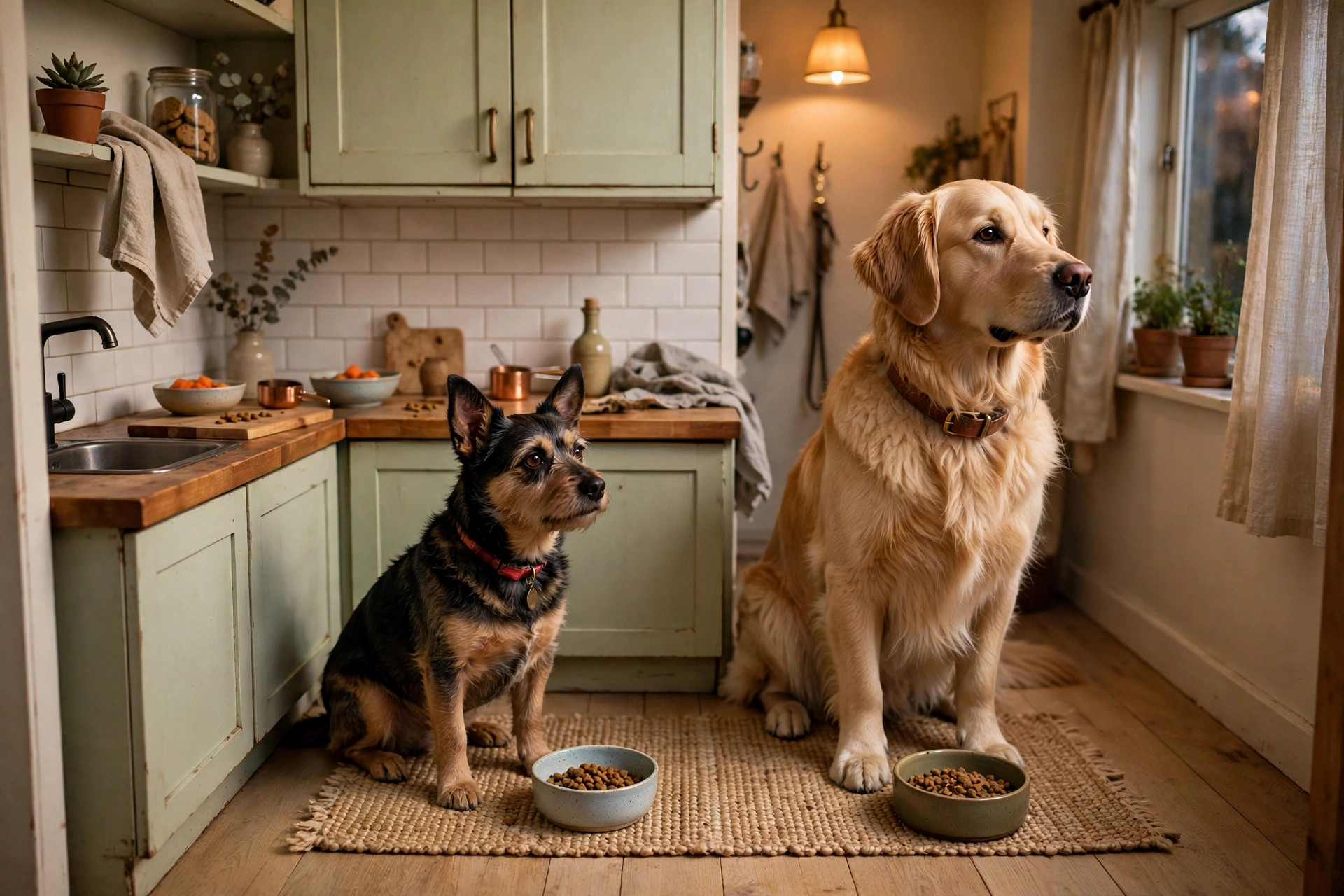
Two dogs, one galley kitchen, six feet of floor between the fridge and the stove. Mealtime in a multi-dog apartment is the highest-tension thirty minutes of the day: the fast eater finishes and cruises to the slow eater’s bowl, the new rescue guards the corner, and you are refereeing with a spatula in your hand. The fix is not dominance theory and it is not feeding in separate locked rooms forever. It is a station-based routine — every dog has a spot, every spot has a job, and the order of operations never changes.
Set up stations, not just bowls
In a tiny kitchen you cannot give each dog a room, but you can give each dog a station — a defined spot with visual boundaries that the dog learns is theirs. Stations work because dogs are excellent at spatial habits:
- One mat per dog, spaced as far apart as the kitchen allows. Non-slip feeding mats ($10–$20 each) in different colors mark the spots. Opposite ends of a galley kitchen, or one in the kitchen and one just outside it in the hallway — distance matters more than being in the same room.
- Face them away from each other. Dogs eating shoulder-to-shoulder in a line can see each other’s bowls; dogs facing opposite walls cannot. In a narrow kitchen, put one station facing the fridge and the other facing the stove.
- Use barriers when needed, not as punishment. A baby gate or an exercise pen panel ($25–$40) across the kitchen doorway during meals is management, not failure. It is especially useful during the first month with a new dog, or permanently if one dog is a guarder.
- Elevated feeders for the tall dog, floor bowls for the short one. Beyond comfort, height differences reduce bowl-switching: a small dog cannot easily reach into a raised large-dog feeder, which removes half the temptation. Our elevated bowl guide covers compact options.
The order of operations: same sequence, every meal
Dogs learn sequences faster than rules. Run this exact order twice a day and within two weeks the dogs will run it themselves:
- Dogs to stations first, bowls second. Send each dog to their mat (“place” or “go to your spot”) before you touch the food. Bowls appearing while dogs mob the counter is how the frenzy starts; calm stations first is how it does not.
- Prep with dogs waiting. Scoop, measure, add toppers — all while the dogs hold their stations. Release the stay only when every bowl is down. The waiting is training disguised as mealtime.
- Feed in a fixed order. Same dog first every time — usually the calmest, most senior, or the one with medical timing needs. Fixed order removes the daily negotiation about who gets served first, which is a real source of pre-meal tension.
- Supervise the full meal, every meal. Stay in the kitchen. The fast eater gets their bowl picked up the moment they finish and gets a brief “all done” before being released to another room — they do not get to cruise the other stations. This one habit prevents 90% of bowl-switching.
- Bowls up after 15–20 minutes. Whatever is left comes up. Free-feeding in a multi-dog home is how the bold dog eats double and the shy dog goes hungry; timed meals also make appetite changes visible fast, which is an early health signal.
- One defined station per dog, spaced apart, facing away from each other.
- Dogs to stations before bowls come out; same feeding order every meal.
- Supervise fully: fast eaters get picked up and released elsewhere, not left to cruise.
- Bowls up after 15–20 minutes — no free-feeding in multi-dog homes.
- Separate the dogs for meals at the first sign of guarding; management is not failure.
Solving the three classic problems
| Problem | What it looks like | The fix |
|---|---|---|
| Bowl-switching | Fast eater finishes, moves to the other bowl; slow eater yields | Pick up the finished dog immediately; add distance between stations; feed the slow eater behind a gate |
| Resource guarding | Stiffening, hovering, growling over a bowl or the prep area | Full separation for meals (different rooms, closed doors); train trade-up games away from mealtimes; consult a trainer if it escalates |
| Different diets or speeds | One dog on prescription food, one inhaling in 30 seconds | Slow-feeder bowl ($12–$25) for the inhaler; feed the special-diet dog in a closed room so there is zero cross-eating |
A note on guarding: mild bowl-hovering often resolves with the station routine alone, because predictability lowers the perceived need to guard. But true guarding — growling, snapping, guarding you during prep — is a safety issue, not a routine issue. Separate the dogs completely for meals and get professional help; our two-cat feeding guide covers the feline version of the same spatial logic if your household mixes species.
The prep system: making it sustainable
A routine only survives if it is easy on the human. Three systems keep multi-dog feeding from becoming a twice-daily production:
- Pre-portion weekly. Seven days of measured meals in labeled containers or bags, one container per dog per meal. Morning prep drops to sixty seconds, and anyone — partner, pet sitter, tired you — can feed correctly. This is the system in our pet sitter template too, which is why sitters stop making portion mistakes.
- One food station for humans. Keep all the dog food, supplements, and measuring cups in one cabinet or rolling cart near the prep area. Hunting through three cabinets with two dogs whining is how portions go wrong.
- Track the slow eater. In a multi-dog home, the shy dog’s appetite is your canary. A dog that leaves food three meals running gets a vet call — you will catch it because timed meals make it visible, unlike free-feeding where nobody notices for a week.
Peaceful multi-dog meals are not about the dogs liking each other. They are about the routine being so predictable that there is nothing left to compete over.
FAQ
Should I feed my dogs in separate rooms permanently?
Only if guarding or extreme speed differences require it. Most multi-dog households do best with separated stations in the same area — the dogs learn the social routine of eating near each other calmly, which generalizes to calmer behavior overall. Reserve closed-door separation for guarders, prescription-diet dogs, and the first month with a new dog.
One dog finishes in 30 seconds and harasses the other. What do I do?
Slow the fast eater with a slow-feeder bowl or a snuffle mat for meals ($12–$25), increase the distance between stations, and — most important — pick the fast eater’s bowl up the instant they finish and redirect them out of the feeding area with a small post-meal ritual (a brief training rep or a chew in another room). The harassment stops when finishing early stops being rewarding.
Can I free-feed if my dogs don't fight?
Not recommended in multi-dog homes even when things seem fine. Free-feeding hides appetite changes (an early illness signal), lets the bolder dog quietly eat more, and turns every dropped crumb into a potential guarding trigger. Timed meals take the same total effort once the routine is set.
How do I introduce a new dog to the feeding routine?
Feed the new dog completely separately — different room, closed door — for the first two to four weeks while they decompress. Then introduce stations gradually: new dog eats on their mat on one side of a baby gate while the resident dog eats on the other, moving to open stations only when both are relaxed. Rushing shared mealtimes is the fastest way to create guarding that did not exist before.