How to Potty Bell Train a Dog in a High-Rise
In a high-rise, your dog’s subtle “I need to go” signals — the pacing, the sniffing, the look — are easy to miss while you are on a call or in the kitchen. By the time you notice, the elevator ride alone takes three minutes and the accident has happened. A potty bell turns the request into a sound you can hear from anywhere in the apartment: the dog rings, you leash up, you go. It is one of the simplest trained behaviors there is, and in a tall building it is worth its weight in carpet cleaner.
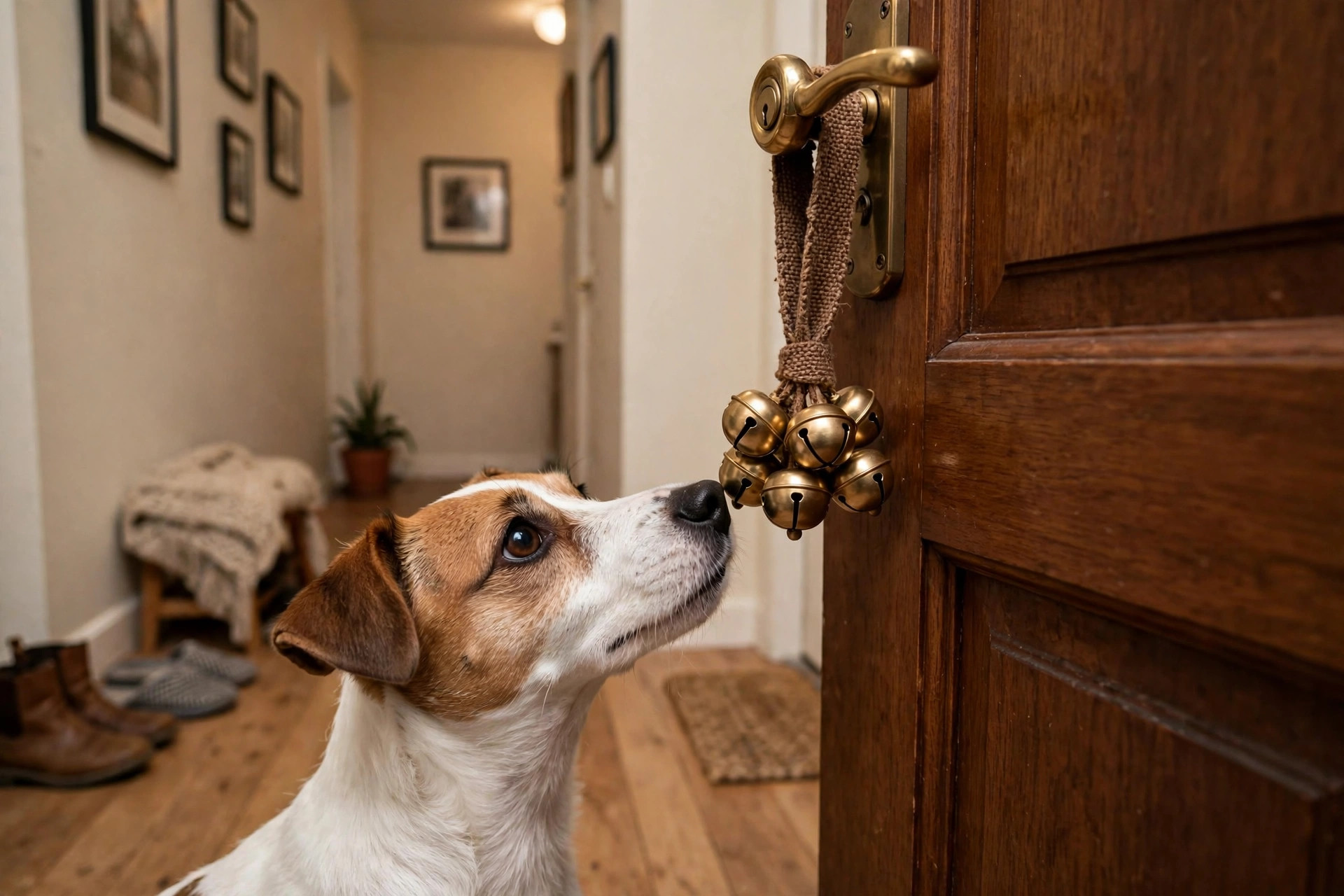
- Use a strap of jingle bells hung from the door handle ($8–$12) at your dog’s nose height — loud enough to hear from another room, simple enough to learn in days.
- Training takes 2–3 weeks: charge the bell (touch = treat) in week 1, add the door-and-out sequence in week 2, fade your prompting in week 3.
- Every bell ring gets an immediate leashed trip out — even the false alarms at first. Ignoring rings teaches the dog that ringing is pointless.
- False alarms are the normal phase, not a failure: keep early trips boring and 3 minutes long, and the dog learns bells mean business, not adventures.
- In a high-rise, plan for the elevator: ring, leash, treat pouch, poop bags by the door, and a practiced calm elevator routine.
Pick a bell your whole apartment can hear
The classic setup is a nylon strap with 4–7 jingle bells ($8–$12 on most pet sites) looped over the front-door handle or a wall hook beside the door. Hang it so the lowest bell sits at your dog’s nose height — too high and small dogs give up, too low and the dog triggers it walking past. For apartments where the front door is far from the living room, add a second strap on the bedroom door or use a battery-powered wireless doorbell button ($15–$25) mounted low on the wall; the chime receiver plugs in wherever you spend your time.
Skip the fancy talking-button boards for this job. Recording “outside” on a button is fun content, but bells are louder, cheaper, impossible to unplug, and work when the power is out. One decision to make now: choose ONE door for potty trips and always use it. In a high-rise that means the door you take to the elevator — consistency is what makes the association stick. If your puppy is also learning an indoor potty solution, keep the bell trips strictly for outdoor runs so the two systems do not blur.
Week 1: charge the bell — nose touches bell, treat appears
Do not hang the bell on the door yet. Hold it in your hand and let the dog investigate; the instant the nose touches a bell, mark (“yes!”) and treat. Repeat 8–10 times per session, two or three sessions a day, for two or three days. Most dogs are boinging the bells on purpose by day three. The only rule: the treat comes from your pocket or the counter, never from the hand holding the bell — you are teaching “touch the bell,” not “mug the hand.”
Once the dog is deliberately ringing, hang the strap on the door at nose height and repeat the game: point at the bells, dog touches, mark and treat. Do this right before every scheduled potty trip — after meals, after naps, after play — so the sequence bell → door opens → outside starts forming. Keep sessions to three minutes; this is a trick that teaches itself fast, and drilling it longer just bores the dog. Puppies in active high-rise potty training can start bell work as early as 10–12 weeks, layered onto the existing schedule.
Weeks 2–3: build the full sequence, then fade yourself out
Week 2 — the door sequence. Now the dog rings, and you immediately open the door, leash up, and go out. Speed matters: the faster the door opens after the ring in week 2, the faster the dog believes ringing causes going. Take the full elevator trip every time — yes, even when you know the dog does not need to go. The point is the association, not the pee. Reward with a treat the moment the dog potties outside, then head back up.
Week 3 — fade the prompts. Stop pointing at the bells. Stand near the door and wait. The dog will offer the ring because the last two weeks paid well — open the door. If the dog stares at you instead of the bells for more than ten seconds, help once (a glance toward the bells), then fade again. By the end of week 3, most dogs walk to the door and ring unprompted before scheduled trips. That is the behavior done — everything after is maintenance.
The critical rule for all three weeks: every ring gets a response. If you ignore the bell because you are busy, the dog learns that ringing is unreliable and stops — or worse, learns that the accident gets your attention faster. A 90-second boring elevator trip to a patch of grass is the price of a reliable signal. You will thank yourself at 2 a.m. when the bell wakes you instead of a puddle.
The false-alarm phase (and how to end it)
Somewhere around week 3 or 4, most dogs discover that the bell also summons a human, a leash, and an elevator ride — and the ring count triples. This is the normal, predictable phase. Do not remove the bell and do not scold; both kill the behavior you just built. Instead, make non-potty trips deliberately boring: leash, elevator, three minutes at the grass, no sniff tour, no greeting other dogs, straight back up. Keep a neutral face and zero conversation.
Dogs are economists: when bells reliably produce a dull three minutes, the demand-ringing fades within a week or two, while genuine needs keep getting signaled because the relief itself is the reward. If the false alarms cluster at a specific time — say, right after dinner — that is usually a schedule problem, not a training problem: add a scheduled trip there and the bell goes quiet. And if the dog rings frantically and repeatedly, always go — urgent rings are how you find out about digestive trouble early.
The bell is a request line, not a vending machine. Answer every ring while the behavior is young, and make the boring trips boring — the dog will do the accounting itself.
High-rise logistics: the elevator is part of the trick
In a tall building, the gap between the ring and the grass is the weak link — a 20-floor elevator ride plus a hallway walk can take four to five minutes, which is longer than a puppy’s warning window. Three things close the gap. First, a door station: leash, treat pouch, and poop bags hung on hooks by the door ($10–$15 for an over-door organizer) so a ring becomes a 30-second departure, not a scavenger hunt. Second, an elevator routine: dog sits in the corner, short leash, treat for calm loading — practiced separately with our elevator etiquette tips until it is boring. Third, know your building’s fastest route: the service elevator, the stairwell for lower floors (many owners on floors 1–5 just take the stairs — faster than waiting), and which exit reaches grass quickest.
For puppies under six months, pair the bell with a strict schedule rather than relying on it alone: out after every meal, nap, play session, and every 2–3 hours. The bell catches the in-between requests; the schedule catches the predictable ones. And on the 30th floor with a brand-new puppy, there is no shame in a balcony grass patch as the emergency backup while the elevator logistics mature — the bell still works for it, rung at the balcony door instead.
FAQ
My dog rings the bell just to go outside and play. Should I take the bell down?
No — that is the false-alarm phase, and removing the bell teaches the dog that signaling gets punished. Keep every trip short, leashed, and boring (3 minutes, no play). The demand-ringing fades when the payoff is dull; genuine requests continue because relief is its own reward.
How long does bell training usually take?
The touch-the-bell trick takes 2–3 days; the reliable unprompted ring takes 2–3 weeks of consistent door-opening. The false-alarm phase adds another 1–2 weeks after that. Most dogs are fully reliable within 6 weeks if every ring is answered in the early stages.
Can an older dog learn the bell, or is it puppies only?
Older dogs learn it faster — they already have bladder control and just need the communication channel. The same three-week plan applies, and many adult rescues pick it up in under two weeks because the motivation (needing to go) is already strong.
What if my dog is scared of the bell sound?
Use a single soft bell or a fabric-covered strap at first, reward generously for any interaction, and build volume gradually. Some sound-sensitive dogs do better with a wireless doorbell button ($15–$25) set to a low chime — same training plan, gentler sound.
We live on the 28th floor. Is the bell even practical?
Yes, with a door station and a practiced routine — but pair it with a schedule for puppies, since the elevator ride exceeds a young puppy’s warning window. Many high-floor owners also keep a balcony grass patch as the backup the bell can signal for.