How to Pet-Proof a Balcony for Dogs
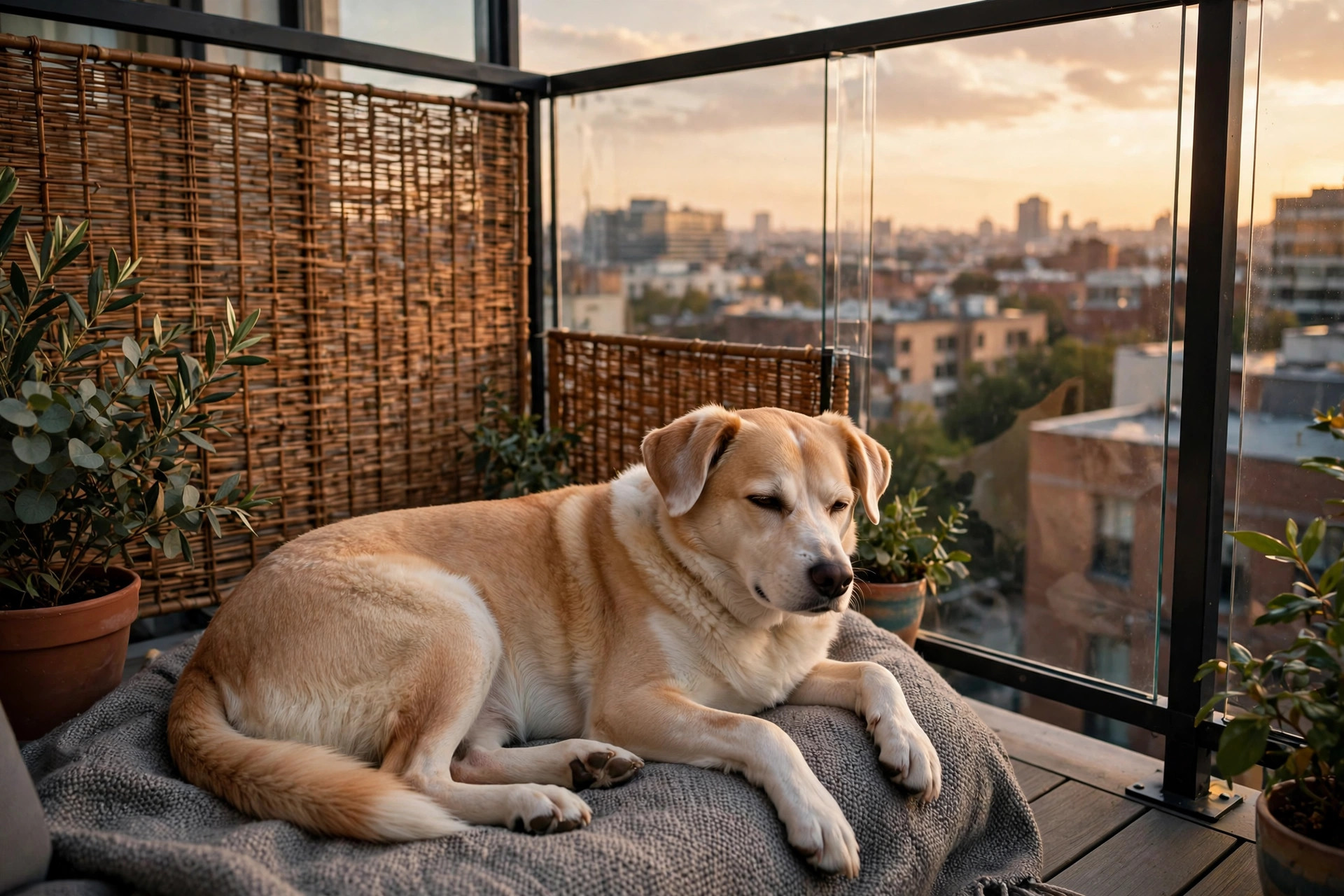
Dog balcony accidents rarely look like cat accidents. Dogs do not slip through rails so much as charge them, lean on them, and stand on the furniture beside them. Proofing for a dog therefore means rigid barriers, broken sightlines, and honest rules about supervision — here is the full setup, sized by dog.
Why dogs need a different balcony audit than cats
Owners often copy cat balcony advice for dogs and miss the risks that actually injure dogs. Dogs rarely squeeze through railings after puppyhood and they do not climb netting — instead they lunge, lean, bark-charge the rail, and chew. A 40-pound dog hitting a railing at speed delivers far more force than any cat, and a dog that fixates on a passing dog below will repeat that charge daily. Your audit therefore starts with strength and behavior, not gap size alone.
- Head and body gaps. Measure the widest railing gap. The rule borrowed from fence safety: if your dog's head can pass through, the body can follow, especially in a panic. For most adult dogs the danger threshold is around 4 inches; for puppies and toy breeds, treat anything over 2.5 inches as an opening. Do not forget the gap under the bottom rail — small dogs slide there.
- Railing height vs. shoulder height. Stand your dog at the rail. If the top rail is below the top of the dog's shoulders when standing on hind legs against it, a determined dog can get its center of gravity over the rail. Standard 36–42-inch balcony rails are not tall for a large dog that jumps — note this honestly rather than assuming height protects you.
- Surface and traction. Wet tile, smooth concrete, and composite decking get slick. A dog that scrambles for footing near the rail can slide into it or under it. Note the surface now; the fix (an outdoor rug with a rubber back, $25–$60) is cheap but only if you plan for drainage underneath.
- Trigger inventory. Spend 15 minutes noting what sets your dog off from the balcony: dogs below, delivery trucks, pigeons, skateboards. The trigger list decides whether you need visual screening (to break line of sight) in addition to physical barriers — for reactive dogs, screening often matters more than mesh.
- Heat load. Check the floor temperature at midday with the back of your hand. Dogs regulate heat through paw pads and panting; a dark slab in summer sun can burn pads in minutes and a brachycephalic dog (Bulldog, Pug, French Bulldog) can overheat on a still balcony faster than anywhere else in the home.
Bring the measurements and the trigger list to the product choices below. Dog balcony proofing fails when it is bought generically; it works when it is matched to one dog's size and one balcony's sightlines.
Barriers that work for dogs: rigid panels, privacy screens, and exercise pens
Flexible cat netting is the wrong tool for most dogs — it invites leaning and chewing and is not rated for impact loads. Dogs need rigid or semi-rigid barriers. These three options cover most apartment balconies; prices are typical 2026 street prices.
| Option | Typical cost | Strengths | Watch out for |
|---|---|---|---|
| Acrylic or polycarbonate railing panels (clamp-mounted) | $15–$35 per 2×4 ft panel | Blocks gaps, breaks wind, see-through | Heat buildup if fully enclosed; needs top ventilation |
| Welded-wire or metal mesh panels (zip-tied or clamped) | $20–$45 per panel | Chew-proof, high airflow | Heavier; check HOA rules on appearance |
| Balcony privacy screen fabric (dense weave) | $15–$35 for a 16 ft roll | Cuts visual triggers, cheap, renter-friendly | Not a physical barrier alone — pair with panels |
| Freestanding exercise pen (x-pen) as inner fence | $45–$110 for 30–42 in height | No attachment to building; movable | Large dogs can push it; anchor or weigh it |
Rigid panels are the core fix for any balcony with gaps over your threshold. Mount them on the inside face of the railing with stainless clamps or heavy-duty cable ties every 12 inches — inside mounting means a lunging dog pushes the panel against the rail, using the building's strength instead of your ties. Polycarbonate outlasts acrylic in UV and impact for roughly 20% more money; for a south-facing balcony, that upgrade pays for itself.
Privacy screening is the behavior fix. A dense-weave balcony screen (typically sold in 16–50-foot rolls, $15–$35) cuts the visual triggers that cause rail-charging. Attach it inside the panels or directly to the rail; it is not strong enough to be the only barrier for a dog over 15 pounds, but combined with panels it both contains and calms. Reactive-dog owners consistently report this is the single change that makes balcony time relaxing instead of vigilant — our guide to stopping dog door dashing uses the same break-the-sightline principle at the front door.
The x-pen inner fence deserves special mention for renters who can attach nothing at all. A 36- or 42-inch exercise pen set 12 inches inside the railing creates a buffer zone: the dog can be on the balcony, near you, but never at the rail itself. Weigh the pen's feet with sandbags if your dog leans, and never use a pen as the sole barrier for a dog left unattended — pens contain calm dogs, not determined ones.
Installation order that survives a lunging dog
Install in this order — gaps first, then sightlines, then comfort. Skipping to comfort items (beds, toys) before the barrier is complete is how 'almost ready' balconies produce incidents.
- Seal every gap at dog height first. Fit panels from the floor to at least 24 inches up, covering the under-rail space and wide baluster spacing. Run a hand along the entire bottom edge; any place your fingers pass through, a small dog's head or a puppy's body can too. For a puppy, add a temporary lower row of finer mesh — puppies outgrow the risk in months, but the mesh must cover the present, not the future dog.
- Extend height if your dog jumps. If your dog's standing reach puts paws over the top rail, add a panel extension of 12–18 inches above the rail, angled slightly inward if your building allows it. Inward-angled extensions defeat jumping far better than vertical height alone, because the dog cannot get its chin over the lip.
- Fit the privacy screen inside the panels. Overlap seams by at least 4 inches and tie every 8 inches along the top; a flapping loose corner becomes a chew toy within the hour. Leave the top 6 inches open if your balcony overheats — the screen's job is to block dog-level sightlines, not to create a greenhouse.
- Add traction and shade. Lay an outdoor rug over the main standing zone and place a water bowl in the shadiest corner. If the balcony has no natural shade, a clamp-on umbrella or shade sail ($20–$50) is a safety item for dogs, not a luxury — especially for dark-coated and flat-faced breeds.
- The lunge test. With your dog inside, push each panel firmly at dog-shoulder height. Then bring the dog out on a leash and let it investigate while you watch for the specific behaviors that predict trouble: pawing at panel seams, chewing tie points, or standing on hind legs against the barrier. Reinforce whatever the dog tests. Dogs audit your work more honestly than you do.
- Under 15 lbs: seal gaps over 2.5 in; 24-in panels usually sufficient.
- 15–50 lbs: seal gaps over 4 in; panels to top rail; privacy screen recommended.
- Over 50 lbs or known jumper: full-height panels plus inward extension; consider tethering policy below regardless of barrier.
The rules that matter more than the hardware
More balcony injuries come from management gaps than from barrier failure. These four rules are the ones trainers and emergency vets repeat, because they address how accidents actually happen.
Leash or tether until proven, every time the setup changes. Any change — new furniture, a visiting dog, fireworks season — resets the proofing clock. A simple protocol: the dog enjoys the balcony on a 6-foot leash attached to you or to a fixed point (never the railing itself) for the first several sessions after any change. Most dogs earn off-leash balcony time within a week; the leash is how you learn whether yours is one of them.
Never leave a dog unattended on a balcony — with narrow exceptions. For dogs in general, unattended balcony time is where chewing through screens, barrier-climbing, and heatstroke happen. If your dog is calm, adult, and the balcony is fully rigid-paneled with shade and water, brief unattended periods are a judgment call many owners make — but it should be a considered exception, not the default, and never for puppies, new rescues, or reactive dogs. If your dog spends workdays alone, an interior setup near a window (see white noise for anxious apartment dogs) is the safer design.
Train a balcony recall before you need it. Practice calling your dog from the balcony to the door with a high-value treat until the response is immediate, then proof it against mild distractions. The scenario this serves is not an escape in progress — it is the moment you spot a hazard (a wasp nest disturbed, a dropped grill lighter, a dog fight erupting below) and need the dog inside now, not after negotiation.
Manage the furniture, again. As with cats, anything climbable near the rail is a step. For dogs the risk item is different: outdoor storage boxes and cooler benches that a large dog can stand on. Keep stand-able items at least 4 feet from the rail for dogs over 40 pounds, and choose low, wide balcony furniture that does not invite standing in the first place.
If your dog charges the rail at dogs below, more barrier is not the first answer — less view is. Owners who add privacy screening before upgrading panels usually find the charging stops, and the panels they already have become plenty.
Costs, monthly checks, and when to rebuild
A complete dog-proofing job for a typical 10×4-foot balcony — rigid lower panels, privacy screen, outdoor rug, and clamps — typically totals $90 to $190, with the panel choice driving most of the cost. A freestanding x-pen approach runs $45 to $110. For comparison, emergency treatment for a fall or for heatstroke commonly ranges from $1,000 to $4,000. This is not an area where the premium option is indulgent; buy the rigid barrier first and economize on everything else.
- Monthly: Re-run the lunge test on two or three panels, check cable ties for UV brittleness (replace any that snap when flexed — ties cost cents), confirm the screen has no chewed corner, and verify the water and shade setup is still in place after windy weeks.
- Seasonally: Before summer, re-check floor heat and shade at the hottest hour. Before winter, confirm panels have not cracked in cold snaps and that de-icing salt tracked onto the balcony is swept — it irritates paws and is toxic if licked in quantity.
- After any incident: A dog that gets a paw through, chews a tie point free, or goes over a barrier element has shown you the weak point. Upgrade that element one class (fabric to rigid, rigid to extended) rather than repairing to the same spec.
Upgrade triggers specific to dogs: adolescence (many dogs test barriers at 8–18 months that they ignored as puppies), a weight gain that changes jump reach, a new reactivity trigger in the building (a new dog on the floor below is the classic one), and any move to a higher floor. If two triggers stack, rebuild rather than patch.
Done well, a dog-proofed balcony becomes one of the best enrichment spaces in apartment life — a sun-and-air room where your dog can watch the city without either of you staying vigilant. That calm is the actual product; the panels are just how you buy it. If your dog is reactive in shared spaces beyond the balcony, our guide to handling close encounters in the apartment safety hub will help you extend the same calm to hallways and elevators.
FAQ
Can I use cat netting for my small dog instead of rigid panels?
For a calm dog under about 10 pounds that does not lean or lunge, tightly tensioned netting can work as a gap-blocker. For any dog that pushes, leans, or chews, rigid panels are the safer default — netting is designed for feline loads, not canine ones.
My dog barks at everything from the balcony. Will screening really help?
Usually, yes. Most balcony barking is visually triggered — the dog sees another dog, fixates, and escalates. A dense privacy screen breaks the sightline and typically reduces barking dramatically within days. Pair it with a trained recall so you can interrupt the episodes that still occur.
How long can a dog stay on a balcony in summer?
There is no safe universal number — floor temperature, shade, breed, and airflow decide it. Check the floor with the back of your hand; if it is hot, the session is over. Flat-faced breeds, seniors, and puppies should have short, supervised sessions with constant water access even on mild days.
What if my building prohibits balcony panels?
Ask specifically about a freestanding exercise pen inside the railing and a privacy screen tied to your own furniture rather than the building fabric. Buildings that refuse attachments often accept freestanding setups. Get the answer in writing before you buy.