Best Freestanding Pet Gates for Renters (No Drilling)
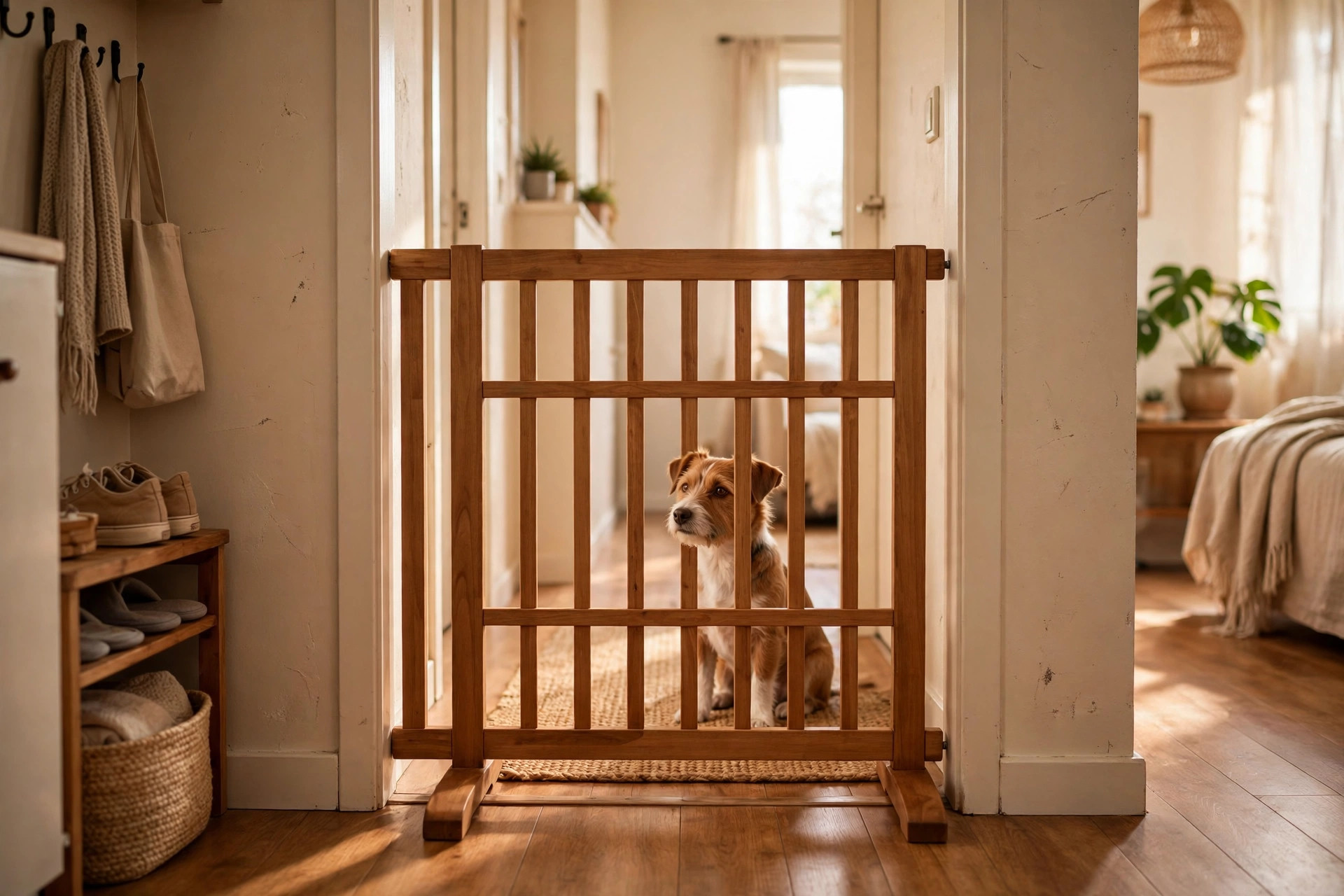
Most pet gates assume you own the walls. Pressure-mounted gates brace between two surfaces — fine for a doorway, useless in an open-plan rental — and hardware-mounted gates need screws your lease explicitly forbids. Freestanding gates solve a different problem: they stand on their own feet, touch nothing, and work wherever you set them down. That makes them the renter's gate of choice for kitchens, studio zones, and wide openings that no pressure gate can span.
The renter's test for any gate is not “does it fit” but “can I remove it in 30 seconds and find zero evidence?” A freestanding gate passes by design: no cups on the wall, no rubber marks on the trim, no patch-and-paint weekend before move-out.
Freestanding or pressure-mounted? Pick by your floor plan
Freestanding gates are not universally better — they are better for specific rental situations. Run this quick decision:
- Open-plan living room / kitchen boundary: freestanding. Pressure gates need two opposing walls within 40–50 inches; an open archway or island gap has nothing to brace against.
- Standard doorway with solid trim on both sides: pressure-mounted works and is cheaper. But check the trim first — rubber pads can leave marks on fresh paint, which is its own deposit risk.
- Wide or angled openings: freestanding. Multi-panel freestanding gates span up to 120+ inches and fold into angles that no pressure gate handles.
- Stairs (any kind, ever): neither — freestanding gates are not safe for stairways. Only hardware-mounted gates belong at stairs. More on this below.
- Cats instead of dogs: freestanding gates are dog gear. Most cats stroll over or under a 24–30 inch gate. For cat containment, see our renter-friendly cat wall guide.
If you share the home with a dog under about 40 lbs and need to block a room rather than a doorway, keep reading — you are the freestanding gate's ideal customer.
Four freestanding gates worth your money
All four are widely sold, well-reviewed models with real rental-friendly track records. Prices are typical US street prices; freestanding wood gates run pricier than pressure gates because you are buying furniture, not hardware.
| Gate | Best for | Typical price | Renter note |
|---|---|---|---|
| Richell Wood Freestanding Pet Gate | The classic; blends with furniture | Usually $70–$110 by size | Hardwood with its own feet; looks like furniture, needs zero wall contact. |
| Primetime Petz 360° Configurable Gate | Wide and angled openings | Usually $90–$130 | Multi-panel zinc/wood design; spans large openings and folds into a Z for storage. |
| PAWLAND Extra Wide Freestanding Dog Gate | Big dogs and open floor plans | Usually $70–$100 | Tall (up to 36 in) wood panels; rubber feet protect floors. Confirm panel width for your opening. |
| Carlson Pet Products Freestanding Wood Gate | Small dogs and tight spaces | Usually $80–$110 | Compact 20–24 in height options; step-over style is easy for humans, fine for small dogs. |
Richell Wood Freestanding Pet Gate — the classic
Richell's freestanding gate is the one you will see in half the renter-pet recommendations online, and the reputation is earned: hardwood panels on wide support feet, finished well enough to look like furniture rather than baby gear, and available in small (36–72 in span) and large sizes. The step-over height (around 20 inches for the small) keeps small and medium dogs out while you walk over it — though if your dog is a jumper, size up. Zero assembly beyond unfolding. The main cost is floor space: the feet extend a few inches on each side, so measure the spot, not just the opening.
Primetime Petz 360° Configurable Gate — the wide-opening solver
For the open archway between living room and kitchen, where nothing is 40 inches wide and everything is 100, the 360's four to six hinged panels fold into angles and span openings pressure gates cannot. The panels are light enough to reposition daily — block the kitchen during cooking, open it after — and it folds nearly flat for closet storage, a genuine advantage in a one-bedroom. At $90–$130 it is the priciest pick here, but it replaces two gates for most open-plan renters.
PAWLAND Extra Wide Freestanding Dog Gate — the tall option
Most freestanding gates top out around 24 inches tall, which a determined medium dog clears. PAWLAND's panels reach about 32–36 inches in the taller configurations, making it the realistic choice for dogs over 40 lbs or athletic jumpers. The panels connect with simple pegs so you can set width in panel increments, and the rubber feet grip hardwood without scratching. Verify total width before ordering: panels come in fixed widths, and you cannot trim them like a pressure gate's tension fit.
Carlson Pet Products Freestanding Wood Gate — the small-space pick
Carlson's freestanding gate is the compact one: a short step-over height and narrow feet that fit a studio doorway or a galley kitchen entrance without eating the walking path. The trade-off is containment power — this is a small-dog gate, full stop. For a beagle or corgi in a small apartment it is the tidiest solution; for a lab, keep scrolling.
Measure before you buy: the two numbers that matter
Freestanding gates do not adjust the way tension gates do, so returns are common. Measure these two things:
- The opening width at floor level, plus 6 inches each side. Freestanding gates get stability from their feet extending beyond the panels, and those feet need flat floor — not a rug edge, not a floor transition strip. Measure on the floor where the feet will actually sit.
- Your dog's shoulder height against the gate height. The rule of thumb: the gate should reach at least 75% of your dog's shoulder height for calm dogs, and full shoulder height for jumpers. A 20-inch step-over gate stops a 30-lb dog that never jumps and nothing else.
- Confirm the opening has flat floor where the feet will sit — thresholds and rug edges destabilize freestanding gates.
- Confirm the gate height against your dog's shoulder, not just weight class.
- Confirm you can step over it comfortably if there is no walk-through door — you will do this dozens of times a day.
- For doorways only: also price a pressure-mounted gate with wall cups. Sometimes it is cheaper and deposit-safe.
Placement tricks for open-plan rentals
A freestanding gate's superpower is working where walls do not. Three layouts that work well:
- The kitchen diagonal. In a studio or open one-bedroom, run a multi-panel gate (Primetime Petz or PAWLAND) on a diagonal from the kitchen counter to the nearest wall segment. The angle is stronger than a straight line — pressure from a nosing dog pushes panels into a wedge instead of sliding them.
- The hallway choke point. Even open-plan apartments usually have one narrower section — a hallway entry, the gap between island and wall. A Richell or Carlson gate there blocks bedroom access with a fraction of the width.
- The furniture anchor. End a gate run against a heavy piece of furniture (sofa arm, bookshelf) instead of a wall. It reads as intentional room division, and a 50-lb bookshelf is as immovable as a stud wall. Keep the gate's feet clear of the furniture's base so nothing tips.
For keeping a dog out of the entryway specifically — door-dashing during deliveries — pair a gate with an entryway routine. Our entryway setup guide covers the full system: gate placement, treat stations, and training the “place” habit.
The one hard rule: never at stairs
This is the safety section, and it is non-negotiable: freestanding gates must never be used at the top or bottom of stairs. They stand on their feet, and a dog hitting one at stair height can topple it — turning a barrier into a falling object the dog rides down. Baby-gate safety standards say the same for freestanding designs: stairs require hardware-mounted gates screwed into the wall, no exceptions. If you rent with stairs and a dog, talk to your landlord about two small screw holes with wall anchors — most approve it in writing when you explain the alternative, and anchors patch cleanly at move-out.
Also watch two apartment-specific risks: long rugs under gate feet (the gate slides; use the bare floor or a low rug pad), and determined chewers on wooden panels — Richell's hardwood holds up better than pine-paneled competitors, but a power chewer needs a metal option or a crate setup for unsupervised time.
FAQ
Will a freestanding gate scratch my hardwood floors?
Any gate with hard plastic feet can mark soft floors over time. Choose gates with rubber feet (PAWLAND, most Carlson models), or add adhesive felt pads to the feet for a few dollars. Move the gate a few inches monthly so any micro-scratches do not concentrate in one line.
My dog pushes the gate over. What am I doing wrong?
Almost always: the gate is too narrow for the opening, so the dog gets a running start, or the feet sit on a rug. Extend the span so the dog approaches head-on, set the feet on bare floor, and angle the panels into a slight V or Z — angled runs resist pushing far better than straight ones. For chronic pushers, size up in height; jumping clears the problem entirely.
Can I use a freestanding gate for a cat?
Not effectively. Most cats clear a 24–30 inch gate without thinking, and taller gates just become furniture to climb. Freestanding gates are dog gear; for cat boundaries, our renter-friendly cat wall ideas cover options that actually contain cats without drilling.
Freestanding or pressure-mounted for a standard doorway?
For a standard doorway with solid trim, a pressure-mounted gate is usually cheaper and sturdier — with one caveat: use wall cups and check your paint. Fresh paint plus rubber pads can peel at move-out. If your lease forbids even cups, freestanding (Richell or Carlson) is the answer, though you pay a bit more.
Do freestanding gates work for puppies?
Yes, with a height check: puppies grow into jumpers. Buy the height for the adult dog, not the current puppy, or you will rebuy in six months. A PAWLAND tall panel now beats a Carlson step-over plus a second purchase later.