Best Renter-Friendly Cat Wall Ideas for Small Apartments
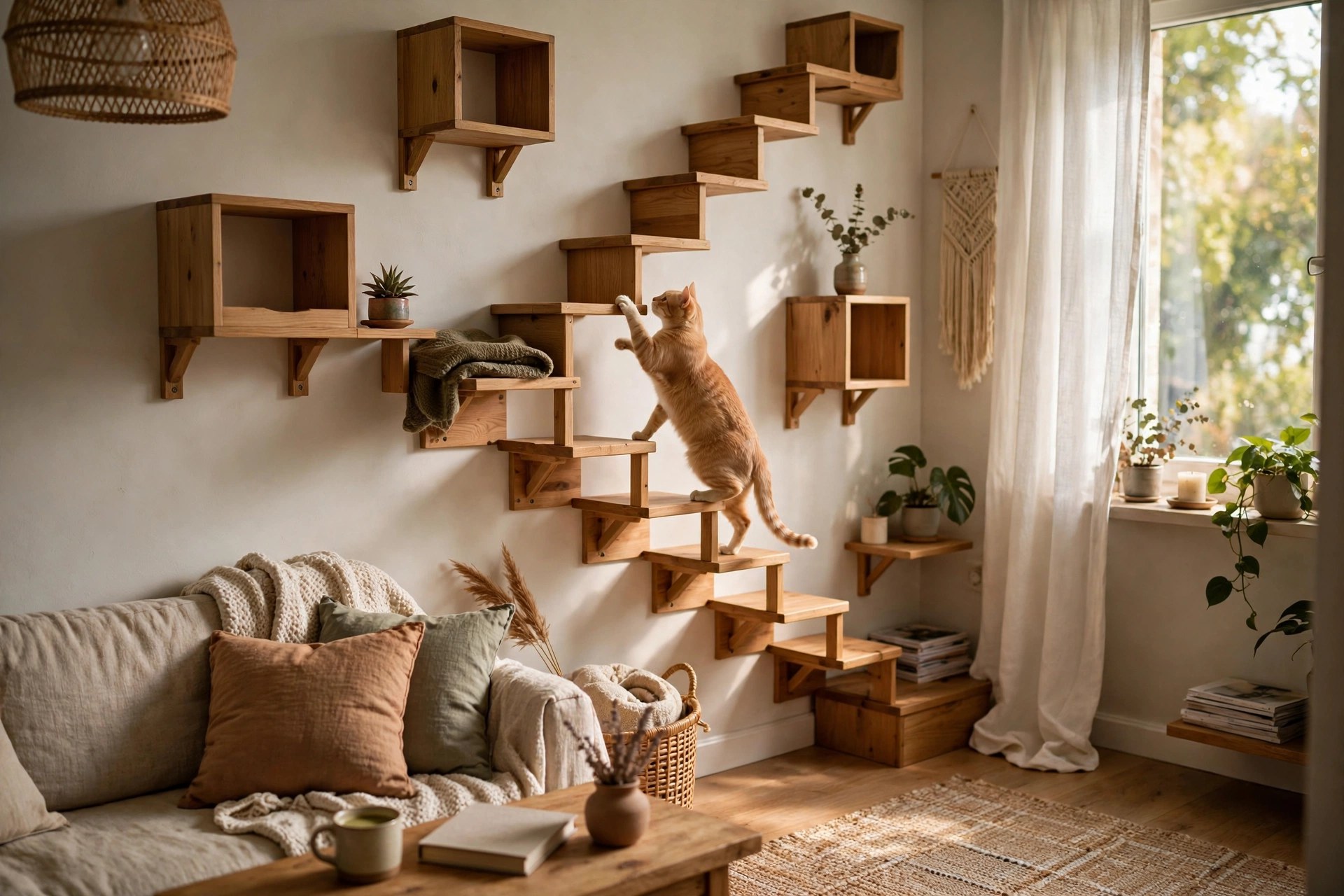
Indoor cats do not need more floor space — they need more territory, and the cheapest territory in a rental is the wall. Almost all cat wall advice assumes you own the place; this guide is for renters: which mounting methods hold a leaping cat, four products worth buying, safe heights and jump gaps, and how to leave the wall untouched on move-out day.
The renter’s golden rule: screw into studs, not into drywall — and photograph every wall the day you move in. The holes that cost you a deposit are rarely the holes you made; they are the ones you cannot prove you did not make.
Start with the deposit, not the drill
Before you buy a single shelf, do the two things that make everything else risk-free. First, take dated photos of every wall where you might install anything, including close-ups of existing scuffs and nail holes. Most deposit disputes are not about your hardware — they are about pre-existing damage nobody documented.
Second, know what actually costs money. Small, filled screw holes (1/8 inch) count as normal wear and tear under most leases. What costs money: unfilled holes, torn drywall paper from ripped-out anchors, and the ragged holes drywall toggles leave. Landlord repairs commonly run $100–$300 per area — which is why method choice matters more than product choice.
The fix costs under $10: lightweight spackle, 220-grit sandpaper, and matching touch-up paint. Apply, wait an hour, sand flush, paint. If your landlord gave you a paint color at move-in, keep the code — it is the difference between an invisible patch and a visible smudge.
Mounting options, ranked for renters
Not all “no-damage” mounting is equal, and the ranking that matters is holding strength under a dynamic load — a landing cat hits a shelf with two to three times its body weight. Here is the honest order, strongest and most renter-friendly first:
- Small screws into wood studs. The gold standard and, paradoxically, the most renter-friendly option: a single 2.5-inch wood screw into a stud holds 50+ pounds, and a shelf on two stud screws is routinely rated 25–50 pounds. The 1/8-inch holes take one dab of spackle each. A $15–$30 stud finder does the job; US apartment studs typically run 16 inches apart, and outlet boxes are usually nailed to a stud — a free reference point. Confirm with a thin pilot hole first.
- Floor-to-ceiling tension-pole towers. Zero holes, full climbing height. The catch is fit: they need ceilings in the 7.5–9 foot range, a level floor, and a base wide enough that the pole does not walk when a 12-pound cat launches off it at speed. Check the manufacturer’s weight rating against your actual cat, not an average cat.
- Heavy-duty adhesive strips (3M Command style). The large 4-strip sets are rated up to 16 pounds on perfect surfaces, but a cat shelf faces dynamic loads — a 12-pound cat landing from a jump briefly exerts 25–35 pounds of force. The practical rule: keep the total load (shelf plus cat) under 8 pounds. That rules out most adult cats on most shelves. Adhesive works for kittens, tiny single steps, or as a secondary hold alongside screws — and heat, humidity, and textured paint cut capacity further.
- Drywall anchors alone. Toggle and molly anchors are rated 25–75 pounds static, which sounds fine until you price the downside: they leave large, ragged holes that are genuine deposit-deduction territory, and they still flex under repeated leaps. Use only for lightweight shelves under 10 pounds total, and only where you cannot reach a stud.
- Suction cups and over-door hooks for anything weight-bearing. No. Fine for a dangling toy, never for a shelf a cat will stand on.
- A quality wood shelf into studs: rated 20–50 lbs. Keep the working load at 15–25 lbs per shelf including the cat, the shelf, and a margin for landing force.
- Adhesive strips: keep total load under 8 lbs — shelf plus cat combined.
- One shelf, one cat at a time. If two cats chase, space shelves so they can pass each other without a mid-air negotiation.
- Test every shelf before the cat does: press down with roughly 30 pounds of force and check for flex, creak, or bracket movement.
Four wall systems worth your money
These are the names that keep showing up in renter cat communities, compared on the things that matter in a lease: how they mount, how many holes they need, and what they cost. Prices are typical US street prices and move with sales.
| System | Best for | Typical price | Renter notes |
|---|---|---|---|
| Catastrophic Creations wall shelves | Modular wood systems you can rearrange | Usually $60–$200+ per set | Solid wood with real brackets; needs stud screws — but the small holes patch cleanly and the shelves survive multiple moves. |
| Frisco wooden wall shelves (Chewy) | Budget first wall; renters testing a layout | Usually $25–$45 per piece | Light brackets and minimal hardware; easy to remove, easy to patch, cheap to replace if a layout does not work. |
| On2Pets wall-mounted perches | Compact walls and window-adjacent spots | Usually $40–$80 | Small footprint suits narrow walls; screw mounting means finding the stud first — do not drywall-anchor these. |
| FUKUMARU cat wall shelf sets | Starter bundles with steps and bridges | Usually $50–$120 per set | Many pieces means many holes — map the full layout on paper before drilling anything, and buy only the pieces your wall fits. |
Notice the pattern: no single “best,” only trade-offs. Catastrophic Creations wins on longevity; Frisco on price and low commitment; On2Pets on compact footprints; FUKUMARU on getting a full route in one box — but demands the most planning. Whatever you buy, the mounting method matters more than the brand on the box.
Heights and jump gaps that work for real cats
Cats can jump four to five feet vertically, but a daily-use wall should be built for cruising comfort, not parkour:
- First step: 18–24 inches off the floor. That is bed or chair height — a height cats step up to naturally, so the wall gets used from day one instead of ignored for a month.
- Vertical gap between steps: 12–18 inches. Tight enough that kittens, seniors, and chunky cats can climb it; generous enough that athletic cats do not feel cramped.
- Horizontal offset: 10–14 inches per step. Straight vertical ladders force awkward landings. Stagger each step sideways and the cat flows up the wall instead of hauling itself straight up.
- Lounging shelves: 10–12 inches deep, 16–20 inches long. Eight inches is a perch; ten-plus is a bed. Leave 16–20 inches of clear space above a lounging shelf so the cat can sit fully upright (a sitting cat needs 10–14 inches of headroom).
- Top perch: 48–72 inches in most apartments. High enough to feel like territory, low enough to stay in your sightlines and within a safe dismount. Above 72 inches only for confident jumpers with a clear landing below.
And the rule most layouts break: every shelf above four feet needs two ways down. A cat that climbs to a dead-end perch and discovers the only exit is a leap past the dog learns to avoid the wall entirely. Plan the route so the cat can always go up, across, and down a different way than it came.
A worked example: one 6-foot wall in a studio
Take a 72-inch-wide stretch of living room wall, free from 24 to 76 inches high. A complete route with five pieces:
- Step 1 at 24 inches, left third of the wall — a simple 12 x 8 inch step.
- Step 2 at 38 inches, offset right by about 12 inches.
- Step 3 at 52 inches, offset back left — the zigzag keeps landings easy.
- Lounging shelf 18 x 12 inches at 64 inches, right side, with 18 inches of clear air above it.
- Perch or cube at 70 inches, left side — the summit, with the lounging shelf as its second way down.
All five pieces go into studs — mark the 16-inch spacing first, then shift the layout to match. Total: roughly ten small screws, about $80–$150 in Frisco or On2Pets pieces, and twenty minutes of spackle work on move-out day. Most renters overthink the product and underthink the stud map; flip that and the wall practically builds itself.
FAQ
How much weight can one cat wall shelf hold?
Into a wood stud, a quality shelf is typically rated 20–50 pounds; keep the working load at 15–25 pounds per shelf — cat, shelf, and landing force combined. Before the cat tries it, press down with about 30 pounds of force and watch for flex. If it moves under your hand, it will fail under a landing cat.
Can I use Command strips instead of screws for cat shelves?
Only for very light loads: keep the shelf-plus-cat total under 8 pounds, on smooth, cool, painted walls. An adult cat’s landing force (25–35 pounds from a jump) exceeds what adhesive strips are rated for, so strips are a backup method or a kitten-only method — not a primary mount for a shelf an adult cat will use daily.
How do I find studs in an apartment without expensive tools?
A $15–$30 magnetic or electronic stud finder is enough. US apartment studs are typically 16 inches apart; knock along the wall listening for the solid thunk versus the hollow drywall sound; and remember that outlet and switch boxes are usually nailed to a stud, giving you a free starting reference. Confirm with a tiny pilot hole before you commit to the full layout.
Will small screw holes cost me my security deposit?
Usually not, if you patch them. Small filled holes count as normal wear under most leases; the deductions come from unfilled holes, torn drywall, and anchor damage. Photograph walls at move-in, fill holes with $5–$10 spackle, sand flush, and touch up with matching paint — most landlords never notice the repair, because there is nothing to notice.