Best White Noise Machines for Anxious Apartment Dogs
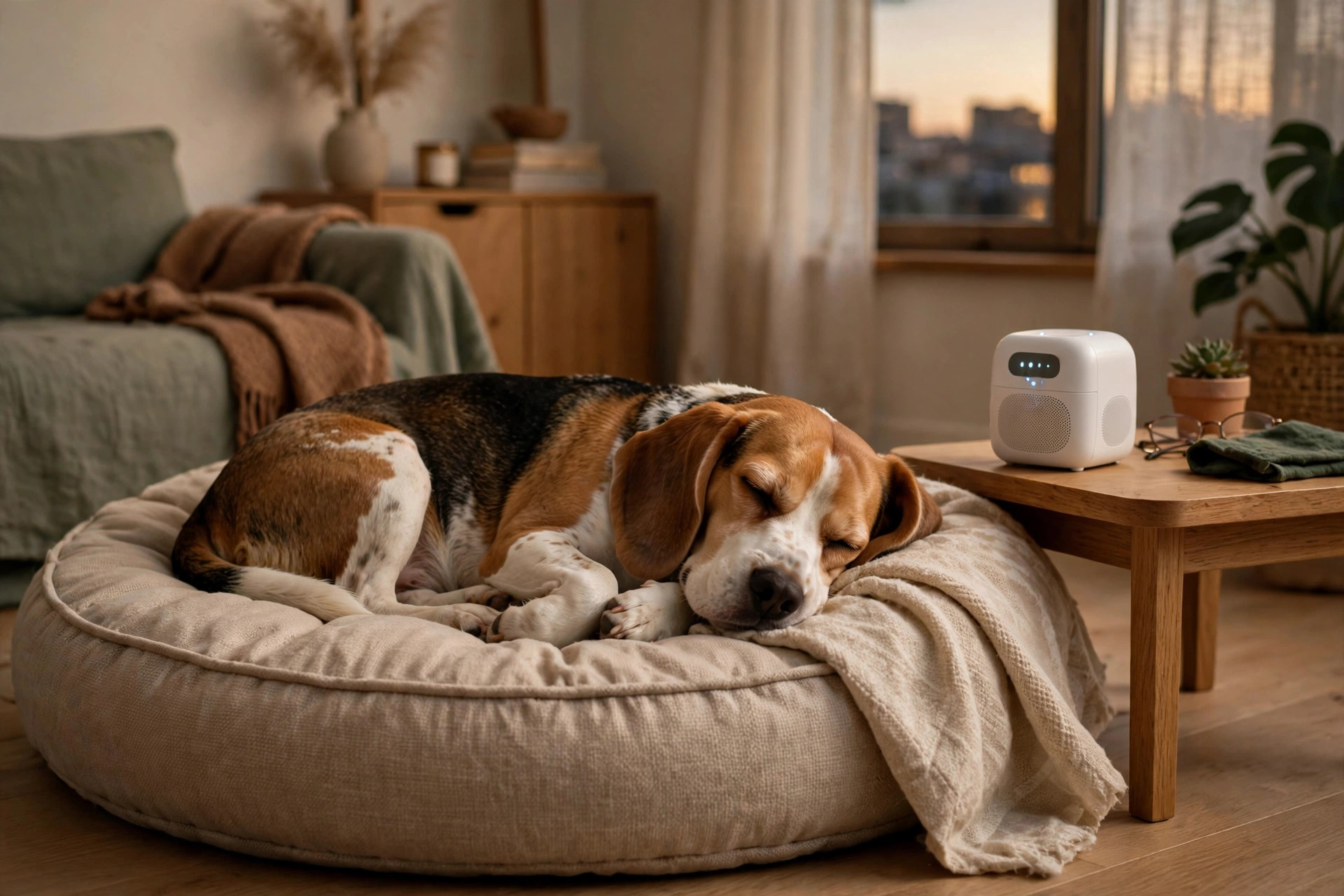
Your apartment dog does not hear “the building.” It hears a horror movie: the elevator ding at 2 a.m., a neighbor’s key in a lock that sounds like your key, footsteps that stop outside your door and then — unbearably — keep going. Dogs evolved to treat sudden sounds in their territory as threats, and apartment hallways deliver sudden sounds all day. A white noise machine does not train the dog or fix the anxiety. What it does is flatten the acoustic landscape — raising the background just enough that the scary sounds stop arriving as spikes.
How sound masking actually works (and what it cannot do)
The mechanism is simple physics, not magic:
- It reduces contrast, not volume. A white noise machine does not make the hallway quieter. It raises the ambient floor from ~35 dB (silent apartment) to ~55–60 dB (steady hum), so a 70 dB door slam arrives as a small bump instead of a startling spike. The dog’s nervous system reacts to sudden changes, not absolute levels — masking removes the suddenness.
- Steady beats interesting. Music, talk radio, and TV all have gaps, crescendos, and sudden sounds — a doorbell in a TV show is a real event to a dog. True white/pink/brown noise is constant by design, which is why it masks better than any playlist.
- It is a support tool, not a treatment. Masking reduces trigger frequency, which lowers the dog’s daily stress load — and a less-stressed dog learns faster. But separation anxiety, noise phobia, and reactivity still need the actual behavior work: desensitization, counter-conditioning, and alone-time training. The machine buys you the calm baseline that makes training possible.
- Placement matters more than brand. The machine goes between the dog and the noise source — near the front door for hallway sounds, near the shared wall for neighbor noise. A $60 machine in the wrong corner loses to a $25 machine in the right spot.
Five machines worth the nightstand
Every machine below is a real, widely sold product. The differences are sound quality (mechanical vs. digital), volume range, and extra features. Prices are typical street prices.
| Machine | Best for | Usually | Dog-anxiety note |
|---|---|---|---|
| Yogasleep Dohm | Most anxious dogs | $50–$65 | Real fan = natural sound; the gold standard |
| LectroFan | Precise control | $50–$65 | 20 fan sounds + 10 white noise variants; exact volume |
| Magicteam Sound Machine | Budgets | $20–$25 | 20 looping sounds; good enough for most hallways |
| Yogasleep Hushh | Travel and crates | $30–$35 | Portable, clips to crate; USB rechargeable |
| Big Red Rooster | Simple and cheap | $20–$25 | 6 sounds, dead simple; the no-fuss pick |
Yogasleep Dohm — the everyday pick
The Dohm is the only machine here that makes sound mechanically — a real fan inside, with adjustable vents that tune the tone. The result sounds like moving air rather than a recording, with no digital loop for the dog’s excellent hearing to detect. (Dogs hear the loop point in cheap digital machines; the Dohm has no loop to hear.) It is also the sound most dogs habituate to fastest, because it resembles the HVAC hum they already live with. The price is the highest here, but for a dog with genuine anxiety, the natural sound quality is worth it.
LectroFan — the control-freak pick
Twenty fan sounds plus ten white/pink/brown noise variants, with precise volume steps — the LectroFan is for the owner who wants to dial in exactly the right masking level. The brown-noise and deep-fan settings are particularly good at masking low-frequency thumps (bass from the neighbor’s speakers, the elevator machinery) that white noise handles poorly. Fully digital, but the loops are long and clean enough that most dogs never notice. The best pick when you know exactly which sounds trigger your dog.
Magicteam — the budget pick
Twenty non-looping sounds (the marketing says non-looping; the loops are just long), a sleep timer, and perfectly adequate volume for $20–$25. The sound quality is clearly digital next to the Dohm, and the cheapest-feeling build on this list, but for masking hallway chatter and door sounds it does the job. The honest budget choice: if the dog’s anxiety is mild-to-moderate, start here before spending more.
Yogasleep Hushh — the portable pick
A pocket-sized Dohm-style machine that clips to a crate, stroller, or travel carrier — USB rechargeable, with a child-lock so paws cannot change the settings. The use case: keeping the masking consistent when the environment changes. Dogs generalize anxiety to new places fast; bringing the familiar sound to the vet’s waiting room, the car, or a pet-sitter’s apartment provides continuity. Also useful as the second machine for the bedroom while the Dohm covers the living room.
Big Red Rooster — the simple pick
Six sounds, one dial, done. No app, no Bluetooth, no 47 ocean variants to scroll through at midnight. For the owner who wants to plug something in and never think about it again, this is the pick — and the simple operation means a pet-sitter or roommate can use it correctly without instructions. The white noise setting is clean and the volume goes plenty loud for apartment masking.
- Volume: conversation level. Aim for 55–65 dB at the dog’s resting spot — about as loud as a normal conversation. Loud enough to mask, quiet enough to talk over. Louder is not better; excessive volume becomes its own stressor.
- Position: between dog and noise. Hallway sounds? Machine near the front door. Neighbor’s TV through the wall? Machine against that wall. The masking works best when the steady sound arrives from the same direction as the scary sounds.
- Run it before the triggers start. Turn it on when you leave for work, not after the dog is already pacing. Prevention beats interruption — a dog already over threshold cannot be masked back down.
- Keep it consistent. Same sound, same volume, same schedule. The machine becomes part of the “safe” environmental cue set — randomness undermines that.
The behavior plan the machine supports
Masking lowers the daily trigger count. Here is what to do with the calmer baseline it creates:
- Alone-time training. With the machine running, practice short departures — out the door for 30 seconds, return before the dog panics, gradually extend. The masking means fewer hallway sounds spike the dog mid-session, so more repetitions succeed. See the separation anxiety toolkit for the full setup.
- Hallway desensitization. Record your building’s actual hallway sounds (elevator ding, doors, voices) on your phone. Play them at very low volume over the white noise, treating the dog for calm, and raise the volume over days. The machine provides the floor that makes the training sounds less startling.
- The calm evening routine. Machine on, lights low, chew or lick mat out — a predictable wind-down sequence teaches the dog that evenings are safe. The evening routine guide has the full protocol.
None of this works if the dog is already in full panic every day — that level of anxiety needs a vet or certified behaviorist, potentially including anti-anxiety medication. The machine plus training handles mild-to-moderate anxiety; severe cases need professional help, and there is no shame in that.
Three white-noise mistakes that backfire
2. Using it only during panic. Turning the machine on when the dog is already barking at the hallway teaches the dog that the sound predicts scary things — the exact opposite of the goal. The machine runs during calm times so it becomes a safety cue, not an alarm bell.
3. Expecting it to replace training. The most common disappointment: “we bought the machine and the dog still barks.” Masking reduces triggers; it does not teach the dog anything. Pair it with the desensitization work above for a month before judging — the combination is dramatically more effective than either alone.
FAQ
Will white noise bother my neighbors?
No — at 55–65 dB inside your apartment, it is inaudible through walls. It is quieter than a TV at normal volume. The neighbor-risk direction actually runs the other way: the machine reduces your dog’s barking, which is what the neighbors were hearing.
Can I just use a phone app instead?
For a trial week, yes — it tells you whether masking helps before you spend money. For permanent use, no: phone speakers distort at sustained volume, notifications interrupt the sound (a sudden ding over white noise is exactly the spike you are avoiding), and tying up a phone 24/7 is impractical. A $25 dedicated machine beats a $1,000 phone at this job.
Which is better for dogs: white, pink, or brown noise?
It depends on the trigger sounds. White noise (equal energy across frequencies) masks high-frequency sounds like voices and keys best. Brown noise (emphasized low frequencies) masks thumps, bass, and elevator rumble best. Pink is the middle ground. Try each for a few days and watch the dog — the right one visibly reduces startling.
My dog barks at the machine itself. What now?
Start with the volume barely audible and the machine across the room, treating calm behavior — the same desensitization approach as any novel object. Most dogs accept it within a few days. If the dog specifically objects to one sound type, switch: dogs that dislike white noise often accept brown noise or a fan sound, which feels more natural.