Best Robot Vacuums for Pet Hair in Small Apartments
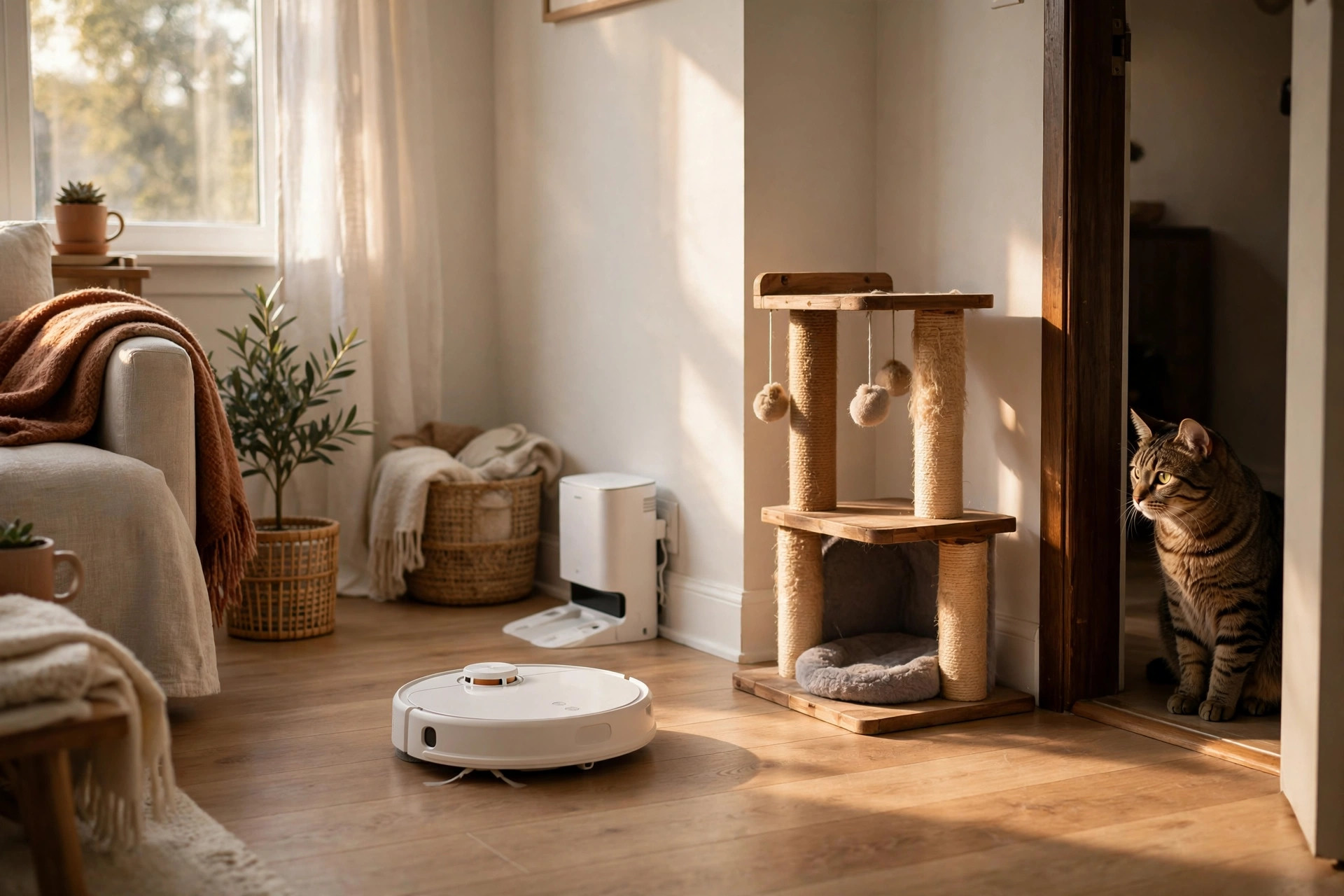
Pet hair does not arrive in a weekly lump you can handle on Saturdays. It arrives daily — off the sofa, off the rug, off your coat every time the dog shakes. A robot vacuum is the only cleaning tool that works while you are at the office: a 20-minute pass every weekday can keep a one-bedroom from ever reaching “tumbleweed stage.” But in 600 square feet the wrong robot is worse than none — one that wedges under the TV stand, screams through shared walls at 7 a.m., or gets stuck on a rug tassel is a problem, not a helper. This guide is about picking the right one and setting it up right.
- A robot vacuum is a daily maintenance crew, not a deep cleaner. It delays the weekend clean — it does not replace a real vacuum.
- Budget roughly $150–$900. The useful apartment features — scheduled runs, obstacle handling, a monthly-emptied dock — exist at both ends of that range.
- Measure your thresholds before you buy: most robots climb about 0.75–1 inch (roughly 2 cm). A chunky door strip defeats them all.
- Noise runs about 55–70 dB; schedule mid-morning runs when you and the neighbors are out.
- Five minutes a week of brush-hair cutting is the price of admission. Skip it and even a great robot chokes.
The honest math: what a robot actually does in 600 square feet
In a pet apartment, the robot’s job is not perfection — it is frequency. A cordless stick vacuum takes about ten minutes per session, and most owners do it twice a week. A robot runs five times a week for twenty minutes while you are out, at zero effort. That gap is the whole game: hair picked up daily never mats into rugs or drifts into corners.
Now the honest limits. No robot cleans your sofa, stairs, or car. Most struggle with litter piles — scatter they handle, but a fresh clump can jam a small intake, which is why a good litter mat still earns its place. Wet messes are a no-go, and except for the Roomba j7+ below, robots do not reliably recognize pet waste — unsupervised runs with an unreliable puppy are a gamble. In a studio, a random-navigation robot can take 45 minutes to cover what a mapped robot does in 20.
Five models that survive pet apartments
All five are real, widely sold machines. Prices are typical street prices.
| Model | Best for | Typical price | Small-apartment note |
|---|---|---|---|
| iRobot Roomba j7+ | Accident-proofing | Usually $500–$800 | Recognizes and avoids pet waste; self-empty base holds ~60 days. |
| Roborock Q Revo | Vacuuming + mopping | Usually $600–$900 | LiDAR mapping; bulky dock needs ~1.5 sq ft of wall space. |
| Shark AV2501S AI Ultra | Value self-emptying | Usually $400–$600 | Bagless base saves bag costs; grid pattern covers rooms evenly. |
| eufy RoboVac 11S Max | Studios and quiet homes | Usually $150–$250 | Only 2.85" tall; fits under low sofas; very quiet on normal mode. |
| ILIFE V3s Pro | Heavy shedders, tight budget | Usually $160–$230 | Tangle-free suction intake — hair does not wrap the roller. |
iRobot Roomba j7+ — the accident-proof pick
The j7+ exists for one reason: it recognizes and steers around pet waste. iRobot backs it with their P.O.O.P. (Pet Owner Official Promise) — a useful guarantee if your dog is still in the occasional-accident phase, because one smeared accident ends most robot-vacuum careers. Beyond that, it is a solid camera-navigation robot with a self-empty base holding roughly 60 days of debris. Not the quietest or fastest mapper. But for a puppy or senior dog, nothing else here qualifies.
Roborock Q Revo — the mopping combo pick
The Q Revo’s appeal is the dock: it empties the dustbin and washes the mop pads, so one schedule covers vacuuming plus light mopping. LiDAR mapping learns the floor plan and covers rooms in tidy rows. The dock is the largest of the bunch — about a foot and a half of wall, the main apartment trade-off. Strong suction (around 5500 Pa) makes it the best choice here for rugs mixed into hard floors.
Shark AV2501S AI Ultra — the value self-empty
Shark’s self-empty base is bagless, which matters: competing bases need $15–$20 replacement bags every couple of months, and a shedding pet shortens that cycle fast. Matrix Clean does deliberate grid passes that suit rectangular apartment rooms. It runs louder than the eufy on boost mode, so schedule runs for when you are out. The best self-emptying pick for a one-bedroom without flagship prices.
eufy RoboVac 11S Max — the studio pick
The 11S Max is the opposite of a flagship: thin (2.85 inches — it slides under low sofas and TV stands), quiet (around 55 dB on normal mode), and cheap. Bump-and-go navigation is fine for a single open room but inefficient across several. For a studio with one pet, the price, noise, and under-furniture reach make it the smartest buy on this list.
ILIFE V3s Pro — the tangle-free budget pick
The V3s Pro’s party trick is the intake: instead of a roller brush it uses direct suction, so long hair goes straight into the bin rather than wrapping a brush roll. Owners of huskies, golden retrievers, and long-haired cats will know what that is worth — five minutes of weekly hair-cutting becomes zero. It is scheduled, low-profile, and quiet. Trade-offs: no mapping and modest suction on thick rugs. For heavy shedders on hard floors, it is the lowest-maintenance robot here.
What to skip
Two categories disappoint. Ultra-cheap random-navigation robots under about $150 get stuck daily, die within a year, and teach your pet the robot is a toy. And $1,000+ flagship combos are wasted on a 600-square-foot studio — multi-floor mapping and auto mop-drying a small home never uses. Buy the eufy or ILIFE and put the savings toward your deposit.
The 15-minute renter-friendly setup
Do these seven things once and the robot will run unattended for months:
- Place the dock against a wall near an outlet. Leave roughly 0.5 meters clear on each side and about 1.2 meters in front so the robot can dock cleanly. A hallway dead-end or bedroom corner usually works.
- Lift every cable. Phone chargers, lamp cords, and headphone wires are the number-one robot trap — run them behind furniture or clip them up. One swallowed cable can kill a side brush.
- Measure your thresholds. Most robots climb about 0.75–1 inch (roughly 2 cm). Chunkier bathroom or balcony strips become walls — add a small rubber ramp or accept that room stays manual.
- Deal with rugs and mats. Tasseled edges tangle wheels; lightweight bath mats get shoved into corners. Tuck tassels under or set a no-go strip during the mapping run.
- Fence the litter zone. Set a no-go zone around the litter box for the first weeks. A tracked litter pile can jam a small intake — scatter is fine, piles are not. A proper litter mat earns its keep here too.
- Schedule mid-morning runs. Set 10 a.m.–2 p.m. weekday cleans: you are out, and so are most neighbors. Skip evening runs if your walls are thin.
- Supervise the first three runs. Introduce your pet gradually — treats while it runs, never forcing contact. Most cats go from suspicious to indifferent within a week; anxious dogs may need the first sessions run while crated.
The brush-tangle problem (five minutes a week)
The maintenance nobody puts on the box: pet hair wraps around every roller brush, constantly. Five weekly minutes solve it: flip the robot, slide the roller out (tool-free on every model here), and cut the wrapped hair along the roller with a seam ripper or small scissors. Empty the onboard bin two or three times a week unless you have a self-empty base, and wipe the cliff sensors monthly — dusty sensors make robots falsely see stairs and refuse to clean near ledges.
Side brushes wear where they flick baseboards; replace every 3–6 months (sets run about $10–$20). Tap out the filter monthly; rinse it every few months and dry fully before reinstalling. ILIFE V3s Pro owners skip the roller-cutting entirely. Set a recurring Sunday reminder: five minutes of care buys years of life; zero care buys a clogged throat in eighteen months.
Which one for which floor plan
- Studio, mostly open: eufy RoboVac 11S Max. Thin, quiet, cheap — everything a small open space needs.
- One-bedroom, mixed hard floors and rugs: Shark AV2501S AI Ultra. Bagless self-emptying plus grid navigation at a sane price.
- Hard floors with a big kitchen: Roborock Q Revo. The mop-washing dock means one schedule handles dust and sticky kitchen floors.
- Puppy, senior dog, or heavy shedder: Roomba j7+ for waste avoidance, or the ILIFE V3s Pro if budget rules — peace of mind or tangle-free ease.
- Tightest budget: ILIFE V3s Pro. The tangle-free intake plus scheduled cleaning covers the core need for under $230.
Renters note: nothing here requires drilling or gluing — the dock just plugs in. For the manual-clean side of the picture, see our pet vacuum guide for small apartments: the ideal pet apartment runs a robot for maintenance and a stick vacuum for everything it cannot reach.
FAQ
Will a robot vacuum replace my regular vacuum?
No. Robots handle daily floor hair; they cannot do sofas, stairs, cars, or upholstery. The winning combination is a robot for maintenance plus a stick vacuum for weekly deep passes — see our pet vacuum guide for the second half.
Can it cross my bathroom threshold?
Most robots climb about 0.75–1 inch (roughly 2 cm). If your door strips are higher, the robot treats that room as outside its world. A small rubber threshold ramp (usually $15–$25) bridges taller strips without any installation.
Is it loud enough to bother my neighbors?
On normal mode most robots run 55–65 dB — about conversation level, quieter than a stick vacuum. Boost modes hit around 70 dB. Schedule mid-morning weekday runs when you and most neighbors are out; skip evening runs in thin-walled buildings.
Will it scare my cat or dog?
Some pets ignore it immediately; others need a week. Start with the robot running while the pet is in another room, then supervised with treats. Anxious dogs do best crated for the first sessions. Forcing contact backfires — let curiosity happen on their terms.
Do self-empty bases really hold 60 days of hair?
For one average shedder on hard floors, roughly yes. With two heavy shedders, expect 3–5 weeks. Check monthly for two cycles to learn your household’s real number.