Best Renter-Friendly Wall-Mounted Cat Shelves
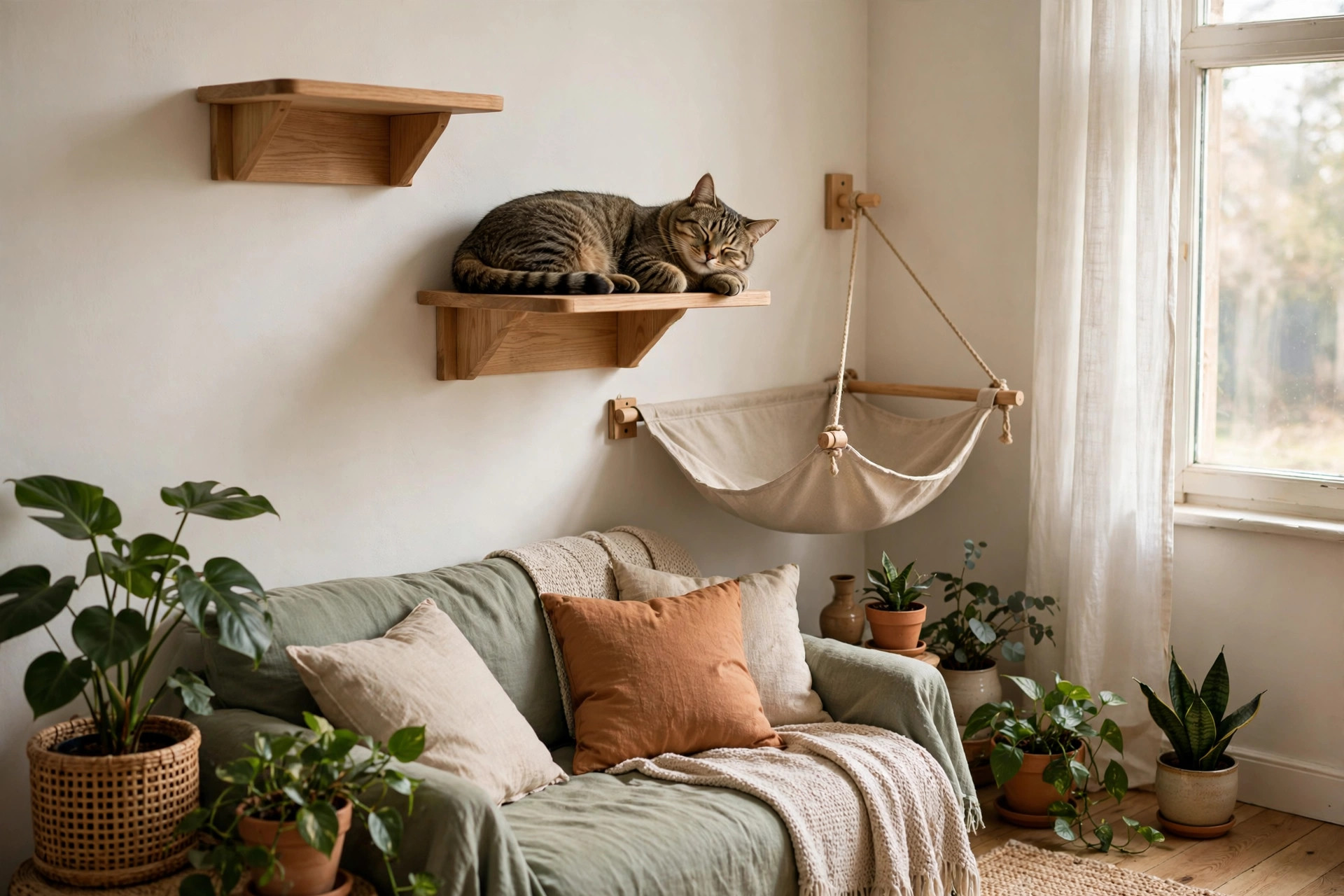
Your cat wants the vertical territory a cat tree promises, but a four-foot tree in a studio eats a corner you do not have — and your lease says no drilling. Wall-mounted cat shelves solve the floor-space problem completely, yet they create a renter’s dilemma: every shelf needs a mount that can survive a 12-pound cat launching off it at speed, and drywall alone cannot. The honest renter-friendly answer is not adhesive strips (which will fail, loudly, at 2 a.m.) — it is a small number of well-placed holes drilled into wall studs, patched invisibly on move-out day, plus a few genuinely zero-hole options for the strictly worded lease.
- Studs are the only safe mounting. Two lag bolts per bracket, driven into a wooden stud — drywall anchors alone will eventually pull out under a leaping cat.
- Budget roughly $100–$250 for a starter route of two to three pieces, plus about $10 of spackle and sandpaper for move-out repairs.
- Plan the route around real stud locations (usually 16 inches apart), not where you wish the studs were.
- A three-piece route leaves 8–12 small holes — the same repair your landlord already does for picture nails.
- No holes allowed at all? Industrial suction-cup window perches give real vertical territory with zero wall damage.
Why a renter’s cat should live on the walls
A decent cat tree occupies about a 2-by-2-foot square — four square feet, plus a halo of dead space around it that nothing else can use. In a 450-square-foot studio, that is roughly 2% of your home surrendered to one piece of furniture, and the good trees cost $80–$150 and need their sisal replaced every few years anyway. A wall route costs zero floor space, lasts essentially forever, and puts the cat at window height, which is where most apartment cats want to be all day.
There is a behavioral argument too. Cats in small homes get most of their exercise and confidence from vertical territory: being able to move through a room at two heights gives them options, and in multi-cat apartments, separate vertical routes measurably reduce the ambushes and standoffs that happen when two cats must share one narrow floor path. A single wall shelf near the window will not replace a cat tree for every cat, but a three-piece route from the sofa arm to the window is a bigger territory upgrade than any floor-standing tower.
The sticking point is always the lease. Most standard rental agreements allow small holes of the picture-hanging variety and expect “normal wear and tear” to be repaired between tenants; the clause to read is the one titled alterations or modifications. Cat shelves fall in a gray area worth a one-line email to your landlord: “I’d like to mount three small pet shelves into wall studs and will patch and repaint on move-out — any objection?” Written permission ends the debate, and most landlords care far more about unauthorized paint colors than a dozen spackled screw holes.
Five setups worth your wall space
Every option below is a real, widely sold product with years of owner history. Prices are typical US street prices and shift with sales — treat the ranges as planning numbers, not quotes.
| Setup | Mounting | Typical price | Renter note |
|---|---|---|---|
| Catastrophic Creations Wall-Mounted Hammock | 2 lag bolts per bracket, into stud | Usually $55–$75 | Fabric hammock, 4 holes total; the classic first wall piece. |
| Catastrophic Creations Wall Steps (each) | 1 lag bolt per step, into stud | Usually $20–$30 each | Cheapest way to build a climbing route; buy two or three. |
| The Refined Feline Lotus Leaf | 3 screws into stud | Usually $120–$160 | Furniture-grade bamboo; the one landlords tend to approve of visually. |
| Mau Pets Ivy Cat Perch | Industrial suction cups on window glass | Usually $59–$79 | Zero holes; re-seat suction cups monthly and keep glass clean. |
| K&H EZ Mount Window Sill | Suction cups on window glass | Usually $30–$45 | Budget no-hole option; check suction weekly in hot weather. |
Catastrophic Creations Wall-Mounted Hammock — the classic first piece
This is the product that converted a generation of apartment cat owners to wall living: a sturdy cotton-poly canvas hammock stretched between two wooden end brackets, rated to hold around 50 pounds — far more than any domestic cat. Mounting is two lag bolts per bracket into studs, so four small holes total, and the fabric piece can be unclipped and machine-washed when it gets grimy. The hammock hangs roughly 20 by 13 inches, big enough for a large cat to sprawl, and the gentle give of the fabric is why cats choose it over rigid shelves. If you buy exactly one wall piece, make it this one.
Catastrophic Creations Wall Steps — the route builders
Sold individually, each step is a small fabric-and-wood platform that mounts with a single lag bolt into a stud. Two or three of them staggered up a wall make the climbing route that connects the floor (or the back of the sofa) to the hammock or a higher perch. Because each step is one hole, they are the lowest-commitment way to test whether your cat actually uses wall routes before you invest in bigger pieces. Stagger them 10–14 inches apart vertically and 12–18 inches horizontally so the cat steps rather than leaps.
The Refined Feline Lotus Leaf — the one that looks like furniture
If your landlord’s main objection is aesthetic — or your own decor standards are high — the Lotus Leaf is the answer. It is a curved bamboo shelf, roughly 18 inches across, that mounts with three screws into a stud and looks like a design object rather than pet gear. The curved shape gives the cat a secure feeling while lounging, and the bamboo wipes clean. The price is the obvious downside: one Lotus Leaf costs about as much as a hammock plus two steps from Catastrophic Creations. Worth it as the showcase perch at the top of a route, probably not as every piece.
Mau Pets Ivy Cat Perch — the zero-hole heavyweight
For leases that truly forbid holes, the Ivy Perch mounts to a window with large industrial suction cups and a tension-cable design, holding a full-size cat with no wall contact at all. It is the closest a no-hole product gets to a real wall perch: elevated, at the window, with a view. The maintenance contract is the catch — clean the glass and re-seat the suction cups about once a month, and check them weekly during summer heat, which is when suction mounts are most likely to let go. A falling perch is a startled cat and possibly a broken window blind, so this one demands the maintenance habit.
K&H EZ Mount Window Sill — the budget no-hole tryout
Same concept as the Ivy Perch at roughly half the price: a fleece-covered shelf held to the window by suction cups. It is a perfectly good way to discover whether your cat even wants window-level territory before spending more. The trade-off for the price is lighter-duty suction and a narrower shelf, so this suits cats under about 15 pounds and owners willing to do the weekly suction check. Pair it with our window perch guide for placement ideas.
What to skip
Two categories consistently end badly in rentals. The first is anything that mounts to drywall alone — toggle bolts, molly bolts, and especially adhesive strips. Toggles hold impressive static weight, but a cat does not apply static weight: a 12-pound cat landing from a three-foot jump delivers several times its body weight in a sharp dynamic load, exactly the kind drywall hardware fails under. The second is flimsy no-name wall shelves from marketplace sellers: thin brackets, vague weight ratings, and mounting hardware that does not include proper lag bolts. If the listing cannot tell you the weight rating in pounds, it does not have one.
The mounting rules that keep your deposit
Everything in this section exists to make two things true at once: the shelf never falls, and the wall looks untouched when you leave.
- Find the studs first. Knock along the wall listening for the solid thud between hollow sounds, measure 16 inches from a corner (the most common stud spacing in US apartments), or spend about $15 on a basic electronic stud finder. Mark each stud edge with painter’s tape — you will plan the whole route around these marks.
- Drill pilot holes. A pilot hole slightly narrower than your lag bolt keeps the stud from splitting and makes the bolt drive straight. The mounting hardware included with the products above assumes stud mounting; if a kit ships only drywall anchors, buy 2.5–3-inch lag bolts separately.
- Respect the load math. Shelves rated for 30–50 pounds are the right neighborhood for cat gear. A shelf rated for 10 pounds of books will not survive a cat, because the cat does not sit politely — it lands.
- Count your holes honestly. A typical starter route — two steps plus a hammock — is about 8–10 holes. That is a $10 spackle-and-sandpaper repair and half an hour on move-out day, not a deposit event. Your landlord patches more holes than that every time a tenant hangs curtains.
- Keep the hardware. Put every bolt and bracket in a labeled bag. Some landlords ask for the original state restored; more practically, you will want the same hardware for the next apartment.
One more rule for concrete and brick walls, common in older city buildings: you will need a masonry bit and concrete anchors rather than lag bolts, and patching means a dab of cement filler instead of spackle. It is more work, not impossible work — but this is the one case where emailing the landlord first is not optional, because masonry patching is visible if done badly.
Layout math: spacing, heights, and escape routes
A wall route is a staircase the cat climbs with its whole body, so the dimensions matter more than the products:
- Start low. The first step should sit 18–24 inches off the floor, reachable from the back of the sofa, an ottoman, or a sturdy side table. Cats adopt new routes fastest when the entry point is somewhere they already stand.
- Step, don’t leap. Space climbing steps 10–14 inches apart vertically and stagger them 12–18 inches horizontally. Seniors and heavier cats want the tighter end of that range; young athletes tolerate the wider end.
- Lounging shelves need real estate. A perch meant for napping should be at least 10 inches deep and 12 inches wide — a cat that cannot fully curl up on a shelf will not return to it.
- End at the window. The top perch earns its keep when it faces glass. If the window has a deep sill, the route can end at a window perch; otherwise the top shelf sits beside the window.
- Turn corners with an L. To go around a corner, overlap two shelves at 90 degrees with 8–10 inches of shared landing so the cat steps across rather than jumping the gap.
- Never build a dead end for two cats. In multi-cat homes, one route up to a single perch is a trap: the bolder cat claims the top and the timid cat gets cornered. Either build two independent routes or make the top landing 16+ inches wide so two cats can pass.
- Keep the route clear of hazards. Not above the stove, not above the litter box (litter and paws rain down), not over the bed unless you enjoy 3 a.m. landings, and not beside anything fragile the cat can sweep off on the way past.
Tape the whole route on the wall with painter’s tape before drilling anything, then live with the tape for a day. You will notice the shelf that blocks a cabinet door or sits at forehead height for a tall roommate — exactly the mistakes tape is cheap enough to catch.
Install day and move-out day
Installation (about an hour):
- Gather tools: stud finder, drill with bits, a level, painter’s tape, a pencil, and the mounting hardware.
- Tape the route, confirm every piece lands on a stud, and check the level line for each piece.
- Drill pilot holes at your marks, working from the lowest piece upward.
- Mount each piece, level it, and tighten — then test by pressing down with roughly twice your cat’s weight and giving it a firm lateral wiggle. Anything that shifts gets re-seated now, not after the cat finds it.
- Re-check every mount after one week of use. Wood compresses slightly under the first loads; a quarter-turn of the bolts is normal maintenance.
Move-out repair (about 30–45 minutes for a full route):
- Unscrew everything and bag the hardware. Fill each hole with lightweight spackle, slightly overfilling, and let it dry 2–4 hours.
- Sand flush with fine sandpaper, wipe the dust with a damp cloth, and let dry.
- Dab matching paint with a small sponge rather than a brush — sponge stippling blends into roller texture far better than brush strokes. Ask the landlord for the paint color; most keep a record, and hardware stores can match a chip the size of a coin.
For broader renter-proofing ideas beyond the walls — gates, cord covers, balcony safety — our renter-friendly cat wall ideas guide covers the rest of the apartment.
If you cannot find a stud where the shelf needs to go, move the shelf — not the hardware. A cat shelf held by drywall alone is a vet bill and a wall repair waiting for their moment.
FAQ
Will mounting cat shelves violate my lease?
Usually not, as long as you restore the walls. Most leases permit small holes comparable to picture hanging and only forbid unapproved alterations like paint colors or fixture changes. Read the alterations clause, send the landlord a one-line email describing the plan, and patch everything on move-out — that combination satisfies the overwhelming majority of landlords.
Can I just use heavy-duty toggle bolts instead of finding studs?
Not for anything the cat lands on. Toggle bolts hold impressive static weight in drywall, but a jumping cat applies a sharp dynamic load several times its body weight — exactly the failure mode for drywall-only hardware. Studs for perches and hammocks, no exceptions; toggles are acceptable only for lightweight decorative pieces the cat never touches.
My walls are concrete or brick. What are my options?
Mount with a masonry bit and concrete sleeve anchors, and plan on cement-based filler for the patch rather than spackle — check with the landlord first, since masonry repairs show if done poorly. If that sounds like too much, suction-cup window perches need no wall contact at all, and a tall scratching post at the route’s base (see our scratching post guide) gives climbing height with zero mounting.
How do I get my cat to actually use the new shelves?
Start with the entry step at a height the cat already reaches, rub a little catnip on fabric pieces, and place treats along the route for the first week — most cats adopt within days once the path feels safe. Keep early expectations low for seniors or timid cats: tighter step spacing and a familiar-smelling blanket on the top perch help enormously.