Best Cat Rest Corner Setup for One-Bedroom Apartments
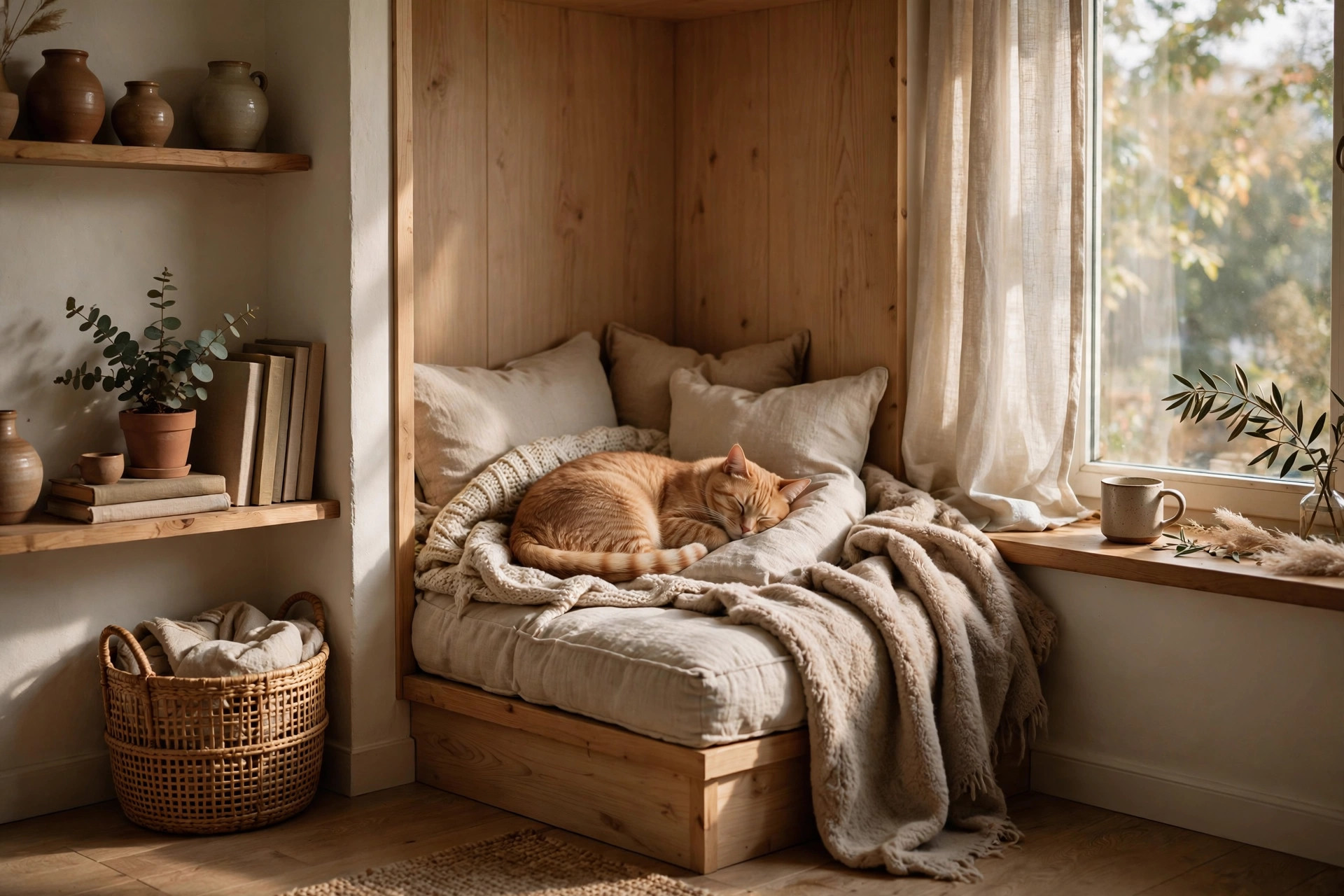
Most cats already have a rest corner — your laundry pile, your keyboard, the warm spot on the sofa you just stood up from. A deliberate rest corner works because it offers everything those accidental spots do — warmth, shelter, a good vantage point — in a place you actually want the cat to be. Here is the system: three placement factors, exact dimensions, floor-plan branches, and rental-friendly picks.
The three placement factors: temperature, traffic flow, noise
Placement decides whether a bed gets used. Score every candidate spot on these three, in order.
1. Temperature. Cats sleep deepest in warmth above our comfort zone: aim for 72–80°F (22–27°C) around the bed, not the 65–70°F most apartments sit at. Good warm spots: 3 to 6 feet from a sunny window, near (never on) a heat source, or in the naturally warm bedroom at night. Keep at least 18 inches between the bed and any radiator, baseboard heater, or space heater — a sleeping cat will not shuffle away from a hot surface the way an awake one does, so contact is a burn risk. Equally, skip exterior walls, drafty window edges, and spots under AC vents, which feel cold to a cat even when the room feels fine to you.
2. Traffic flow. Cats want to observe movement, not sit in it. Place the corner at least 6 feet off the main walking path between the front door, kitchen, and bathroom, facing into the room with a wall at the cat's back — a corner is ideal. That protects the flanks while keeping the door in sight, which is what a cat checks when it half-wakes. Reject the gap between sofa and coffee table, anywhere a chair rolls, and any landing where people pass within arm's reach.
3. Noise. You need predictability, not silence. A steady low TV hum all evening beats a front-door spot that erupts when the neighbor comes home. Rule of thumb: if you can hear the spot's dominant sound from the hallway with the door closed — slamming doors, barking, the elevator — the cat will find it too stimulating for deep rest. In thin-walled rentals, favor the bedroom side of a shared wall; living rooms host the loud activities.
Exact dimensions: what actually fits
“Cozy” is not a dimension. Use these numbers when you shop and when you clear floor space.
| Measurement | Target | Why it matters |
|---|---|---|
| Bed interior diameter | 18–20 in for a 9–11 lb cat; 22–24 in for large breeds | Cats curl against an edge; oversized beds stop feeling sheltering. |
| Bolster height | 3–5 inches | High enough to rest a chin on, low enough to step over. |
| Height off the floor | 6–14 inches | Elevation adds security and distance from cold floors; above ~14 in it needs a step. |
| Distance from heat sources | At least 18 inches | Warmth without the burn risk of direct contact. |
| Distance from the window | 3–6 feet | Passive solar warmth without the sill's draft and glare. |
| Front clearance | At least 12 inches | A clear hop-in path and a visible escape route. |
| Total footprint | ~3–4 sq ft | A 20-inch bed plus clearance is a 2×2 ft square — plan it like furniture. |
A rest corner does not have to be one bed: two smaller surfaces — a bolster bed plus a folded blanket on a chair, both in the same corner — often beat one expensive bed, because the cat gets a temperature choice. Put a warm option and a cooler option side by side and let the cat vote.
Branch by floor plan: studio, one-bedroom, or balcony
The three factors apply everywhere, but each layout hides its good spots in different places.
Studio apartments: claim one corner permanently
In a studio there is no door between the cat and your life, so the corner must be a zone that is never disturbed: the bedroom-side corner furthest from the kitchen, or under a console table against the wall. Budget exactly a 20-inch bed plus 12 inches of front clearance. And keep the litter box away — food, toilet, and rest each need their own zone even when the zones are 8 feet apart.
One-bedroom apartments: split day and night spots
A one-bedroom supports two stations, which matches real cat behavior: a daytime spot near household activity, a nighttime spot near where you sleep. Put the day bed in the living room's quietest corner and a simpler second surface — even a folded fleece on a low shelf — in the bedroom, 3+ feet from your side so the cat is not startled when you get up. Two cheap beds beat one premium bed; the system matters more than any single item.
Apartments with a balcony or patio door: use the glass, respect the draft
A sliding glass door is a free floor-to-ceiling window — but its bottom track is usually the draftiest 6 inches in the apartment. Place the bed 3 to 6 feet back from the glass on the sunny side, clear of the door's swing path. In summer, shade that glass section: afternoon sun through glass can push a dark bed surface past 100°F, too hot for unsupervised napping.
Rental-friendly constraints that actually hold
- No drilling needed. The best rest corners need zero wall modifications — floor beds, ottomans, and cleared bookshelf shelves all qualify. Skip wall-mounted shelves unless the lease explicitly allows anchors.
- Protect the floor. A washable low-pile rug under the corner, about 6 inches larger than the bed on each side, absorbs kneading and insulates against cold floors. Landlords notice scratched hardwood.
- Keep it reversible in 10 minutes. Could you return this corner to “just a room” before a move-out inspection? Adhesive mounts, carpet tape, and screwed-in brackets fail this test.
- Have a winter backup. Many leases restrict balcony use in winter. If your corner relies on the balcony-adjacent spot, pick the backup location now.
Three beds worth buying for small apartments
These recur in apartment-cat discussions because they fit small-space constraints: compact, washable, no assembly drama. Prices are typical US street prices and move with sales.
| Bed | Best for | Typical price | Small-space notes |
|---|---|---|---|
| K&H Pet Products Thermo-Kitty Bed | Cats that chase the warmest spot; older or thin-coated cats | Usually $40–$60 | Low-wattage heater holds ~102°F and only warms under the cat's weight; washable cover. Needs an outlet within cord reach. |
| Frisco Bolster Cat Bed | The default all-rounder; curl-sleepers | Usually $20–$35 | 20 inches across with a 4-inch bolster — matches the spec table. Machine washable, light enough to move between spots, cheap enough to own two. |
| Frisco Cat Cave Bed | Shy or easily startled cats | Usually $25–$40 | Enclosed dome, one entrance: maximum shelter in a 20-inch footprint; collapses flat. Skip for cats that like open sightlines. |
The two-bed insight: with a $50 budget, two $25 Frisco beds in two good spots usually outperform one premium bed. Apartment cats rotate locations by time of day — cover both the day room and the bedroom instead of perfecting one.
The first-week plan: teaching the cat the corner is theirs
About 10 minutes a day for one week:
- Days 1–2: scent, no pressure. Rub a worn t-shirt or a cloth the cat has slept on into the bed. Never pick the cat up and place it in the bed — that makes the corner feel like a trap.
- Days 3–4: pay in treats. Drop a treat on the bed whenever the cat walks past; feed one meal a day next to (not in) the bed.
- Days 5–7: move the competition. The step people skip. Cat sleeps on your sweater pile? Move the top sweater onto the bed. Sleeps on the sofa arm? Drape that blanket over the bed for a few days. Cats choose by texture and scent more than by location.
Still ignored after two weeks? The problem is almost always placement, not the bed — re-score the spot. Most failures are an unnoticed draft or a walking path 3 feet away.
FAQ
My cat keeps sleeping on the sofa instead of the new bed. What am I doing wrong?
Nothing about the bed — the sofa wins on warmth, height, and scent. Move the sofa's throw blanket onto the new bed for a few days and check the temperature: the new corner is often 5 degrees colder than the sofa, and no treats fix that. Warm the corner first, then re-run the treat step.
How far from a radiator or space heater should the bed be?
At least 18 inches, with no direct contact possible. A deeply sleeping cat does not thermoregulate by moving the way an awake cat does, and radiator burns are a real winter veterinary presentation. Put the bed beside the radiator along the wall, not in front of it.
Should the rest corner go in the bedroom or the living room?
If you build only one, choose the room where you spend evenings — usually the living room. Cats do their longest daytime sleep near household activity, and a cat sleeping near you is not rehearsing anxiety. Add a simple bedroom surface later if the cat follows you at night.
Are heated beds safe to leave on while I am at work?
Low-wattage thermostat-controlled beds like the K&H Thermo-Kitty are designed for unsupervised use: the heater activates under the cat's weight and holds around 102°F. The cord matters more — route it behind furniture in a cord cover and plug into a surge protector. Skip human heating pads; they run hotter without pet-specific thermostats.
I have two cats. Do they need two rest corners?
Yes. Bonded pairs will share, but the option to separate must exist — resource guarding in cats is quiet, and the subordinate cat simply stops using the corner. Build one primary corner and one secondary surface at least 6 feet away: living room plus bedroom works in a one-bedroom.