Best Indoor Cat Hideout Ideas for Small Apartments
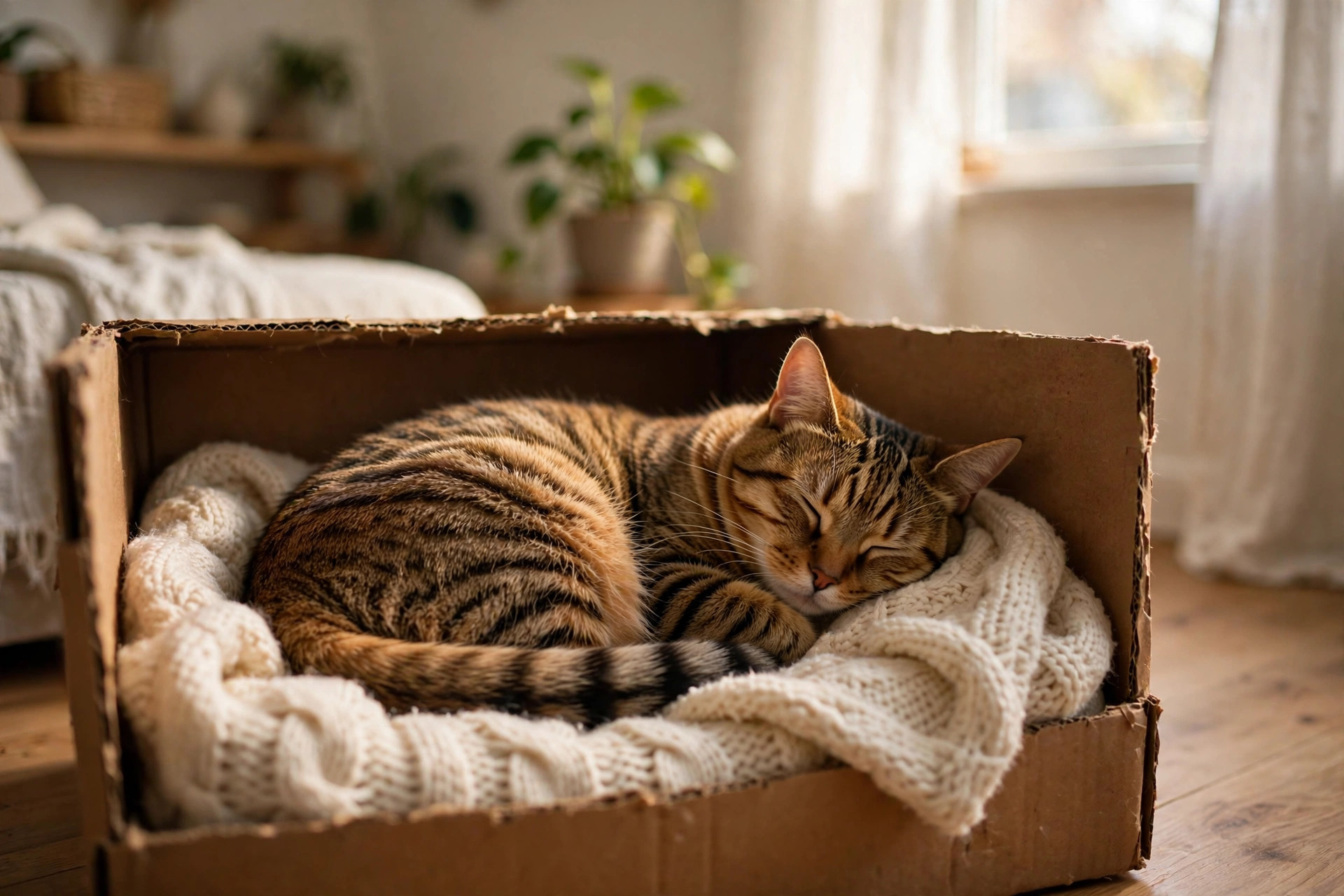
If your cat keeps vanishing into the box spring, behind the fridge, or inside your open suitcase, it is not being difficult — it is telling you the apartment has no proper hiding spots. Cats that can retreat on their own terms are calmer, bolder, and far less likely to develop the stress behaviors (over-grooming, litter-box avoidance, 3 a.m. zoomies aimed at your face) that make small-space cat life miserable.
- Hiding is a core need, not a quirk: studies on shelter cats show access to a hideout measurably lowers stress hormones within days.
- You need at least two hideouts in different rooms — one in the social area, one somewhere quiet. A single hideout gets guarded or ignored.
- The best apartment hideouts cost $0–$45 and occupy 2 square feet or less: an upgraded cardboard box beats most $80 cat furniture.
- Never drag a cat out of a hideout, and never wash its bedding on a schedule — the familiar scent is the point.
- Hiding that suddenly increases, or comes with appetite loss, is a vet visit — not a personality change.
| Hideout | Footprint | Typical cost | Best for |
|---|---|---|---|
| Upgraded cardboard box | ~2 sq ft | $0 | Every cat; the universal starter |
| Under-bed den | 0 added sq ft | $0–$15 | Studios where floor space is sacred |
| Curtain-backed corner | ~1.5 sq ft | $10–$20 | Nervous newcomers, foster cats |
| Furniture-integrated cave | ~2 sq ft | $25–$60 | Owners who want it to look intentional |
| Felt or wool cave bed | ~1.5 sq ft | $25–$45 | Cats that knead and burrow |
Why your cat vanishes (and why you should let it)
A cat's brain is wired with a simple equation: small enclosed space = safe. In the wild, a concealed resting spot means no predator can approach unseen and no rival can corner them. Your apartment removed the predators but kept the wiring, and added new stressors the wiring never anticipated: hallway noise, the neighbor's subwoofer, visitors, the vacuum, the blender.
Research on cats in shelters — the most stressful housing imaginable — found that cats given a hiding box showed lower stress scores within days compared to cats without one, and recovered from stressful events faster. Your apartment is not a shelter, but the mechanism is identical: a cat that can hide chooses to come out more. Owners consistently report the paradox — provide good hideouts and the cat spends more time in the open.
The line between healthy hiding and a problem is pattern, not location. Normal: the cat naps in its box most of the afternoon, emerges for meals and evening play, and greets you (on its own schedule). Concerning: a previously social cat suddenly hides all day, skips meals, or only comes out when the apartment is empty and dark. That pattern — especially paired with appetite change, litter-box changes, or over-grooming — warrants a vet visit before you rearrange furniture.
1. The upgraded cardboard box
The box your cat already worships, but engineered. A plain shipping box (roughly 16×12×12 inches for an average cat; bigger for Maine Coon types) works, with three upgrades that turn trash into territory:
- Cut two exits. One entry hole (about 7–8 inches across) plus a second smaller opening on an adjacent side. Cats distrust single-exit spaces — two exits is the difference between a hideout and a trap.
- Line it. A folded fleece blanket or an old t-shirt you have worn (your scent is a feature, not a bug) makes the cardboard comfortable and personal. Skip the washing machine for this item; shake it out instead.
- Stabilize it. Tape the bottom flaps flat so the box doesn't shift or collapse when the cat launches in at speed. A wobbly hideout gets abandoned after one scare.
Replace the box every 2–3 months, or sooner if it gets damp or starts smelling. Pro move: when you replace it, transfer the old blanket unwashed into the new box — the familiar scent tells the cat the new box is already theirs. For multi-cat homes, provide one box per cat; two cats will time-share a single box the way siblings time-share a bathroom, which is to say badly.
2. The under-bed den
The highest-value hideout in a small apartment is one that consumes zero additional floor space. If your bed frame has 7 or more inches of clearance, the void underneath is premium cat real estate — dark, enclosed on top, with multiple escape routes. The problem is that raw under-bed space is usually a dust-bunny graveyard of storage bins and lost socks.
The fix takes fifteen minutes: clear a 2×3-foot section at one end of the bed, lay down a washable rug or blanket, and push storage bins to the other end to form a partial wall. You have just built a den with a roof (the mattress), three walls (bins and bed frame), and open exits. Cats that ignore fancy beds will claim an under-bed den within days because it satisfies the full checklist: dark, warm (mattress heat radiates down), enclosed, and escapable.
Two cautions. First, check what is stored down there: keep cleaning chemicals, medications, and anything chewable out of the den zone. Second, platform beds with less than 5 inches of clearance don't work — the cat can squeeze in but can't turn around comfortably, which defeats the purpose. Measure before you commit.
3. The curtain-backed corner
Some cats — especially recent rescues, fosters, and kittens — want a hideout that isn't fully enclosed but still breaks the sight line. A corner of the room backed by a curtain gives exactly that: the cat can see out through the fabric gap while feeling invisible.
Setup: pick a low-traffic corner (bedroom corners beat living-room corners), hang a curtain panel from a $10–$15 tension rod wedged between two walls or inside a closet doorway, and place a folded blanket or small bed behind it. Leave a 4–6-inch gap at the bottom so the cat can slip in without drama. Total cost is the tension rod plus fabric you probably own.
This is the best first hideout for a cat that just moved in. New cats in new apartments go through a predictable arc — hide for days, then emerge at night, then gradually claim daytime territory. A curtain corner gives them a staging area for that arc without wedging themselves behind the washing machine, which is where they go when no proper option exists. Once the cat is confident, most graduate to more open spots on their own; leave the curtain up anyway, because vet visits and houseguests will send them straight back to it.
4. The furniture-integrated cave
If a cardboard box in the living room offends your aesthetic sensibilities, hide the hideout inside furniture. The two best conversions:
- The ottoman cave. A storage ottoman (usually $30–$60) with the lid left ajar, or with a cat-sized arch cut in one side, becomes a den that reads as furniture. Line the interior with a blanket. Bonus: the storage compartment holds toys and grooming tools.
- The end-table conversion. A cube-style side table with an open front, or a nightstand with the cabinet door removed, lined with a cushion. Place it against a wall so the open side faces the room — the cat gets a cave with a view, you get a side table.
The rule for furniture caves: the entry must be generous. Cats reject openings they have to squeeze through when a dignified alternative exists — cut arches at least 8 inches wide and tall. And never put the food bowls inside the cave; cats strongly prefer eating and hiding in separate locations, and combining them makes both functions worse. If you want vertical territory too, pair a furniture cave with renter-friendly cat wall shelves — hideouts below, perches above, and the cat owns the room in three dimensions.
5. The felt or wool cave bed
Felt cave beds — the enclosed wool pods that look like a cat-sized igloo — are the one commercial hideout worth the money for dedicated burrowers. The wool holds warmth, muffles sound slightly, and the single round entry satisfies the enclosed-space instinct. Typical prices run $25–$45 from wool-goods makers and pet brands; the handmade felt ones on marketplaces are often better constructed than the mass-produced versions.
Buy for the cat you have, not the cat you imagine. Felt caves suit cats that knead, burrow under blankets, and sleep curled tight. Long, sprawling sleepers and very large cats often reject them — a 15-pound cat in a standard cave looks like a muffin overflowing its tin, and the cat knows it. Check the stated dimensions against your cat's curled-up diameter before ordering; many caves run small.
Maintenance is the hidden cost: wool felt pills and collects hair aggressively. A lint roller lives next to the cave, and most felt beds can be hand-washed (never machine-washed — they shrink into cat hats). Expect a lifespan of 1–2 years with daily use, which works out to roughly $2 a month for the cat's favorite spot in the apartment. That's the cheapest rent anyone pays.
Where to put them: the 3-spot rule
Hideouts fail more often from bad placement than bad design. Three rules cover it:
- Spread them across the apartment's noise zones. One hideout in the social area (living room) and one in the quiet zone (bedroom). A cat startled by the doorbell needs a nearby option, not a cross-apartment commute. In a studio, "different rooms" means opposite ends — one near the entry, one near the bed.
- Keep them away from resources. Never place a hideout next to the litter box or the food bowls. Cats compartmentalize: toilet here, food there, safety somewhere else. A hideout beside the litter box gets treated as part of the bathroom, not as a retreat.
- Respect the cat's vote. Put out two or three options and watch for a week. The cat will rank them decisively — the ignored one gets relocated, not discarded. A hideout that fails in the hallway may thrive in the bedroom; location is half the product.
The hideout test: if the cat uses it within 48 hours, placement is right. If it sits empty for a week, move it before you blame the design — nine times out of ten, it was the location.
Three ways owners ruin a good hideout
First: dragging the cat out. Every forced extraction teaches the cat that the hideout isn't safe, which is the one thing it must be. If you need the cat — carrier time, medication — lure with treats or wait. The hideout's sanctity is worth more than five minutes of convenience.
Second: over-cleaning. Washing the hideout bedding weekly strips the scent markers the cat deposited to claim it. Shake out debris, spot-clean stains, and do a full wash only when it genuinely smells — roughly monthly, and never with strong-scented detergent. Unscented, always.
Third: the single-hideout trap. One hideout in a two-cat apartment becomes a guarded resource, and the subordinate cat goes back to the box spring. The formula is simple: one hideout per cat, plus one extra if you have the space. They don't need to be fancy — a second cardboard box costs nothing and ends the turf war.
Get these right and the payoff compounds: a cat with reliable retreats plays harder, explores more, and — the paradox every owner reports — spends far more time out in the open, because confidence is built on knowing you can leave. For the rest of the environment, see our enrichment ideas for tiny apartments and the rest corner setup guide.
FAQ
My cat only hides under the bed and won't use the nice bed I bought. Is something wrong?
Nothing is wrong — the cat is grading your purchases. Under-bed space wins on darkness, enclosure, and warmth, which is exactly the checklist in this guide. Instead of fighting it, upgrade the under-bed spot (clear it, add a blanket) and stop taking the rejection personally.
How many hiding spots does one cat need in a studio?
Two is the practical minimum: one in the living area, one near the sleeping area. Three is ideal if you can manage it without tripping over them. More important than count is distribution — two hideouts ten feet apart in the same room count as one.
Are covered beds better than open beds for anxious cats?
For genuinely anxious cats, yes — enclosed beats open until confidence builds. But watch the cat, not the label: some anxious cats prefer a high open perch (safety through vantage) over any cave. Offer one of each and let the cat decide.
My cat started hiding much more this week. When should I worry?
When the increase comes with other changes: eating less, avoiding the litter box, over-grooming, or hiding in new, unusual spots (like the bathtub). A sudden behavior shift lasting more than 48 hours deserves a vet call. Hiding alone, in a cat that still eats and plays, is usually just a cat being a cat.