Best Cat Window View Setup for Indoor Apartments
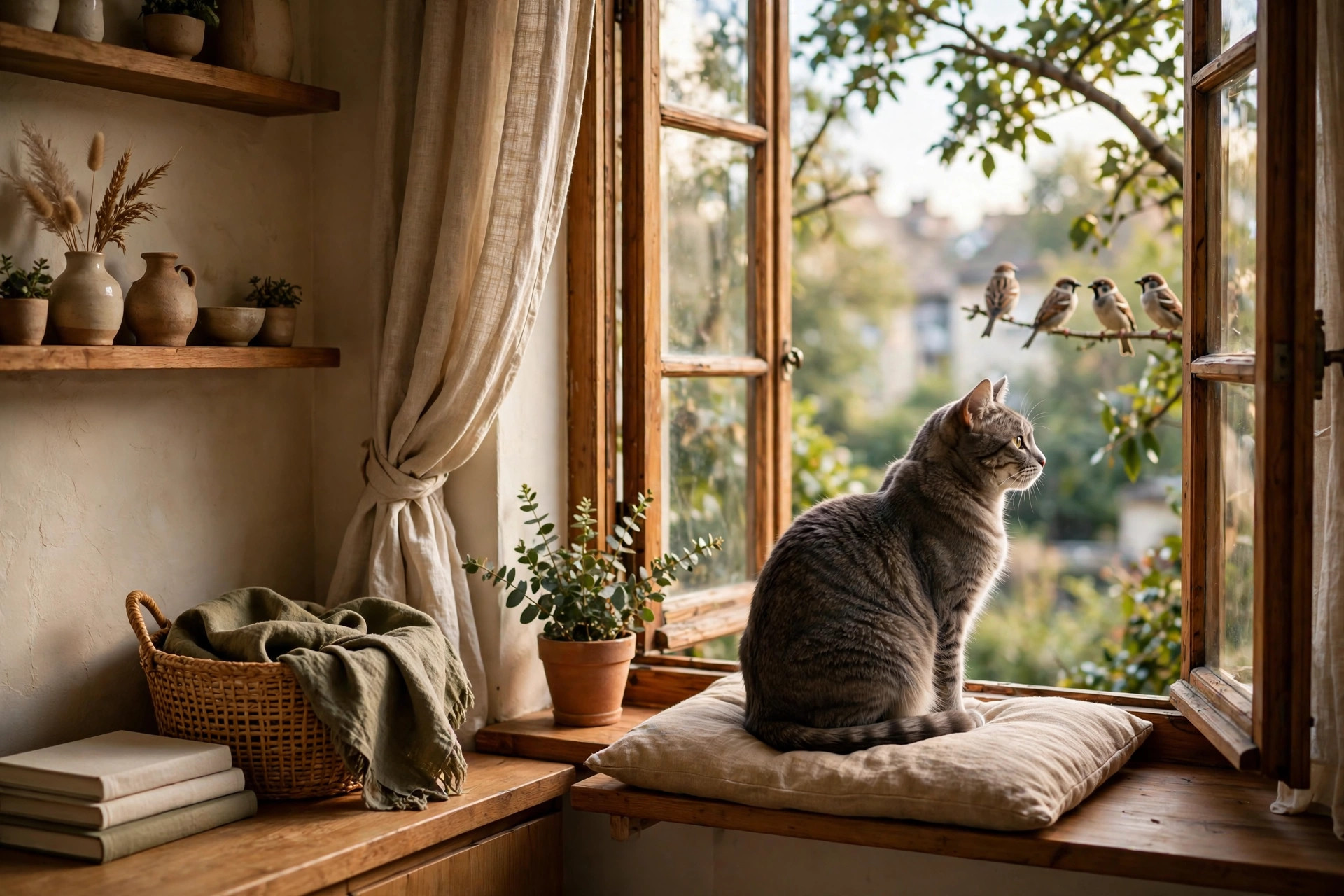
A window perch is the highest-value enrichment per square foot for an indoor apartment cat: vertical territory, hours of passive entertainment, and a sun-warmed nap spot, with zero floor space claimed. But a perch is only as good as its mount. This guide starts where most articles skip — how a perch holds a cat's weight on glass — then compares three proven perches, covers installation, blind cord safety, and which windows cats actually use.
First, the mount: suction cups vs. sill-braced perches
Every window perch attaches in one of two ways, and the choice matters more than the fabric or brand.
Suction-cup perches stick to the glass with 2 to 4 large cups. The rental advantage is obvious: zero frame contact, no screws, no landlord conversation. The failure mode is equally obvious: cups lose grip over time. Heat cycles, dust, and repeated landings all degrade the seal. Treat the manufacturer's weight rating — typically 40 to 60 lbs on the better-known suction perches — as a new-out-of-box number, not a permanent one. It sounds generous for a 10-lb cat, but a jumping cat momentarily loads 2 to 3 times its body weight; a 12-lb cat landing hard can briefly put 25–35 lbs on one side. A 40-lb rating is the minimum worth buying.
Sill-braced perches rest on the window sill itself, usually with a Velcro strap or brace against the frame. No suction to fail — but they need a real sill. Measure first: you want at least 3 inches of sill depth and a window width matching the perch's span (most fit 24–36 inch windows). Narrow modern sills, window AC units, and crank-out casements rule this style out.
The decision rule: a solid sill 3+ inches deep means a sill-braced perch — it cannot fall off the glass. Too narrow, or a lease that forbids touching the frame? Buy a suction-cup perch rated 40 lbs or more, and put cup maintenance on your monthly checklist.
- Suction-cup: renter-friendly, zero frame contact; needs 40+ lb ratings and monthly re-seating.
- Sill-braced: nothing to fail; requires a 3-inch-plus sill and matching window width.
- Jumping cats apply 2–3x body weight at landing — buy headroom, not just enough.
- Never mount a perch above a radiator or over a hard, sharp-edged surface.
Three perches compared for small apartments
These three recur in apartment-cat communities because they are proven designs with long track records. Prices are typical US street prices and move with sales.
| Perch | Best for | Typical price | Small-space notes |
|---|---|---|---|
| K&H Pet Products EZ Mount Window Sill | Renters with narrow sills; the classic starter perch | Usually $25–$40 | Suction mount with margin for an average cat. ~12-inch-deep platform fits standard windows without blocking curtains. Re-seat cups monthly. |
| K&H Pet Products Kitty Sill Deluxe | Windows with a real sill; set-and-forget owners | Usually $20–$35 | Sill-braced with a Velcro frame strap — zero suction maintenance. Bolstered edge for chin-resting cats. Confirm your 3-inch-plus sill first. |
| Frisco Window Perch with Bolster | Sprawlers; one perch for sunbathing and sleeping | Usually $25–$40 | Suction mount with a padded bolster rim all around — popular with edge-wedgers. Slightly deeper platform; check window width and curtain clearance. |
No winner here, only the right mount for your window. A renter with 2-inch sills buys the EZ Mount; a pre-war apartment with deep stone sills takes the Kitty Sill Deluxe and never thinks about it again; a sprawler gets the Frisco bolster. Match the mount to the window first, the cat's lounging style second.
The 20-minute installation checklist
- Measure the window first. Width between frame sides, sill depth, and glass-to-curtain distance. Platforms run 12–14 inches deep — confirm nothing (curtain, blind slats, AC unit) occupies that space.
- Clean the glass properly. For suction perches, wash with warm water, wipe with rubbing alcohol, and let dry fully. Dust and cleaner residue are the top reasons cups fail early. Warm the cups in warm (not hot) water for a minute — pliable rubber seals far better than cold stiff rubber.
- Mount, then load-test. Press each cup firmly, working air bubbles from center to edge. Then press down on the platform with about twice your cat's weight — for a 10-lb cat, roughly 20 lbs of force — and watch for any cup edge lifting. Re-seat before the cat ever touches it.
- Give the cat a staircase. The top reason cats ignore perches is access, not the perch. A 24-inch-plus jump onto a narrow platform feels risky to cautious cats and seniors. Park a sturdy ottoman or storage cube 12–18 inches below and beside the perch for the first month; most cats graduate to direct jumps within weeks.
- Schedule monthly maintenance. On the first of each month, press-test every cup and wipe the contact area. South- and west-facing windows degrade cups faster from heat cycling — check those every two weeks in summer.
Blind cord safety: the non-negotiable part
A window perch parks your cat exactly where blind cords hang, and looped cords are a genuine strangulation hazard — cats bat at dangling cords, and the US Consumer Product Safety Commission has documented pet incidents with corded coverings for years.
- Best fix: go cordless on that window. Cordless cellular or roller shades eliminate the hazard entirely. If you replace one window covering, make it the perch window.
- Second best: cord cleats, used fully. Wrap the entire cord — every loop, zero slack dangling — around a cleat mounted high on the frame, out of batting range. A half-wrapped cord is barely better than a loose one.
- Break continuous loops. Many manufacturers sell retrofit kits that eliminate cord loops; never cut a loop and leave two dangling ends at cat height.
- Tie-backs are not enough. A cord in a loose bow at mid-window is still a loop a cat can catch a paw or neck in during a 3 a.m. zoomie. Cleat it high or remove it.
Window orientation: which windows cats actually use
Orientation decides sun hours, and sun hours decide usage.
East-facing windows are the usual feline favorite: gentle morning sun exactly when cats are most active after breakfast, cool through the afternoon. If you set up one perch, the east window usually wins on daily usage.
South-facing windows deliver the most total sun — excellent in winter, a liability in summer. A dark pad in direct July sun through glass can exceed 110°F on the surface, too hot for unsupervised napping and rough on suction cups. South perches work year-round with a light-colored summer cover.
West-facing windows get harsh late-afternoon sun and the worst heat cycling — the toughest combination for suction-cup longevity. Fine as a secondary perch, a poor choice for your only one.
North-facing windows get no direct sun but still work for bird-watching and daylight; do not expect deep-sleep sunbathing. Pair a north perch with a low-wattage heated pad in winter if you want it to double as a nap spot.
Final ranking rule for small apartments: accessibility beats orientation. A perfect south window behind an unclimbable sofa wins no prizes — rank windows by reach first, sun second.
FAQ
My suction-cup perch keeps falling off. What am I doing wrong?
Usually one of three things: dirty glass, cold stiff cups, or aged rubber. Re-do it properly — alcohol wipe, warm the cups, press out air bubbles. If the cups are over a year old, replace them; rubber hardens with age and UV, and no re-seating fixes that. And if the perch is rated under 40 lbs for a 10+ lb cat, the rating was the problem.
Can I use a suction-cup perch on double-pane or low-E windows?
Yes — cups grip the interior glass surface, and double-pane construction does not change that. The surface must be smooth flat glass: textured or frosted privacy glass will not seal, and interior grids crossing the mounting area are a problem. Low-E coatings sit on inner glass layers, not the surface you stick to.
Is it safe to put a perch above a radiator?
No — rule this placement out completely. A falling cat landing on a hot radiator is a burn injury, and rising heat degrades suction cups far faster. Keep perches at least 18 inches horizontally from any radiator, baseboard heater, or vent — the same rule as our rest-corner guide.
My cat ignores the perch. Should I give up?
Run the access check first: add a chair or ottoman as a step and a treat trail for a week. Most “ignored” perches are actually inaccessible perches, especially for kittens under 6 months and seniors over 10. If access is solved and three weeks pass with no interest, try a different window — the view or sun angle is usually the problem, not the perch.
How much weight should a window perch really hold?
Buy for the landing, not the nap. A sleeping 10-lb cat loads 10 lbs; the same cat jumping on loads 20–30 lbs for a split second. A 40-lb rating gives comfortable margin for cats up to ~12 lbs. For large breeds (15+ lbs), look for 50–60 lb ratings or switch to a sill-braced design, where the frame — not rubber cups — carries the load.