Best Puzzle Feeders for Apartment Cats
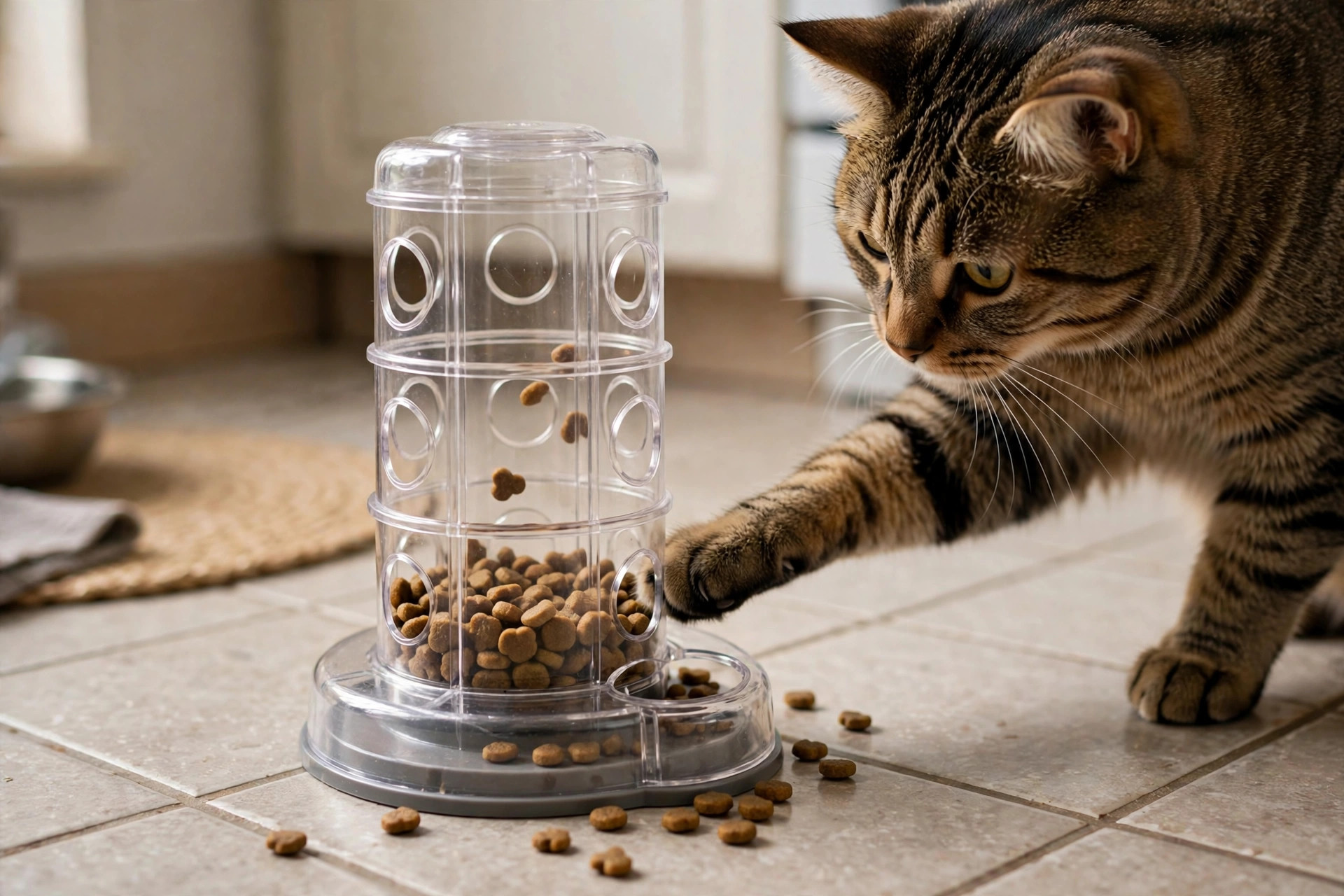
A wild cat eats ten to twenty small prey items a day, each one earned through stalking, pouncing, and problem-solving. An apartment cat eats twice a day from a bowl in ninety seconds flat — then spends the remaining twenty-three hours with a hunter’s brain and nothing to hunt. That mismatch is behind an astonishing share of indoor-cat problems: the 3 a.m. wake-up calls, the counter surfing, the scarf-and-barf vomiting from inhaling dinner. Puzzle feeders restore a fraction of the work, and the behavioral payoff is outsized.
- Puzzle feeders fix two problems at once: fast eating (and the vomiting it causes) and indoor boredom.
- Start easier than you think. A feeder the cat cannot solve in five minutes becomes furniture, not enrichment.
- Cleaning decides long-term use. Anything that is not dishwasher-safe or trivially hand-washable gets abandoned within a month.
- Hard plastic on hard floors is loud at 6 a.m. Put a mat under noisy feeders or pick rubber-based designs.
- Wet food and puzzle feeders rarely mix — plan for kibble or treats in puzzles, wet food in a bowl.
Five feeders worth the kitchen floor
Every feeder below is a real, widely sold product — no gimmick toys, no prototypes. Prices are typical street prices.
| Feeder | Best for | Usually | Apartment note |
|---|---|---|---|
| Doc & Phoebe’s NoBowl Feeding System | The full hunting simulation | $40–$50 | Mouse-shaped feeders hidden around the apartment; silent |
| Catit Senses 2.0 Food Tree | Classic paw-fishing | $30–$40 | Sturdy tower; can rattle on hard floors without a mat |
| LickiMat Casper | Wet food and calming | $10–$15 | Rubber mat; silent, dishwasher-safe, doubles as a slow feeder |
| Catit Senses 2.0 Digger | Beginners | $15–$20 | Shallow tubes are easy wins for first-time puzzlers |
| Trixie Cat Activity Fun Board | Variety in one board | $25–$35 | Five different challenges; rubber feet keep it quiet |
Doc & Phoebe’s NoBowl — the hunting pick
The most behaviorally honest product on this list. Instead of one puzzle station, you get five mouse-shaped feeders that you hide around the apartment — behind the sofa, on a bookshelf, under the coffee table — so the cat actually hunts its meals the way nature intended. Each “mouse” holds about a fifth of a daily ration and dispenses through a small hole as the cat bats it around. It is completely silent, which matters for 6 a.m. feedings in thin-walled buildings. The commitment is real: you hide five mice twice a day. Owners who stick with it report the biggest behavior changes — less night waking, less food obsession — of any feeder here.
Catit Senses 2.0 Food Tree — the classic pick
The tower design every cat owner recognizes: kibble goes in the top, the cat fishes it out through side openings level by level. Three difficulty settings (rotate the middle disc) let you ramp up as the cat learns. It is sturdy and stable, and the narrow footprint fits a kitchen corner. Two caveats for apartments: hard kibble rattling inside hard plastic is genuinely loud on tile or hardwood at dawn — put it on a mat or rug — and the whole thing disassembles for the dishwasher, which you will appreciate weekly.
LickiMat Casper — the calm pick
The odd one out, and the only pick that handles wet food. You smear pâté, yogurt, or pumpkin purée across the textured rubber surface and the cat licks it off over ten to fifteen minutes. Licking releases calming endorphins, so this doubles as an anxiety tool — excellent before vet visits or during thunderstorms. It is silent, nearly indestructible, dishwasher-safe, and costs about the same as two coffees. Every apartment cat household should own one regardless of what else they buy.
Catit Senses 2.0 Digger — the beginner pick
New to puzzles? Start here. The Digger is a low dome with short tubes of varying widths — the cat reaches in and scoops kibble out with a paw. It is solvable within minutes, which is exactly what you want for a first feeder: early wins build the puzzle habit, while an impossible first puzzle teaches the cat that the weird plastic thing is not worth its time. Graduate to the Food Tree or the NoBowl once the cat clears this one without thinking.
Trixie Fun Board — the variety pick
Five different modules in one board: a ball track, pegs to fish around, a wave-textured licking area, tunnels, and a water/food bowl section. Cats that get bored of single-mechanism puzzles stay engaged longer when the challenge changes every few minutes. Rubber feet keep it from sliding and rattling on hard floors — a thoughtful detail the louder plastic towers skip. Cleaning is slightly fussier than the single-piece designs, but everything rinses clean.
The difficulty ladder: don’t start at the top
The number-one reason puzzle feeders end up in a closet is starting too hard. A cat that cannot extract food within about five minutes does not try harder — it walks away and meows at you instead, and now you have a hungry, frustrated cat and a useless gadget. The ladder that works:
- Week 1: LickiMat or Digger. Nearly impossible to fail. The cat learns that effort near the weird object produces food.
- Week 2–3: Food Tree on easy. Visible kibble, wide openings. The cat learns paw-fishing.
- Week 4: Food Tree on hard, or the Fun Board. Smaller openings, more steps between effort and reward.
- Ongoing: NoBowl mice. The endgame — the whole apartment becomes the puzzle, and mealtimes become hunting sessions.
If the cat stalls at any rung for more than a few days, drop back one level rather than pushing through. Frustration is the enemy; the goal is a cat that chooses the puzzle over the bowl, not a cat that gives up on both.
- Washable without a fight. Kibble dust and saliva build up fast. Dishwasher-safe or wide-opening designs win; narrow crevices you cannot reach lose.
- Noise profile. Test it on your actual floor at 6 a.m. volume. Hard plastic on tile echoes through apartments in a way the store shelf never reveals.
- Stability. A feeder the cat can tip over becomes a kibble grenade. Wide bases and rubber feet matter more than clever mechanisms.
- Right-sized openings. Match the kibble: standard kibble needs standard openings, and large dental kibble jams narrow designs.
The scarf-and-barf fix nobody mentions
If your cat inhales dinner and vomits it back up ten minutes later, the vet’s first question is usually about food — but the second should be about delivery speed. Cats that eat too fast swallow air with the kibble, and the distended stomach rejects the meal. Puzzle feeders are the most effective non-medical fix: a cat cannot inhale what it has to fish out one piece at a time. For dedicated speed-eaters, pair a puzzle feeder with a slow feeder bowl for the wet-food meals — the combination covers both meal types, and most chronic vomiters improve within two weeks.
The apartment payoff is bigger than the feeding payoff. A cat that hunts its breakfast through five hidden mice is a cat that naps through your work calls instead of parkouring off the bookshelf at 2 p.m. Combine puzzle feeding with a solid rotation of hiding spots and the “bored indoor cat” problem mostly solves itself.
FAQ
My cat ignores the puzzle feeder completely. Is it a lost cause?
Almost certainly not — the feeder is probably too hard, the reward is too low-value, or both. Drop to the easiest possible setup (kibble visible and reachable), and load it with the highest-value treats the cat knows, not regular kibble. Smear a little wet food on the entrance to lure the first investigation. Most “my cat won’t use it” cases resolve within three days of making it easier and tastier.
Can I put wet food in a puzzle feeder?
In a LickiMat, absolutely — that is what it is for. In hard-plastic paw puzzles, no: wet food smears into crevices, spoils within hours, and turns cleaning into a nightmare. The standard apartment setup is puzzle feeders for the kibble meals and a regular bowl or slow-feeder for wet food.
How often should I wash puzzle feeders?
Rinse or wipe daily, deep-clean weekly. Kibble leaves an oily residue that goes rancid, and cats — famously fastidious — will reject a feeder that smells off. Dishwasher-safe designs make this painless; it is the single best predictor of whether a feeder stays in use past month two.
I have two cats. Do I need two of everything?
You need enough stations that one cat cannot guard them all — that usually means at least two puzzle stations placed in different rooms, following the same logic as separating feeding spots. Watch the first week: if one cat camps the feeder while the other waits, add a second setup rather than hoping they work it out.