Best Puppy Playpens for Small Apartments
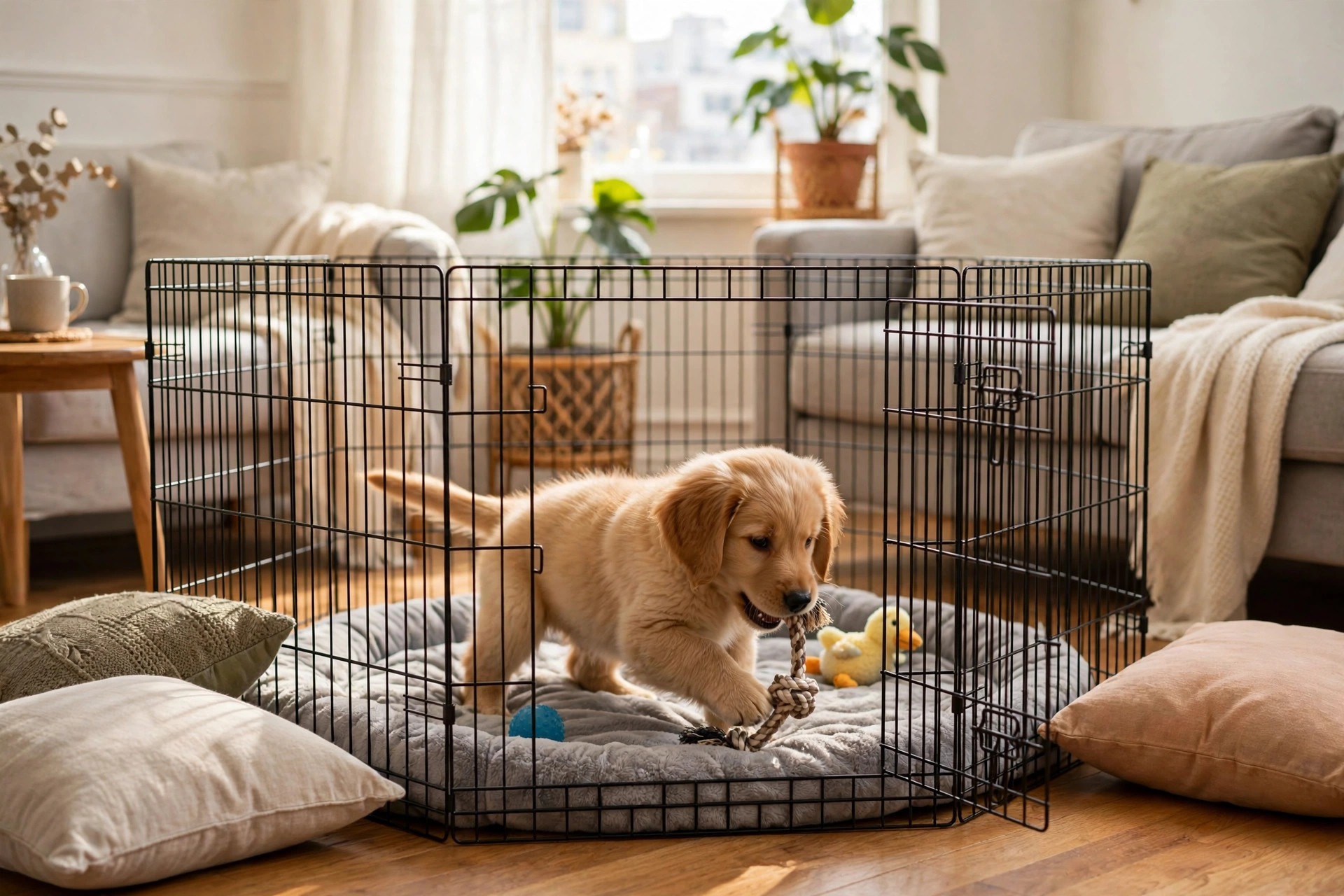
A new puppy in a 700-square-foot apartment has one mission: reach everything before you can stop them. A playpen buys you the five minutes to shower, take a work call, or carry the trash out — without returning to a chewed baseboard or a puddle on the rug. But in a small space, the wrong pen is worse than no pen: it eats the room and rattles at 6 a.m.
- For most apartment puppies: a 24-inch-tall metal exercise pen with 8 panels. Big enough to hold a bed and a pad, small enough to fold flat behind a sofa.
- Bar spacing matters more than brand. Gaps wider than about 2.5 inches can trap a small puppy’s head; narrower mesh is safer for toy breeds.
- Budget $50–$130. The difference between tiers is usually height adjustability, latch quality, and how flat it folds — not safety.
- A pen is a training tool, not a storage unit: puppies should rotate through pen time, crate time, and supervised free time through the day.
- Always put something soft and waterproof under the pen — it protects the rental floor and kills the rattle.
Six playpens that survive apartment life
Widely sold pens with long track records in puppy homes; prices are typical US street prices and move with sales.
| Model | Best for | Typical price | Small-apartment note |
|---|---|---|---|
| MidWest Foldable Metal Exercise Pen (24") | The default; most puppies | Usually $50–$90 | Folds flat to ~3 inches; sets up in under a minute; the standard everything else is measured against. |
| IRIS USA 24" 8-Panel Pet Playpen (with door) | Puppies who chew metal bars | Usually $55–$75 | Plastic panels are quieter and lighter; narrower footprint than most metal pens. |
| Yaheetech 8-Panel Heavy-Duty Playpen | Sturdier feel on a budget | Usually $55–$85 | Heavier gauge wire and taller options up to 40"; check bar spacing on the tall versions. |
| FXW Home+ / AsterDog Playpen | Growing puppies | Usually $85–$130 | Adjustable height (24–32") so one pen lasts through adolescence; solid latches. |
| EliteField 2-Door Soft Exercise Pen | Travel and calm older pups | Usually $55–$95 | Mesh walls, packs into a bag; silent on floors. Not for determined chewers. |
| Ruff ’n Ruffus Portable Foldable Playpen | Travel and temporary use | Usually $35–$55 | Pop-up design needs no assembly; fine for short sessions, flimsy for daily long-term use. |
MidWest Foldable Metal Exercise Pen — the default
This pen shows up in nearly every puppy starter kit for a reason: eight 24-inch panels, a step-through door, and a fold-flat design that stores in about three inches of space. The 24-inch height contains most puppies until they outgrow the pen phase; bump to 30 inches for tall or athletic breeds. The black e-coat finish resists chewing better than bare wire. Downsides: bare metal on hardwood is loud and scratches if dragged, and the latch is nose-able by a smart adolescent dog — a floor mat underneath (see below) is effectively mandatory.
IRIS USA 24" Playpen — the quiet one
The IRIS pen swaps metal for molded plastic panels with a built-in door. Two apartment advantages: it is dramatically quieter when a puppy bumps the walls, and at around half the weight of a metal pen it is easier to reconfigure daily. The plastic resists average chewing, though power chewers will leave tooth marks. The 24 x 24-inch panels open to a roughly 6 x 6-foot octagon — generous; most apartments will run it as a rectangle against a wall instead, which works fine with fewer panels.
Yaheetech Heavy-Duty 8-Panel — the sturdy budget pick
Yaheetech’s pen is for owners who want the MidWest formula with thicker wire and more height choices, including 32- and 40-inch versions for leggy breeds. The heavy-duty build resists the "lean and lift" trick some puppies learn with lighter pens. One caution specific to the taller models: the bar spacing widens on some sizes, so measure before buying for a small breed — a 40-inch pen with 3-inch gaps is a head-trap for a Chihuahua puppy. The rust-resistant coating handles the occasional pad leak better than cheaper black-wire pens.
FXW Home+ (AsterDog) — the grow-with-them pick
If you would rather buy one pen than two, this is the standout: panels adjust from 24 to 32 inches tall, so the same pen that contains an 8-week-old puppy still works at six months. Gravity-fed rod latches defeat nose-pushing, and rounded corners are kinder to walls and shins. It costs more than the budget picks, but one purchase instead of two wins the math — plus a floor mat underneath, like every metal pen.
EliteField Soft Exercise Pen — the travel pick
Mesh walls, a waterproof floor, and a pack-down the size of a small suitcase: this is the pen for family visits and outdoor gatherings. Two zippered doors (top and side) make entry easy, and it is completely silent on any floor — a real plus for thin walls. The honest limitation: it only suits puppies that already respect boundaries. A teething pup can chew through mesh in one unsupervised afternoon, so this is a supervised-sessions pen, not a while-you’re-at-work one.
What to skip
Two categories consistently disappoint. Ultra-cheap thin-wire pens under $35 arrive bent, rattle like maracas, and fold when a puppy leans on them — false economy. And wooden "playpen fences" look lovely in photos but are heavy, don’t fold, splinter under chewing, and cost two to three times more than a pen that does the job better.
Footprint and sizing math
A standard 8-panel pen with 24-inch panels opens to roughly a 62-inch octagon — about 20 square feet, a real chunk of a one-bedroom. Three ways to shrink it:
- Run it against a wall. Four to six panels against a wall makes a generous rectangle of 8–12 square feet instead of a full octagon. The wall side is free containment.
- Remove panels. Panels detach individually on most metal pens. A 4- to 6-panel setup still holds a bed, a water bowl, and a washable pee pad — everything a puppy actually needs.
- Go corner-shaped. Two walls plus an L of panels turns a dead corner into pen space with almost no panels at all.
Height guidance: 24 inches suits most puppies under 25 pounds expected adult weight through the pen phase. Plan on 30 inches for medium breeds and 36–40 for large-breed puppies — though by the time a large puppy can clear 36 inches, it should be transitioning out of the pen anyway. Bar spacing: under 2.5 inches for small breeds; standard spacing is fine beyond that.
The floor-mat rule: whatever pen you buy, put a washable, waterproof mat underneath it — sized 6 inches larger than the pen on each side. It protects rental hardwood from scratches, absorbs pad leaks before they reach the floor, and turns a rattling metal pen nearly silent. Skip the mat and the pen will cost you your security deposit one drag at a time.
Where the pen actually goes
Placement decides whether the pen gets used daily or folded up by week two. Work through it in this order:
- Where you spend the day. A pen in the room you work or lounge in means the puppy is near you, which keeps them calm and keeps you actually using it. A pen exiled to a spare room gets abandoned.
- Near the exit route. Pen-to-door should be a straight, short path. A puppy that needs to go out at 3 a.m. should not cross the whole apartment — accidents happen in transit.
- Off shared walls. Puppies whine in pens, especially the first week — distance from the neighbor’s bedroom wall is free noise control. Our dog crate setup guide covers the same placement logic for crate-and-pen combos.
- On a hard, cleanable floor if possible. Kitchen-adjacent spots beat carpeted bedrooms for the accident-heavy early weeks. If it must be on carpet, the waterproof mat underneath is non-negotiable.
Inside: a bed on one side, a no-spill or clip-on water bowl, one or two safe chew toys, and a pee pad as far from the bed as possible. Puppies avoid soiling where they sleep, so maximum bed-to-pad separation teaches the habit faster.
A pen schedule that actually works
The pen is one tool in a rotation, not a puppy warehouse. For a young puppy, the workable pattern looks like this: pen time after play sessions while you get things done (30–60 minutes), crate time for naps (puppies nap 16–20 hours a day and sleep better enclosed), and supervised free time for training and bonding. If you work from home full time, our apartment puppy routine for full-time workers lays out a full day’s schedule built around this rotation.
Two rules keep the pen a happy place instead of a prison:
- End pen time before the puppy melts down. Come back while they are calm, not after 10 minutes of screaming — rescuing them at peak panic teaches that panic works.
- Keep departures boring. A stuffed Kong or lick mat at pen-entry time turns "I’m leaving" into "treat time." No long goodbyes.
Most puppies outgrow daily pen use between 5 and 8 months, as house training solidifies and teething passes. Keep it stored flat rather than selling it — it doubles as a recovery space after vet procedures and travel containment later.
FAQ
Playpen or crate for a new puppy in an apartment?
Both, used differently. A crate (with a divider) is for naps and overnight — the enclosed den feel aids house training. A pen is for awake time when you can’t supervise every second. Most apartment setups put the crate inside or next to the pen.
What size playpen does my puppy need?
Big enough for a bed, a bowl, and a pee pad with room to move — typically 8–12 square feet. Full 8-panel octagons are overkill for most apartments; 4–6 panels against a wall is the sweet spot.
Will a puppy climb out of a 24-inch pen?
Most won’t until nearly past the pen phase. Athletic breeds (terriers, herders) may climb earlier — if your puppy is practicing parkour on the panels, move to a taller pen or crate-plus-gated-room.
How do I stop the pen from sliding on hardwood floors?
The waterproof mat handles most of it: rubber-backed mats grip both pen and floor. For extra security, run two panels against a wall or heavy furniture so the pen can’t walk when the puppy launches off the walls.
Is it cruel to keep a puppy in a pen while I work?
No — as part of a rotation with naps, training, play, and supervised free time. What’s cruel is a puppy left to fail: chewing dangerous things unsupervised and learning the whole apartment is a bathroom. A pen prevents that.