Best Pet Gates With a Cat Door for Apartments
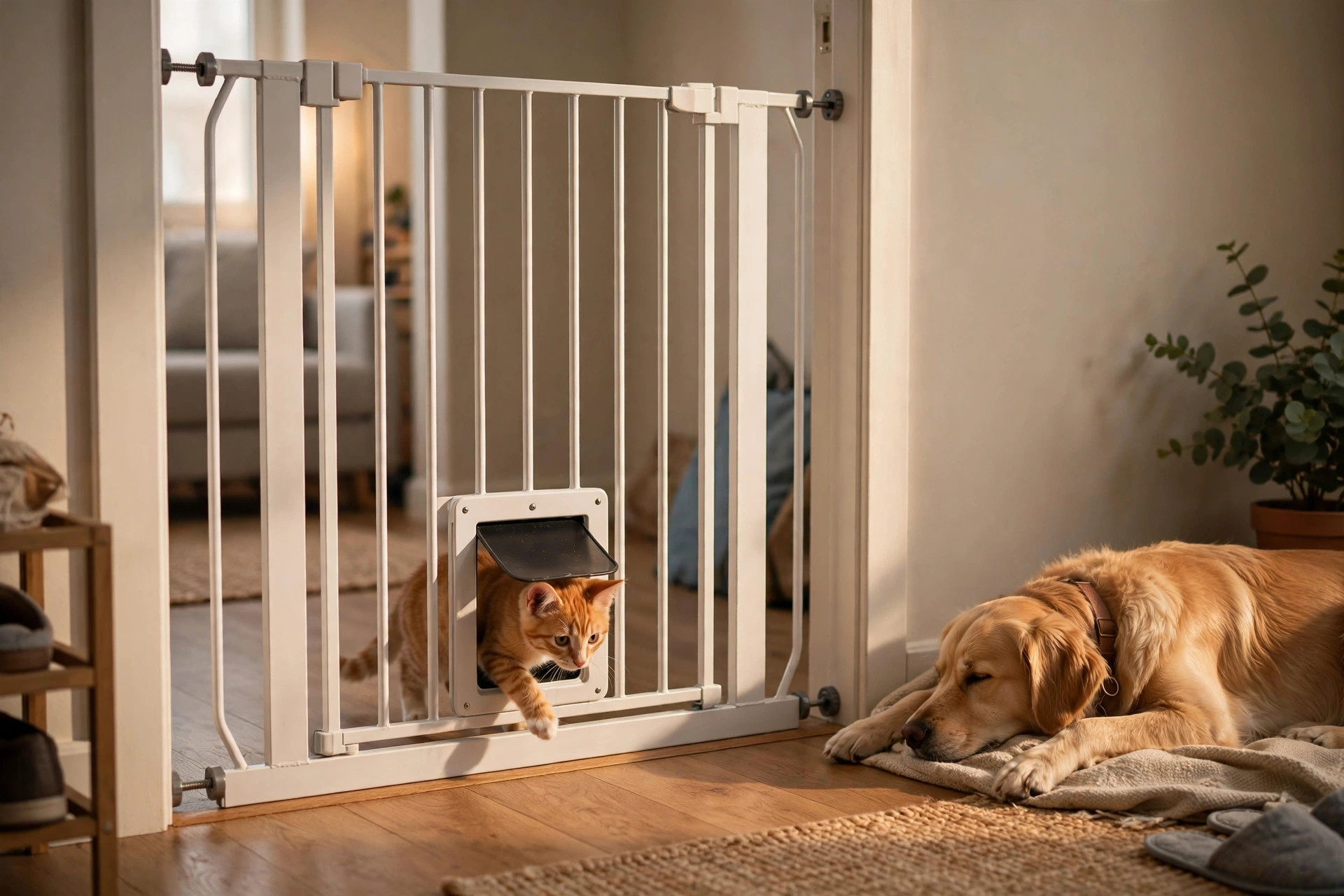
The classic apartment standoff: the cat needs access to the litter box, the food, or a dog-free nap zone, while the dog needs to be kept out of all three. A gate with a small lockable pet door solves the geometry elegantly — the cat slips through a 7–10 inch opening, the dog watches from the other side, and you walk through the full gate without stepping over anything. The catch is sizing honesty: a door small enough to stop your dog but large enough for your largest cat, bars a small dog cannot squeeze, and a mounting style your lease allows. These four gates get that balance right in real apartments.
Sizing honesty: will it actually separate your pets?
Measure three things before ordering. First, your cat at the widest point (usually hips or a winter belly) plus an inch: that is the minimum clear width and height for the small door. Most cat doors here offer about 7.5 x 7.5 to 10 x 10 inches of passage, but flaps and rims steal half an inch. Second, your dog's head width and shoulder compressibility: a determined small dog under about 12 pounds can follow a cat through a 10-inch door, especially a lean terrier. If your dog is that size, a cat door only works if you accept it as a cat convenience, not a dog barrier, and manage by training instead. Third, bar spacing on the main gate: for cats that will not use the door and small dogs, gaps over about 2.5 inches invite squeezes and stuck heads. Bring the tape to the doorway too: measure top and bottom of the opening (apartment frames are rarely parallel) and note baseboards that steal an inch from pressure mounts.
If your household has no dog and you simply need room division, our freestanding gate guide covers no-pressure options. If a baby or toddler shares the space, choose only gates certified for child use at the stated spacing and never rely on a pet gate at the top of stairs.
- The cat door must lock. An unlockable flap will be learned by every pet in the home, including the dog.
- Pressure-mount for doorways, hardware-mount for stairs. Never pressure-mount at the top of a staircase.
- Budget $65–$140. Steel outlasts plastic latches in daily walk-through use.
- Walk-through gates pay for themselves the first week you stop stepping over a fixed barrier with laundry in hand.
Four gates that work for cats and dogs
Each model is a current, widely sold walk-through gate with a lockable small door, at typical US street prices in fall 2026. We judged on door size and lock, latch operation with full hands, and how the mount behaves on rental trim.
| Model | Width fit | Typical price | Apartment note |
|---|---|---|---|
| Carlson Extra Wide Walk-Through | 29–36.5 in, extensions to 50+ | Usually $75–$110 | Best all-rounder; 10-in cat door, steel. |
| Regalo Extra Wide with Pet Door | 29–38.5 in | Usually $65–$95 | Budget steel; good first gate. |
| MYPET North States Paws Passage | 28–41 in with extensions | Usually $90–$130 | Rotating lock; best door control. |
| Evenflo Position & Lock (pet use) | 26–42 in, pressure | Usually $35–$55 | No walk-through; spare-room budget fix. |
Carlson Extra Wide Walk-Through — the default for dog-plus-cat homes
Carlson's steel gate is the one property managers and fosters keep reordering: a full walk-through door you operate with one hand, a 10 x 7 inch cat door with a spring-loaded lock, and extensions that honestly span the wide cased openings in newer apartments. Pressure mounting with optional cup hardware suits renters; add the cups (small screw) only with landlord permission or at stair locations where hardware is mandatory. The cat door sits low and centered enough that older cats accept it without a hop. For a litter zone behind the gate, pair it with the furniture or top-entry setups in this batch so the dog is doubly discouraged from lingering at the barrier sniffing.
Regalo Extra Wide — the value steel gate
Regalo matches Carlson on concept at a lower price: steel frame, walk-through latch, lockable pet door, and included extensions in most boxes. The latch takes slightly more thumb force, which adults adapt to and toddlers cannot defeat (a feature, in mixed households). Finish and welds are a step below Carlson, so expect to re-tighten pressure pads monthly in high-traffic halls. For a first cat-door gate in a rental, the savings are sensible; upgrade later only if the hallway becomes a permanent installation.
MYPET North States Paws Passage — the door-control pick
The Paws Passage door does something clever: it rotates and locks at multiple settings, so you can allow one-way or timed access and truly lock a clever dog out while the cat commutes. The gate itself is sturdy, the small door is generously sized for large cats, and the hardware-mount option is well designed for the one doorway that becomes permanent. It costs more and the styling is more nursery than loft, but for the litter-room door in a dog-obsessed household, the lock granularity solves the 3 a.m. problem of a dog who learned to nose a simple flap.
Evenflo Position & Lock — know its limits
Included honestly as the budget boundary: this is a classic pressure gate without a walk-through door or a true cat door in most variants, useful only to block a dog from a room where the cat can jump over or pass elsewhere. Do not buy it expecting cat-door function. We list it because apartment owners often inherit one; as a dog barrier for a guest room it is fine, but for the cat-commute job, spend the difference on the Regalo. Stepping over any fixed gate daily in a small home gets old by day three.
What to skip
Gates with non-locking cat flaps, bar spacing over 3 inches with a small dog in the home, and any pressure gate marketed for the top of stairs. Also skip accordion and soft-mesh retractable gates for dog containment: cats love them as hammocks and determined dogs go under the bottom edge.
Install and teach the commute
Install pressure gates with all four pads firm, the gate plumb, and the walk-through swinging away from the dog's usual charge direction. Test with your own hip before trusting it with a leaning dog. Then teach the cat separately from the dog's education: prop the cat door open for two days with treats on the far side so the cat learns the route without flap pressure, then close it with the lock set to free-swing, then introduce the normal resistance. Dogs learn the boundary faster when the gate predicts good things staying calm on their side: reward settled watching, redirect attempts to paw the door, and never let the dog rehearse rushing the cat through the opening. In multi-pet introductions, this gate becomes the safety backbone described in our one-bedroom introduction guide, letting scent and sight proceed without forced contact.
Protect the rental: felt pads under pressure cups prevent paint rings, and a photo of the doorway before install documents your deposit diligence. If the opening is too wide or angled (common in open-plan lofts), a freestanding configuration from our freestanding guide plus a cat door panel is often straighter than forcing a pressure gate to span a gap it hates.
The laundry test: carry a full basket through one-handed. If you cannot operate the latch and swing with your hip while the dog watches politely, the gate will annoy you daily. Walk-through design is not a luxury in an apartment; it is the difference between a system and an obstacle.
Troubleshooting the cat-door household
If the cat refuses the door, check height and flap stiffness before assuming stubbornness: senior cats dislike pushing a stiff flap with arthritic shoulders, so set locks to the lightest free-swing or prop for a week longer. If the dog fixates, increase distance rewards and add a mat station (see our settle training in an upcoming guide) so the dog has a paid job near the gate. If litter tracking appears at the gate line, the cat is hurrying through: place the litter mat on the cat's side so the commute includes a capture step. A gate solves access; it does not solve motivation, so keep the cat's side stocked with the resources (box, water, perch) that make the trip worthwhile.
FAQ
Can a small dog fit through the cat door?
Often, yes, if the dog is under roughly 12–15 pounds, lean, and motivated. Measure your dog's head and shoulders against the door's clear opening (usually 7–10 inches). If separation is essential, choose the smallest door your cat accepts, keep it locked when unsupervised during training, and manage with station training rather than relying on size alone.
Pressure mount or hardware mount in a rental?
Pressure mount for flat doorway containment between rooms; hardware mount (screws into studs or solid trim) for stairs, large strong dogs, or any permanent installation. Never use pressure-only at the top of stairs. In rentals, get written permission for hardware cups, use felt pads, and photograph the trim before and after.
How do I teach my cat to use the small door?
Prop it fully open with treats and play on the far side for two days, then let it swing freely, then add normal flap resistance. Keep the dog absent for the first lessons so the cat learns without pressure. Most cats commute confidently within a week; older cats may need the flap taped half-open longer.
Where is the best place for a cat-door gate in a small apartment?
At the litter-room or bedroom doorway, where the cat gains a dog-free resource zone and the dog's exclusion has a clear reason. Avoid gating the only bathroom humans need at night with a step-over design; walk-through models belong on high-traffic paths. Ensure the cat always has water and a rest spot on its side of the gate.