Best Enzyme Cleaners for Pet Accidents on Rugs
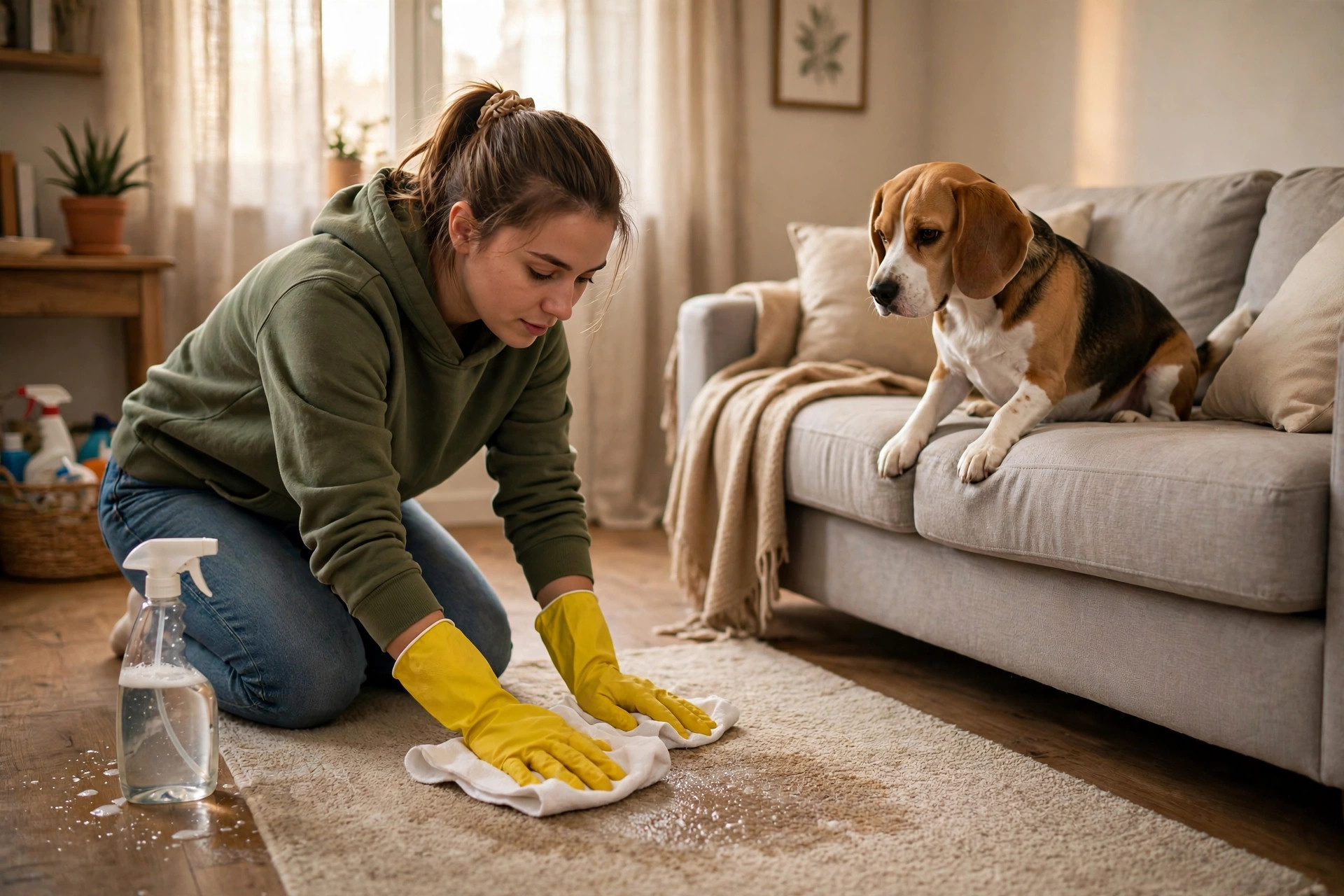
Here is why the stain keeps coming back: pet urine is not one stain, it is three. The water-soluble part washes out easily. The pigments leave the visible mark. And the uric acid forms microscopic crystals that bind to rug fibers and reactivate with humidity — which is why the spot smells fine in winter and returns with a vengeance on the first humid day of spring. Regular cleaners handle the first two. Only enzymatic cleaners break down the third, which is why they are not optional for rug accidents — they are the entire solution.
The chemistry your regular cleaner cannot touch
Understanding the three-part stain explains every failure mode:
- Urea (water-soluble). The bulk of fresh urine. Blotting and water remove most of it — which is why a fresh accident “cleans up fine” with paper towels. This is the easy 70%.
- Urochrome pigments. The yellow-brown color. Oxidizing cleaners (hydrogen peroxide-based) and sunlight break these down. This is the visible 20%.
- Uric acid crystals. The remaining 10% and 100% of the long-term problem. These crystals are insoluble in water, bind tightly to fibers, and — critically — your pet’s nose detects them at concentrations you cannot smell. As long as they remain, the spot is a marked bathroom in the dog’s mind.
Enzymatic cleaners contain live bacterial cultures and enzymes (protease, lipase, amylase) that literally digest the uric acid crystals and organic matter into water and carbon dioxide. It is a biological process, not a chemical one — which means it needs time, moisture, and the right conditions. Spray-and-wipe in thirty seconds does nothing; the enzymes need 8–12 hours of damp contact to finish the job.
The treatment protocol (do this exactly)
The product matters less than the method. Most “this enzyme cleaner didn’t work” complaints trace to a skipped step here, not a bad bottle:
- Blot, never rub (immediately). Stack white towels or paper towels on the spot and stand on them. Press straight down. Rubbing spreads the urine outward and drives it deeper into the pad. Keep blotting until the towels come up nearly dry.
- Find the full extent. On a dry rug, old spots are invisible. A cheap UV blacklight ($8–$12) in a dark room makes dried urine glow — mark every spot with painter’s tape. The visible stain is usually half the actual affected area.
- Saturate, don’t mist. Soak the area thoroughly — the cleaner must reach as deep as the urine went, which means through the rug and into the pad for a real accident. A light spritz on the surface treats 10% of the problem. Use enough that the area is genuinely wet.
- Cover and wait 12 hours. Lay a damp towel over the treated area (keeps it moist so the enzymes stay active) and keep pets and feet off. Overnight is perfect. This is the step everyone skips and the reason the method “doesn’t work.”
- Blot dry and air out. Remove the cover, blot up the moisture, and let the area air-dry completely — a fan helps. Do not use heat; heat sets any remaining pigment.
- Sniff-test at nose level. Get down to the rug. If any odor remains, repeat once. Two full treatments resolve the vast majority of accidents; a spot that survives three is in the pad and needs the pad treated or replaced.
Five enzyme cleaners that actually work
Every product below is a real, widely sold enzymatic formula — not a scented water with “enzyme” on the label. Prices are typical street prices.
| Cleaner | Best for | Usually | Rug note |
|---|---|---|---|
| Rocco & Roxie Stain & Odor Eliminator | Most rug accidents | $20–$25 | Strong enzyme load, carpet-safe; the default pick |
| Nature’s Miracle Advanced | Set-in and old stains | $12–$18 | Dual-action formula; good on dried spots |
| Simple Solution Extreme | Large areas | $10–$15 | 3x concentrated; economical for big rugs |
| Biokleen Bac-Out | Fragrance-sensitive homes | $10–$13 | Lime-extract based, milder scent; gentler formula |
| Kids ’N’ Pets | Budgets | $12–$16 | Decent enzyme action; widely available |
Rocco & Roxie — the everyday pick
The name everyone knows, and in this case the reputation is earned: a high enzyme concentration that handles fresh accidents in one treatment when the protocol above is followed. It is carpet and rug safe, the scent is mild and dissipates, and the spray bottle actually produces a useful stream for saturating. The price per ounce is higher than the budget options — justified for the apartment with a puppy in training or a senior dog having accidents, where you will use it often enough for effectiveness to matter more than unit cost.
Nature’s Miracle Advanced — the old-stain pick
Fresh accidents are easy; the brown mystery spot you found when moving the sofa is the real test. Nature’s Miracle Advanced pairs enzymes with an oxygen-boosted formula that attacks both the uric acid crystals and the set-in pigments — the two problems old stains have. For dried spots, extend the dwell time to a full 24 hours under the damp towel and expect to treat twice. It is also the best value per ounce of the premium options.
Simple Solution Extreme — the big-area pick
When the accident covered half the living room rug — the puppy that held it until exactly the wrong moment — you need volume. The 3x concentrated formula dilutes for large-area treatment without buying four bottles, and the gallon jug is the economical choice for multi-pet homes or foster situations. Same enzyme chemistry as the others; the advantage is purely cost-per-square-foot on big jobs.
Biokleen Bac-Out — the gentle pick
Live enzyme cultures in a lime-extract base, with a much lighter scent profile than the competition — the pick for the household where strong fragrances trigger headaches or the cat objects to everything. The enzyme load is milder, so it is best for fresh accidents rather than archaeological digs; treat promptly and it performs. Also useful as the maintenance spray for the litter-box-adjacent rug zones.
Kids ’N’ Pets — the budget pick
The honest cheap option with real enzymatic action — not as concentrated as Rocco & Roxie, but a legitimate enzyme cleaner rather than scented water. Widely available in grocery stores, which matters at 11 p.m. when the accident just happened and you need something tonight. For the occasional accident in an otherwise trained pet, this is all you need.
The two things that kill enzymes: heat and bleach. Never use hot water on a urine stain (it cooks the proteins into the fibers permanently), and never follow a bleach-based cleaner with an enzyme cleaner without rinsing thoroughly — bleach residue destroys the live cultures on contact. Enzyme cleaner goes on a cool, chemical-free stain, every time.
Three enzyme-cleaner mistakes that waste the bottle
2. Treating the rug but ignoring the pad. On wall-to-wall carpet, urine soaks through to the pad within minutes. Treating only the surface fibers leaves a reservoir of crystals underneath that wicks back up with humidity. Saturate deep enough to reach the pad — this is why “soak, don’t mist” is the rule.
3. Declaring victory too early. Your nose adapts to the smell within minutes (olfactory fatigue), so “smells fine now” right after treatment means nothing. The real test is 48 hours later, at nose level, after the area is fully dry. The dog’s nose never had the adaptation problem — if the crystals remain, the dog knows, and the spot gets reused.
FAQ
How do I know if the stain is actually gone?
Two tests: the UV blacklight should show nothing glowing after the area is fully dry, and a sniff test at rug level 48 hours later should smell like nothing. The dog’s behavior is the third test — if the pet returns to the spot, crystals remain and it needs another treatment.
Are enzyme cleaners safe on all rug types?
On synthetics, wool, and cotton, yes — test an inconspicuous corner first regardless. On silk, viscose, or antique/hand-knotted rugs, stop: take it to a professional rug cleaner and tell them it is a pet urine stain. DIY enzyme treatment on a $2,000 rug is a false economy.
Can I use an enzyme cleaner in a carpet shampooer?
Check the bottle — several brands (Nature’s Miracle, Simple Solution) make machine formulas specifically for this. Do not put standard spray-bottle enzyme cleaner in the machine: the dilution is wrong and the foam can damage the machine. And remember the order: enzyme treatment first, machine extraction after, never steam-heat before the enzymes have worked.
My puppy keeps having accidents. Should I just remove the rugs?
During active house-training, rolling up the expensive rugs and using washable pee pads in the training zone is the sane move — it is not giving up, it is staging. Keep one cheap, washable rug down so the puppy learns the texture distinction, and bring the good rugs back once training is reliable. Every accident you prevent is one less enzyme treatment.