Best Deshedding Brushes for Apartment Cats
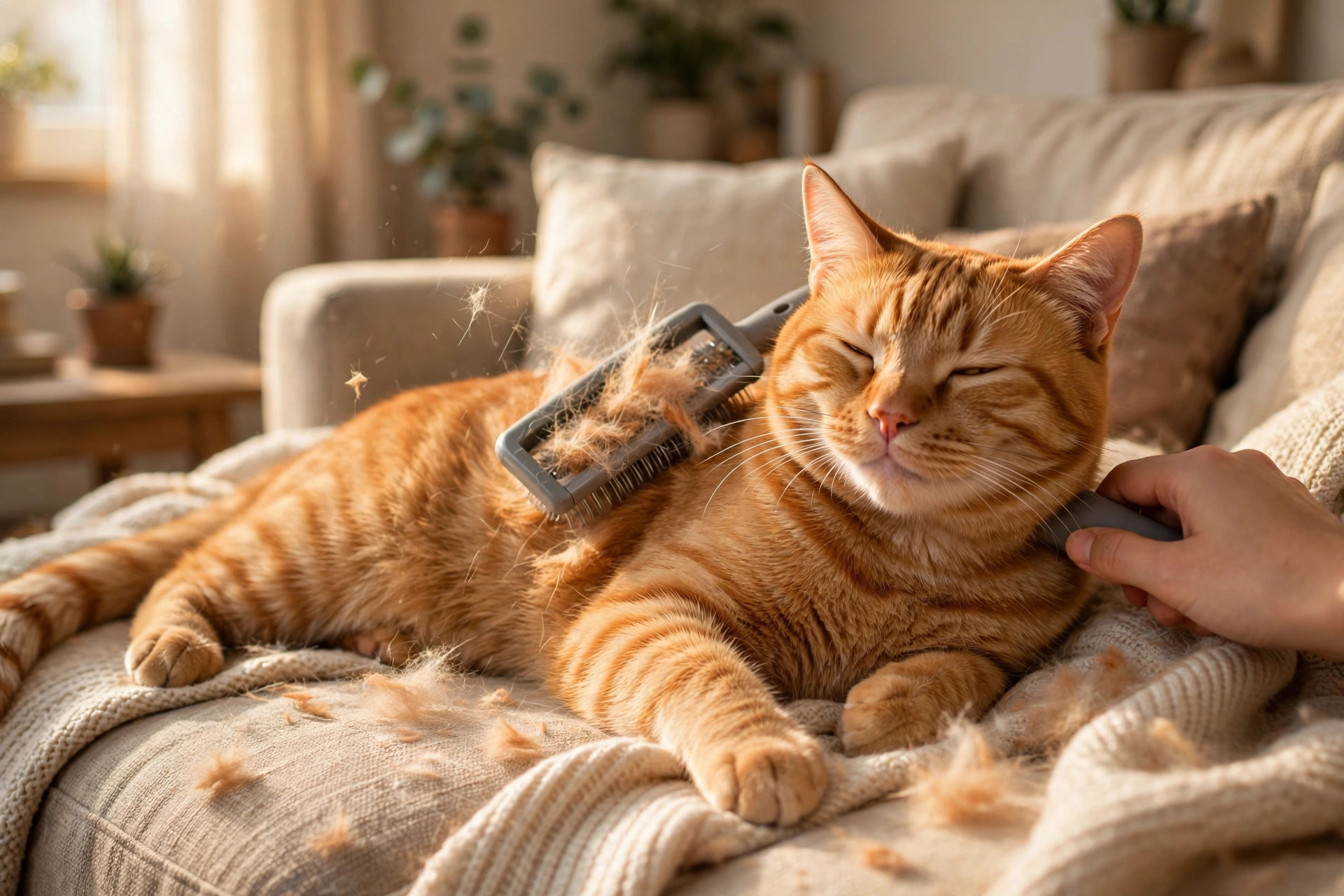
One indoor cat sheds roughly its own body weight in fur every year, and in a 600-square-foot apartment, all of it lands on your things. The difference between a home that feels clean and one that feels like living inside a fur coat is not vacuuming harder — it is intercepting the fur at the source. A good deshedding brush, used for five minutes twice a week, removes the loose undercoat before it migrates to the sofa, the bedsheets, and your black work pants.
The apartment fur equation
Cats shed year-round indoors because apartment lighting and heating erase the seasonal signals that concentrate shedding outdoors. That means the fur problem is continuous and low-grade rather than seasonal — which is actually good news, because a steady routine beats seasonal panic brushing:
- Loose undercoat is the enemy. The fine, downy undercoat is what drifts through the air and weaves itself into fabric. The longer guard hairs shed too, but they are visible and easy to pick up. Deshedding tools target the undercoat specifically.
- Brushing also means fewer hairballs. A cat that swallows less loose fur during self-grooming produces fewer hairballs — which means fewer 3 a.m. retching sessions on the rug. The grooming benefit and the cleaning benefit are the same action.
- Five minutes twice a week beats thirty minutes monthly. Undercoat releases continuously. Long infrequent sessions fill the brush fast, irritate the cat, and leave weeks of fur on the furniture. Short frequent sessions keep the cat’s cooperation and your sofa simultaneously.
- The tool must match the coat. A heavy deshedding blade on a short-haired cat with thin skin causes irritation; a gentle rubber brush on a long-haired cat with dense undercoat does nothing. Coat type decides the tool, not marketing.
Deshedder vs. slicker vs. rubber brush: which one you need
These three tools do different jobs, and most multi-cat apartments end up owning two of them:
- Deshedding blades (FURminator-style). A fine metal edge that reaches through the topcoat to pull loose undercoat. Maximum fur removal per stroke — and the easiest to overuse. Best for medium and long-haired cats with real undercoat; use sparingly on short-haired cats.
- Slicker brushes. Fine wire pins that catch loose fur and tease out small tangles. Gentler than a blade, better for finishing and for cats with sensitive skin. The everyday workhorse for most cats.
- Rubber brushes (ZoomGroom-style). Soft rubber nubs that grab loose hair through static and massage the skin. Cats that hate every other brush often love these. Least fur per stroke, but the one the cat will actually sit still for — which makes it the most-used tool in many homes.
If your cat has one coat type, start with one tool from the matching category below. If you have two cats with different coats — the classic short-haired tabby plus long-haired rescue — budget for two tools rather than compromising on one.
Five brushes worth the drawer space
Every brush below is a real, widely sold product with a track record on actual cats — no gimmick gloves with 200 reviews. Prices are typical street prices.
| Brush | Best for | Usually | Apartment note |
|---|---|---|---|
| FURminator deShedding Tool | Heavy shedders | $30–$40 | Maximum undercoat removal; use sparingly |
| SleekEZ Deshedding Grooming Tool | All coat types | $12–$18 | Simple blade, no moving parts; surprisingly effective |
| Maxpower Planet Grooming Brush | Budgets | $10–$15 | Dual-sided undercoat rake; great value |
| Hertzko Self-Cleaning Slicker | Sensitive skin | $14–$20 | One-click fur release; gentle daily driver |
| Kong ZoomGroom | Cats that hate brushes | $9–$13 | Rubber massage brush; the cooperation king |
FURminator deShedding Tool — the heavy-shedder pick
The FURminator’s stainless edge reaches through the topcoat and pulls loose undercoat out in shocking quantities — the first session on an unbrushed long-haired cat can fill the blade a dozen times. That effectiveness is also the warning: used too often or with too much pressure, the edge irritates skin and can thin the coat. The rules are simple — 1–2 times per week maximum, light pressure, 10–15 minutes, never on the same spot repeatedly, and never on a cat with skin conditions. Respect those and it is the fastest route to a fur-free sofa; ignore them and you get a bald patch and a cat that hides from the drawer.
SleekEZ — the all-rounder pick
The SleekEZ is a deceptively simple wave-patterned blade — no buttons, no batteries, nothing to break — that grabs undercoat on cats, dogs, and, famously, furniture and car seats. On cats it works best with short, light strokes on medium and long coats; the fur collects on the blade and peels off in satisfying sheets. It is less aggressive than the FURminator, which makes it safer for regular use on short-haired cats that still shed plenty. At this price it is the easiest recommendation on the list.
Maxpower Planet — the budget pick
A dual-sided undercoat rake: one side with wider-spaced teeth for dematting, the other with denser teeth for deshedding. For under $15 it does 80% of what the premium tools do, and the rounded tooth tips are forgiving on technique — a real consideration if you have never deshedded a cat before. It lacks the FURminator’s edge sharpness on the densest undercoats, but for a typical short-to-medium-haired apartment cat it is all the tool you need.
Hertzko Self-Cleaning Slicker — the sensitive-skin pick
Thin-skinned cats — many Siamese, Devon Rexes, and elderly cats — flinch at deshedding blades. The Hertzko’s fine bent-wire pins glide through the coat catching loose fur without digging, and the one-click retraction releases the collected fur into the trash instead of onto your fingers. This is the daily-driver brush: gentle enough for every-other-day use, which is exactly the frequency that keeps fur off the furniture without a weekly wrestling match.
Kong ZoomGroom — the reluctant-cat pick
Some cats will not tolerate any brush with metal in it, full stop. The ZoomGroom’s soft rubber nubs feel like petting — most cats lean into it, purr, and drool — while the rubber generates enough static to pull loose hair out of the coat. It removes less undercoat per stroke than a blade, but a cat that sits still for ten minutes of ZoomGrooming sheds less net fur than a cat that bolts after thirty seconds of FURminating. For brush-haters, kittens learning the routine, and post-vet-stress grooming, start here.
- Monday + Thursday, 5 minutes. Deshedding tool (blade or rake), working with the grain in short strokes. Stop when the brush comes up mostly clean.
- Daily, 60 seconds. A quick slicker or rubber-brush pass while the cat is already on your lap. This is the habit that matters most.
- Spring (if your cat sheds seasonally): bump to 3x weekly for 4–6 weeks. Indoor cats shed less dramatically than outdoor ones, but the spring coat change is still real.
- Always end before the cat does. Two minutes of willing brushing beats ten minutes that ends in a bite. The cat decides when the session is over; you decide when the next one starts.
Three brushing mistakes that backfire
2. Brushing against the grain. Every stroke goes with the direction of fur growth, from head toward tail. Against-the-grain strokes pull live hair, hurt, and teach the cat that brushing is an ambush. The one exception is a gentle lift-and-release on the rump of very dense coats — and even then, lightly.
3. Only brushing the back. The fur that ends up on your sofa comes from everywhere the cat sits — which means the belly, the britches (rear fluff), and behind the ears matter as much as the back. These are also the spots that mat first on long-haired cats. Work the whole cat in short passes, saving the belly for last when the cat is most relaxed.
FAQ
How is a deshedding tool different from a regular brush?
A regular brush mostly moves the topcoat around. A deshedding blade’s fine edge reaches past the guard hairs to the loose undercoat underneath — the layer responsible for most of the fur on your furniture. That is why one deshedding session removes dramatically more fur than a week of regular brushing, and also why it needs more care to use safely.
My cat hates being brushed. Where do I start?
With the Kong ZoomGroom or just your hand — whichever the cat already tolerates. Brush for 30 seconds during an existing cuddle, treat, stop. Build the duration over two weeks. Cats that “hate brushing” usually hate long sessions, metal tools, or being held still; short, voluntary, rubber-tool sessions convert most of them.
Can I over-brush with a FURminator?
Yes, and it is the most common mistake with the tool. More than twice a week, too much pressure, or repeated strokes on one spot can irritate the skin and thin the coat — the infamous “FURminator bald patch.” If the skin looks pink after a session, you went too far; skip a week and go lighter next time.
Do deshedding brushes work on the furniture too?
The SleekEZ famously does — it was designed for coats but works brilliantly on upholstery and car seats. For the sofa itself, though, a dedicated rubber broom or a good pet vacuum is faster. The brush removes fur at the source; the vacuum handles what escaped.